2025.10.17 Shino Yabuta + Yua Miyakoshi + Shiho Fujita
Gakugei-daigaku was the only district in Japan selected for the “Coolest Neighborhoods in the World” rankings by the British media outlet Time Out. It is a town where “new” and “old” intersect, featuring lively shopping streets favored by the youth alongside quiet residential areas just a short walk from the station. We set out to uncover the secrets behind this neighborhood’s appeal, which has captured even international attention.
Gakugei-daigaku is a popular station on the Tokyu Toyoko Line, extending from Shibuya. Bustling shopping streets spread across both the east and west sides of the tracks. Here is our report on the nighttime charm of Gakugeidai, an area celebrated by overseas media.
■Team 1: North Area
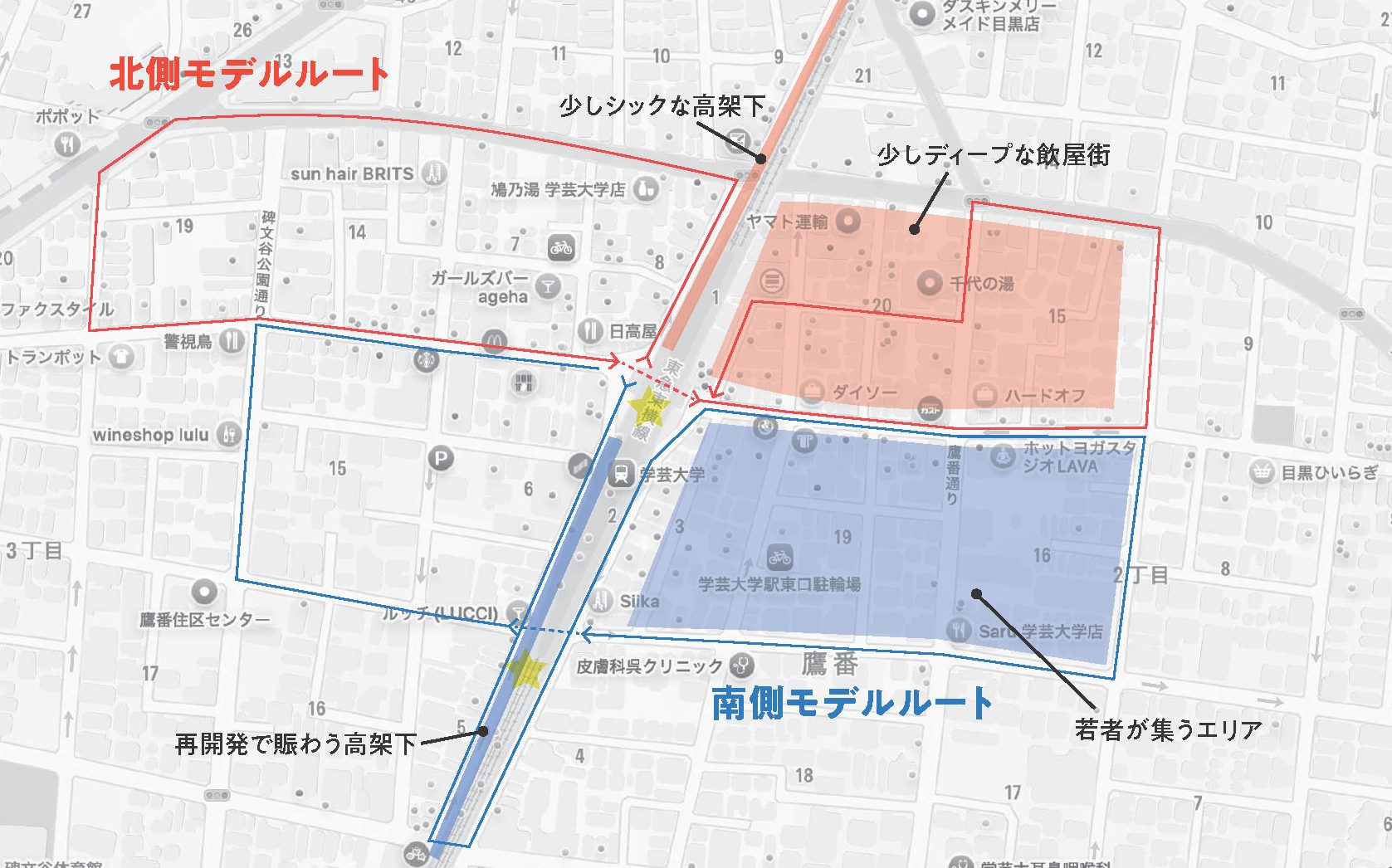
Team 1 primarily explored the northern side of Gakugei-daigaku Station. We walked north along the elevated tracks, passing through dark alleys before emerging into the bustling commercial district. As bright streets and dim lanes appeared alternately, we searched for heroes and villains while experiencing the contrast between light and shadow. Stepping just one block away from the streetlamp-lit main thoroughfares plunges you into immediate silence. I felt that this contrast between light and dark is a defining characteristic of the Gakugei-daigaku neighborhood.
The lighting we selected as heroes highlights the unique personality of this town. Spotlights illuminating restaurant terrace seats appeared suddenly after a stretch of dark alleys, signaling the start of the entertainment district. The Art Nouveau-style streetlamps in the shopping district created a beautiful contrast with their classic design against modern shops, evoking an atmosphere unique to a town where the old and new intersect. Curiously, only the center streetlamp emitted a warm tone; while it felt slightly out of place at first, that idiosyncratic balance felt like part of the shopping street’s character.
Particularly impressive was the warm glow from a small deli located just past the main commercial area. While the surroundings were dark and foot traffic was sparse, the light spreading from inside, the vibrant glow of the sign, and the gentle light filtering through the awning brought a sense of security to the alley. As the town undergoes modernization, we felt the reassuring strength of a presence that remains unchanged and close to the local community.
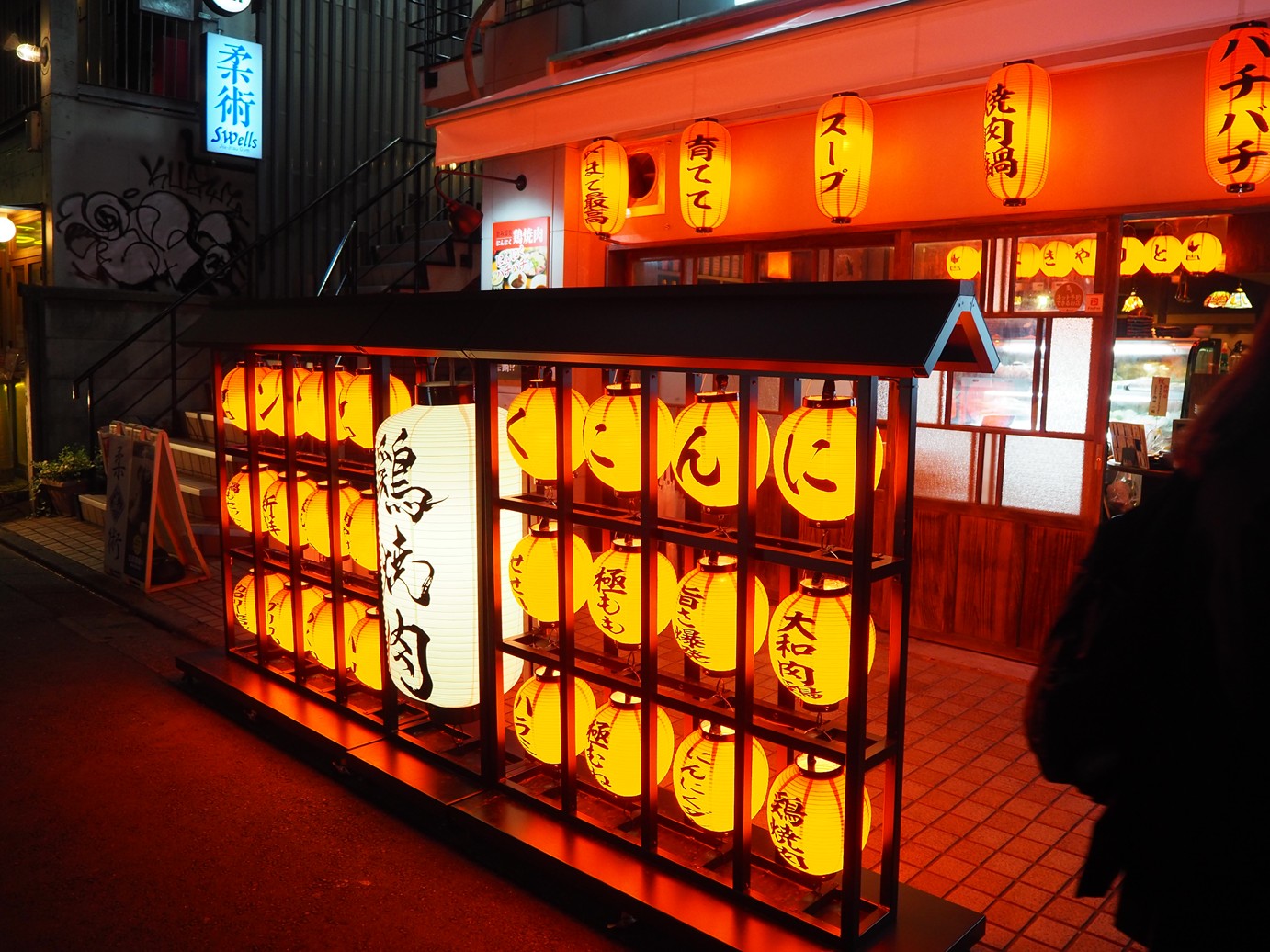
Conversely, the lighting we identified as “Villains” consisted entirely of lights failing to fulfill their intended roles due to excessive brightness, jarring colors, or poor maintenance. We noticed a pair of security lights that were piercingly bright compared to the surrounding dark alleys; the glare was so intense we worried about the impact on the residents of the apartment building directly behind them. In an alley lined with long-established izakayas(Japanese pubs), a single lantern emitting an incredibly garish, brilliant red light stained the entire vicinity red, creating an impression far removed from the neighborhood’s true identity. Additionally, a staircase where warm lighting beautifully complemented a Showa-era retro building was marred by several burnt-out bulbs; the lack of maintenance turned what could have been a lovely scene into one of loneliness and neglect.
Walking through Gakugei-daigaku at night made me realize how difficult it is to achieve “just the right light.” It is not simply a matter of “the brighter, the better.” I felt that a comfortable nighttime environment is only created through appropriate lighting design that considers the town’s personality, its specific use, and the surrounding environment. (Shino Yabuta)


■Team 2: North-South Crossing
Team 2 decided to explore the town freely, pausing at each alley to discuss which way looked more intriguing. This spontaneous approach allowed us to start from the northwest side of the station and circle the entire district clockwise. Even at a leisurely pace, we managed to cover the commercial areas in about an hour and a half, giving us the impression that the town is relatively compact.
We were surprised to find six different shopping districts spreading out in all directions from the station. However, stepping just one block off the main thoroughfare of any shopping street immediately reveals a quiet residential area, leaving us with the strong impression that the station, shops, and homes exist in very close proximity.
What frequently caught our eye were the streetlamps. Each shopping district featured a different design, and we enjoyed comparing them. Among them, a streetlamp with a charming decorative
design was chosen as a “Hero.” As mentioned by Team 1, among its three fixtures, one had a lower color temperature while the other two were higher; this balance of warmth and coolness functioned well and received high marks. Furthermore, since a new building designed by a famous architect is being constructed right behind it, concerns were raised that this old-fashioned decorative lamp might be removed. We designated it a Hero out of a sense of solidarity, hoping it can hold its ground despite its potentially limited lifespan.
A streetlamp featuring beautiful stained glass was also named a Hero. This one also showed a difference in illuminance between its two lights, and it was highly rated for its artistic design.


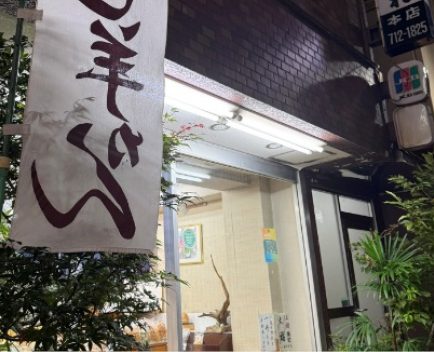
On the other hand, the lights most frequently cited as villains were those associated with commercial shops. Many members felt that the signage lighting for drugstores and clinics, as well as the storefront lighting of a traditional Japanese confectionery shop, was excessively bright. The confectionery shop’s lighting, in particular, utilized linear fixtures typically found in classrooms or offices; because these were installed low on the storefront ceiling, they caused significant glare. Another “Villain” was a decorative, glowing ball—resembling a traditional mari ball toy—hanging beneath a streetlight. Concerns were raised specifically because the electrical outlet on the utility pole was uncovered and exposed to the elements, posing a potential safety hazard. Since there are no large-scale commercial complexes around the station and most buildings are capped at about five stories, a charming landscape of crowded, traditional small buildings has been preserved. We also noted that many restaurants and shops have been renovated, suggesting a town that maintains its shitamachi (old downtown) emotional core while updating itself to suit the
modern era. (Yua Miyakoshi)

■Team 3: South Area
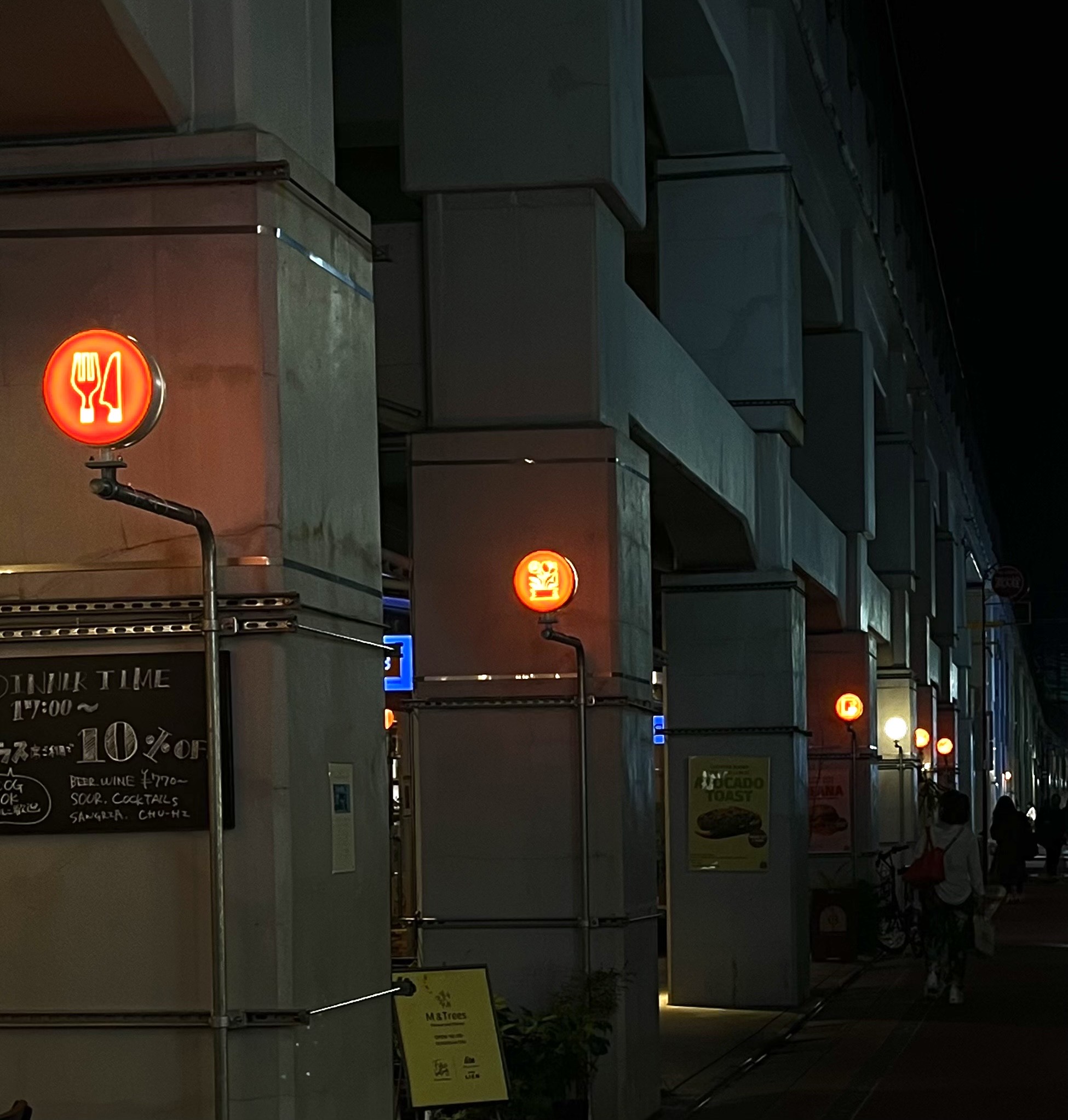
Team 3 explored the route heading south from Gakugei-daigaku Station, concluding by walking through the shopping districts from the east side to the west side. The area around the station is a blend of residential zones and shopping streets that have remained largely unchanged for years, alongside a gradual under-the-elevated-tracks renewal project that has been unfolding since 2021, fostering a fresh, modern atmosphere.
The lighting highly rated as heroes by our team was concentrated in this renewed area under the tracks, where we spent the most time observing. Many shops succeeded in creating a wonderful ambiance; the storefront facades—including the light reflecting off the underside of the tracks—were beautiful. Even the signage, which is often labeled a villain, showed an overall sense of unity in light quality, despite some minor maintenance issues. We were also impressed by a bicycle parking lot in the same row; it used warm, bulb-colored light to illuminate only key points, as if intentionally coordinating with the aesthetic of the neighboring restaurants.
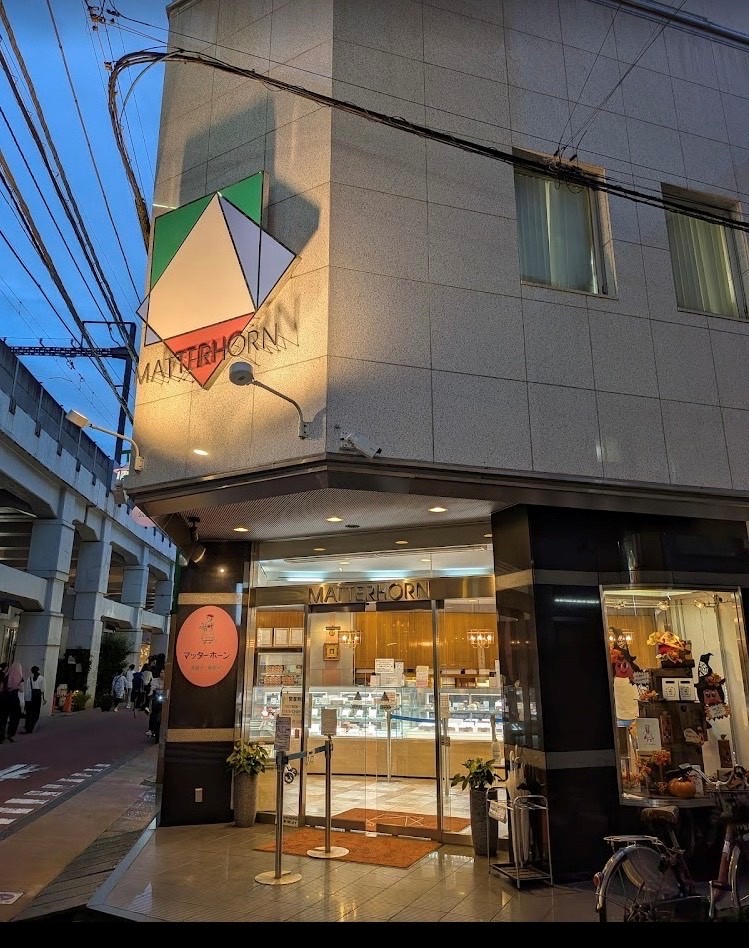
On the opposite side of the road from the elevated tracks, in an area that has remained largely unchanged for years, we found a long-established patisserie. Its exterior lighting, including the signage design, was understated and not overly assertive. Inside, classical chandeliers provided a glow that was elegant rather than glaring; we felt this harmonized beautifully with the modern lighting under the tracks, maintaining a perfect balance between the old and new sections of the neighborhood.
In contrast, the lighting at a multi-tenant building was labeled a villain. The white downlights in the ceiling were piercingly bright, while the spherical fixtures on the sides were a mismatched jumble of color temperatures and lamp types. Our team felt that a unified lighting plan could significantly improve the building’s atmosphere. Additionally, security lights along a straight path leading toward the shopping district were excessively bright over a wide area. while this may be the right choice from a security standpoint, they increased glare to the point that pedestrian comfort was
compromised.
Through this night walk survey, I truly felt that Gakugei-daigaku is a town successfully updating itself while preserving its original soul. I believe the lighting accompanying the renewal under the tracks will lead the way for the town’s evolving identity. This was a wonderful opportunity to consider what “just the right light” looks like—one where the ongoing redevelopment and the nostalgic Showa-era areas enhance each other to increase the overall charm of the neighborhood. (Shiho Fujita)