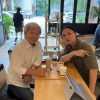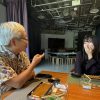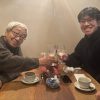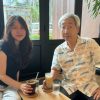
Interviewer: Jack Lim Jack: Good morning Mr. Mende. Today’s theme is “Dreams”. We will keep it open for discussion, whether it refers to the dreams when we sleep, or ambitions and wishes. I will start with the question: When you sleep, do you have recurring dreams? Mende: I have many times dreamt of the same scenery and the same landscape, which gave a feeling of déjà vu. In this dream, I am usually flying. I see the ocean, the sun all over town, with beautiful nature and landscape. And I am usually just stand on a higher place. Do you know the ‘Tetsuwan Atomu’ (Astro Boy) ? I am just flying like Atomu. This is my favourite dream. I very much enjoy dreaming. Jack: Do you also dream a lot? Mende: Yes, I always have very good and optimistic dreams. I don’t have any fearful and bad dreams. Even when I have to fight somebody, I can always win. How about you? Jack: I dream a lot. I can dream even during a quick 10-minute nap, or when I fall asleep on a bus ride. My dreams come in all forms, good and bad. A recurring dream that I have usually happens when I’m almost falling asleep: I step on something slippery, like a banana peel, and fall backward, hitting the back of my head. Then I wake up with a sudden jolt, lying in bed, shocked. Sometimes, though, I…
Interviewer: Lin Huangyi (Akira) Akira:Mende-san, today I’d like to talk about the cost of losing dark sky. Perhaps we can continue our chat starting from the elevator as a warm-up to recall the value of starlight. What’s your most memorable experience of a starry night? Since we’re from different generations, I imagine our impressions might differ. Mende:One of my most unforgettable memories was in Annapurna, Nepal, at a mountain campsite. We were staying in tents, and one midnight I stepped outside—the galaxy was so close it felt like I could reach out and touch it. Everything was silent and dark, but the stars were overwhelming. I don’t know why, but tears came to my eyes. Akira:That sounds incredible. Maybe every human being, no matter what era or area they live in, will cry at this scene. It is kind of echo just like deep inside our subconscious. Once you’ve had that kind of moment, it never leaves you.For me, this happened during university in Chongqing. We visited the Jingxin Buddhist Temple (which literally means “Peaceful Mind”) on a mountain. This temple was part of a lighting project designed by BPI.When we got back to the hotel, there was a sudden blackout—the electricity system had broken down, and everything went dark for hours. At that moment, my classmates and I decided to do something crazy. We went back to the temple again, using only our phone flashlights. It was magical: the…
Interviewer: Momoe Nomura Nomura: When I was in grade school I was deeply hurt and had a painful experience while interacting with other people. I was given a hurtful nickname, others made fun of my home situation, and things were thrown at me during class. I didn`t have the means to protect myself, so naturally I withdrew from people altogether. As a result, I have a hard time finding the words to communicate my feelings and relationships with people became even scarier. This continued for quite a while. Now, as an adult I still don`t feel comfortable getting too close to people, but having no interaction is also very lonely. Trying to find or create this in-between zone has been a challenge that is still with me. Mende: I see. Relationships and creating boundaries, this might be an important theme throughout the course of life. When I sit down and open up with another person, I usually prefer sitting at an angle instead of face to face. Continual eye contact gets uncomfortable if you don’t have somewhere else to focus on from time to time. Sitting at an angle I feel a little more at ease. Having somewhere else to focus on also creates a natural rhythm in the conversation. Nomura:Yes, I like to sit at an angle too. I don’t like sitting face to face because the other person will just be staring at my face, and I am insecure about…
Interviewer: Ton Kek Hian Wee Ton: Today, I’d like to talk about traveling. I understand that you are a very well-traveled person. So, do you prefer exploring nature or the built environment of cities? Mende: Which one do you prefer? Ton: As for me, I’m more of a city person because I love looking at structures. When I was young, I loved playing with Lego and was always building something. So, when I travel, I enjoy looking at buildings, and seeing the different designs. I guess that makes me more of a ‘city person.’ How about you, Mr. Mende? Are you a nature lover or a city explorer? Mende: I like both, but I’m especially drawn to nature because it always inspires me. Nature is truly important to me. We, Japanese people, have a deep respect for nature, viewing things like the ocean, mountains, and even humans themselves as part of it.Since I started aspiring to a career in design, I’ve had more opportunities to travel and visit cities around the world. I enjoy exploring different cities and observing local people’s lives and architectural designs. However, I still find I sometimes need to reconnect with nature from time to time in order to find balance.I’ve been to Tanzania with my wife to see wild animals in their natural habitat. You might not know this, but I started scuba diving when I am 60 years old, and by the time I…
Interviewer: Kunzhi Jiang Jiang: Today I’d like to talk about “Cinema Lighting.” I think cinema lighting is very important. For example, I recently watched “The Godfather,” and felt that light and shadow in cinema can really reveal various conditions of human psychology. Especially senses with intense contrast, light and shadow help create a very tense situation. Mende: Yes, there are many dark scenes in this film. It is an impressive example of using light to symbolize human emotion. Jiang: Yes. I was really impressed with how light is focused on the left side of the screen and the right side gradually becomes dark. I felt this represents the two-sided nature and internal turmoil of the characters. What kind of movies do you like? Mende: I like films of various genres, but I was really moved by the French movie “Diva.” The use of natural light is beautiful. The softness and warmth of natural light really dictates the atmosphere of this film. Jiang: This sounds like a film with many great scenes. I am curious about the balance of light and shadow. By the way, films by the Taiwanese director, Edward Yang, are also very impressive. Lighting melts into the quiet everyday scenes of his films in a way that is very easy. Mende: Taiwanese films certainly have a unique charm. Particularly, natural light is skillfully used to create detailed scenes and atmospheres, unable to be reproduced with artificial lighting. Jiang: “A Brighter Summer…
Interviewer: Iris Wu Iris:Hi Mende-san, today we are going to talk about what era you would like to visit if you had a time machine. This ‘era’ can refer to your personal lifetime, or a historical period, or even a future era you imagine.For me, I would go back to around 2010, when I got into a really good middle school and I didn’t have to worry so much about studying. Since it was a boarding school and there were no mobile phones, my classmates and I always hung out together. Also back in those days, my parents were still very young and healthy. I would love to go back to that time and enjoy it with them. Mende: So, you remember your happy days. What about the future? Do you have any ideas about what it might hold? Iris: Not really, because I believe there are many unpredictable things ahead. I enjoy the uncertainty in my life; just like how I never knew I would pursue design one day, I’m excited about what I’m doing now. Mende: Of course, nobody knows what will happen in the future. However, you know, I’m still curious. I’m very surprised by your answer because I thought with a time machine, it would be the distant past or the far future.As for me, I’d like to go back to 200-300 years ago, when Japan had a very peaceful and exciting life. It was the…
Interviewer: Linxi Chen Chen: Today I’d like to talk about minimalism. Minimalism started as an art movement in the realm of western art after the end of World War II. This movement dramatically affected later generations.When you hear the word “minimalism”, what do you think of? Mende: Minimalism is also used in the world of music. Well, I picture minimalists who prefer things simple or straightforward. Are you a minimalist? Chen: Technically speaking, I am not a minimalist right now, but I would like to become a minimalist.The term “minimalist,” refers to someone who practices minimalism—a lifestyle centered on living with the bare essentials. In Japanese, it’s also expressed as “最小限主義者” (saishougen shugi sha), which translates directly to “minimalist.” This concept involves simplifying one’s life by reducing material possessions. My understanding of a minimalist is “someone who simplifies complex things, seeking a better way of being while maintaining a comfortable state both materially and mentally, and continues this lifestyle keeping themselves simple.”In the real world, the ideal scenario would be being light enough to carry all your essentials in just one suitcase and a bag, with the freedom to always be ready to do whatever you want. I think the reason this kind of thinking emerged is the result of experiences throughout my life. When I was a child, I was often told at home and school that ‘frugality is a virtue.’ Growing up, we lived in a large house…
Interviewer: Masashi Kurobe Kurobe: Today’s coffee break theme is “Cities and Countryside.” I come from a rural town, but I have been living in Tokyo for some time now and have gotten used to urban life. Recently, I went to Shimane Izumo for a lighting survey. While walking through the town, I found that the lighting was different from that in the city, simple and not overly decorated, which was very attractive. Personally, I like experiencing first hand light in rural areas and viewing city lights from a distance. For example, the night view from the LPA office. Mende: That’s a new perspective. Speaking of “cities and countryside,” when we say things like “there are no dark places in Tokyo,” but in the countryside, there are so many dark places that people might fall into rice fields. So, they say they need more lights and install LED security lights. Stereotypically speaking, I think there is a huge difference in the atmosphere or quality of light in the city and the countryside. Kurobe: That’s true. When I lived in my hometown, I never thought darkness was an inconvenience, but now when I go back home, there are so many places that are truly dark and you can’t see anything.Now, I think you’ve traveled to many countries. Do you have a favorite rural town or countryside area? Mende: I have traveled, but mostly for business trips as an adult. So my perspective…
Interviewer: Yuta Shibata Shibata:Today I’d like to talk about memory and forgetfulness. Since I started working at LPA, six months have passed. Working as a lighting designer, I have found that memory is just as important as originality and creativity. While working with several senior members of the staff, I have the impression that they have very good memorization skills. I am not very good at memorizing things or trying to recall things. Mende:You sound like an old man. Have you always been like that? How about college entrance exams? You have to remember a lot of boring facts and stuff. Shibata:Ever since I was young. I had trouble remembering facts that would be on the college entrance exams, but I was good at math and physics, subjects where you think and solve problems through a thought process. Mende:I’m like that too. I used to think that if I filled up my brain with arbitrary facts it would exceed capacity and I wouldn’t be able to produce new ideas. But that’s completely wrong. What is important for a designer is the power to imagine. I have come to realize that memorization, good or bad, doesn’t really matter. However, I am like you and had trouble with memorization and really suffered. In grade school, history facts were always a problem and I made up phrases and rhymes to remember dates and events. Shibata:That is an interesting way to remember things. I…
Interviewer: Chuanyi Liu Liu:Today’s theme is winter sports. I heard that you are very good at skiing and used to go with the students in your seminar class every winter. I was born and raised in a cold area and used to ski a lot back home. Japan is very famous for its ski resorts and has hosted the winter olympics. Every year, many foreigners come to ski. Mende: Well, I`m not that good at skiing. When I was younger skiing was pretty popular, but I never took to it. I started when I was 50. What other winter sports do you do? Liu:When I was in China, I lived in the northern area and skied often. I started snowboarding this year. The thrill of speed and feel of wind on your face is addicting. Snowboarding is a great sport. Making a run across the snow and the feel of snowflakes on your cheeks is an unforgettable experience in a snowy and icy world. Snowboarding is also a great way to experience the outdoors. I think seeing the beautiful colors of a snowy landscape, breathing fresh mountain air, and the feeling of being one with nature is very relaxing. Mende: Sometimes when I attack a slope aggressively, I feel like I am the wind. That is the real thrill in skiing. Liu:In the beginning I thought it was very scary. It is kind of like riding a bike. Until you can handle…
Interviewer: Sunny Xu Sunny: Hi Mr. Mende. Today I would like to talk about a new technologic: AI (Artificial intelligence). What do you think about AI as a design tool? Mende: Have you tried to use AI to make some sentences or other things? Sunny: Recently, I tried to use an AI tool, Mid-journey, at a workshop with the Singapore office. First, the user types into the app simple words or phrases, what style you want, or what object you want to see. Then the app will show the user images. For example, if I want to see Singapore, Sentosa, or other locations and lighting, then I just type in these words, and the app will show different versions of this image. The computer can also make some beautiful perspectives or drawings. Mende: So what do you think about this latest technology for our lighting design business or the project teams? Sunny: On the negative side, a lot of time is needed for AI to show complete work. However, since I have studied drawing in the past, I think drawing is faster than trying again and again. This is my position. Mende: Could Mid-journey create new designs or new lightscpaes for our projects.? For example, a hotel guest room. What will be the new design? I don’t know if AI will be able to exceed our creativity in this area. A fellow professional recently stated, instead of lighting designers, if…
Interviewer: Eddy Lau Eddy: Today’s topic for the coffee break is “Favourite Place to Travel”. Mende-san, you must be travelling a lot. Do you have any favourite place, you will not get bored of visiting again and again, or even living there? Mende: Yes, I have been to so many places, but it is hard to decide which one is my favourite. Each place is very interesting to explore. Eddy: For me, one of my favourites is Barcelona in Spain because the weather there in summer is amazing, sunbathing on such a beautiful long coastline. Especially for tourists to explore the city, there is such a nice walkable environment with stunning historical architectures all around the city, which are surprises everywhere to discover. The food is nice, and so are the people. How about if you want to move to a place, other than Japan, where will it be? Mende: I mean moving to live at a new country and travelling is a little bit different. Maybe travelling is more like a first impression. I never stay in one place for a long time, like studying aboard. So, I almost get a bit nervous living aboard, and you know, staying in Tokyo is much more convenient. There is one place that comes to my mind. My wife and I went twice or thrice to Andalusia, southern Spain, and there is a very small city called Ronda. This was the first…
Interviewer: Ito Yuki ITO:Today I`d like to discuss the “appeal of dark spaces. ”Dark space is a pretty rough idea. However, I imagine not totally pitch, black spaces, but dark spaces with a softly lit lamp, a level of darkness to feel comfortable and relaxed. Do you have any lasting impressions or experiences with dark spaces?! MENDE:Memorable dark spaces…hmm…I have so many. It is hard to choose. The level of darkness at a hotel I stayed at in Phuket left a very lasting impression. As a hotel, the level of darkness was unthinkable. I couldn’t even read the menu in the hotel restaurant. However, the interesting thing is, at first, the darkness felt very inconvenient. But as my eyes started to adapt, I gradually got used to the darkness. If I wanted to do some work in this space, it would probably be harmful. But if one is not reading or writing, I felt it was a very comfortable space and level of brightness. ITO:The fixtures I use in my home have a function to change the level of brightness and color temperature. I usually set the color temperature and brightness at the lowest setting, creating a very dim room. So, I really understand the feeling of relaxation in a dark space. MENDE: Isn’t such a dark room inconvenient for everyday living?! ITO:If I want to do some work, yes it is inconvenient. So when I set the lighting low, I…
Interviewer: Xiaoyi Dong Dong: Today I’d like to talk about feminism. I recently read the book “ Japanese Misogyny: I hate Women” written by the popular writer, Chizuko Ueno. Even though I was born and raised in China, I can sympathize with many ideas in this book. Have you had the chance to read this book? Mende: No, not yet. Was it good? Will you please explain misogyny? Dong: It means to look down on women or a strong hatred towards women. Not only men hating women, but also women hating women. For men it is called misogyny. For women it is self-hate. Ms. Ueno gave a speech at the University of Tokyo that is very popular in China about no matter how hard women work it is unanswered or thankless. Mende: Why is that? Dong: In Japan, even if one graduates from a well-known university, gets a good job, and performs well for that company, this kind of strong, independent women is not viewed as adorable or loveable compared to the type of women who needs to be protected by a man, who is even weaker than the independent women in question. This line of thought is not exactly the same in China, but similar. For example, women who have graduated from famous universities such as Beijing University or Tsinghua University are less approachable compared to women who have graduated from other universities. Mende: Is that right? I don`t think…
Interviewer: Raba’a Bte Tainy Tainy: What is your preferred meal of the day?Mine is ・・・ Breakfast: Bread, cereal, and hot tea.Lunch: I need to have rice (small portion), not too heavy with 2 or 3 small dishes,Dinner: As I age, I prefer soupy noodles or something light. How about you, Mr. Mende? Mende: My preferred meals are… Breakfast: A complete breakfast is very important meal for me and my wife. I wake up early in the morning to prepare breakfast such as egg, potatoes, salad (coleslaw), etc.Lunch: Something light in the office, such as Thai curry or rice vermicelli.Dinner: My wife, Kazuko enjoys cooking. She is very good at cooking. For that I do not have to cook as my wife always asks me to wash the dishes. In my youth, my favourite dish was “tonkatsu” – pork cutlet and potato croquettes. I have three brothers that enjoy eating. We (Japanese people) are good at adjusting other country’s cuisine such as Japanese curry from India and ramen from China to our tastes. Tainy: What food you miss when you were young that you would like to have now but cannot find? Mine is curry puff (epok epok in Malay). It is a well-known and simple food in Singapore not only for the Malays but other races as well. However, I cannot find the one with filling made of fish meat like what my late mom made. Usually, we can find filling…
Interviewer: Chia Xing Chia Xing: Mr. Mende, how did you feel when you got your first house? Mende: My first house after getting married 48 years ago, is a reasonably small condominium and that was also when I just started as a lighting designer. At that time, I thought I must do something special for the house. But I did not have much money to spend, so I decided to do more for the flexible interior. How about your house? Is your house a condominium? Chia Xing: My upcoming house is a HDB flat, which is Government-subsidised public housing for Singaporeans. In Singapore, it is rather difficult to get a completely new house as we are required to go through a bidding system. I got the bid for this house 6 years ago. The house was supposed to be completed by this year but due to Covid, it got delayed. Mende: Are you going to renovate your house? It must be exciting. Chia Xing: Yes! It is exciting as there are some expectations to the house lighting as I am a lighting designer. Mende: How many rooms are there in the house? Chia Xing: This is the layout of our house. We have 3 bedrooms, but I am thinking of removing one bedroom to make the living room bigger. My husband and I like to host gatherings, so we prefer a larger living room to have more space for guests to hang out. This is…
Interviewer: Hikaru Kawata Kawata:Today’s topic is automatic mannerisms and involuntary habits. I would especially like to talk about the habits we have that we like and those we want to change. One habit I have that I am really fond of is the bodily position I find relaxing. Ever since I was little, whenever I wanted a quick nap or just to relax for a moment, I would sit in a cross-legged position and bend my upper body over into a round ball. Mende:That sounds really painful, anything but relaxing. I don’t think most bodies bend that way. Kawata: I find it really calming. I get really cold hands and feet so I tuck them around my torso, in a very revolutionary style. Not many people can copy this habit, so I really like it. Mende:Yes, it is very unique. Any bad habits? Kawata:I get nervous in front of people and under the pressure I bite my tongue. I can’t seem to relax, it is a very bad habit. Mende:So, speaking of physical habits, lately when I am working at my computer, my wife will suddenly say, “Turtle!.” I realized that while working at my computer over long periods of time I gradually start to hunch over. Bad habit! Kawata:How about a good habit? Mende:I like to play a lot of different sports. When I am trying something new, I always do research beforehand so I can perform better. I think…
Interviewer: Jing Liu Mende: So, what is today’s topic of discussion? Liu: Marriage or single life? Mende: How come you chose this topic today?! Liu: This is a hot topic of discussion in China right now. Personally, my parents have been asking about marriage as of late, so it is a subject on my mind. Mende: Are you an only child? Liu: I have an older brother. Mende: As the younger brother, born while the one-child policy was in place, did you have any trouble? Liu: I heard my parents had to pay a fine. Also, both of my parents worked at a government-run company, so they each had to take a 20% cut in salary. Personally, I think it is fine not to get married, but for the sake of my parents who raised me, I think that is a good enough reason to get married. Mende: So, are you prepared to make a decision, marriage or single life, based on today’s talk? Liu: If I find someone and fall in love, I think I will get married, but if that proves difficult I am fine with the single life. However, in China, it is very difficult for men to get married. One reason is the number of eligible men for marriage is more than 30 million compared to women of the same age. Mende: There are fewer women than men? Liu: Yes. Unquestionably, there are fewer women. So,…
Interviewer: Lin Tsan Lin: Today I`d like to talk about novel and design. I have been writing fiction since I was in Jr. high. I didn’t plan on becoming a designer, but here I am at LPA. Since then, I’ve noticed that creating fiction is a little like design. Mende: So, how do you write your stories? Lin: Now, I have a computer, so my last step is to type, but first I use a pencil and notepad to write my themes, story and flow. A skeleton if you will. The meat comes last on the computer. Even if I think I have finished, it is necessary to go back and fix and rewrite, several times. Mende:A Lot of lighting design is structured around instinct. So, sometimes an initial rough sketch is the end design, but we also think of scenarios to go along with lighting designs. For example, what kind of light would be most comfortable for visitors? Or, maybe seasonal scenarios, but I don’t think our designs are quite as elaborate as your method of writing and rewriting. Lin: For me, my first draft is usually the longest. After I finish writing I let it simmer for about a week, as I also collect my composure. Then like a wood carver, I widdle it down, revise, eliminatinate, and repeat. How about essays? The process seems more lighthearted. Mende: Yes, essays… Once, I was asked to write a book, but…
Interviewer:笹本 明美 Sasamoto:I`d like to talk about something that I currently get into and why. Mende:I have several hobbies, but what I am into now is cooking. Since the pandemic began last year, my wife and I have spent many long hours at home together. I realized that I don’t want to just eat good food and compliment the chef, but I thought I should also learn to make something good to eat, myself. Sasamoto:That is really great! Are there days when you make dinner? Mende: No, I am not allowed just yet. Sometimes I make one dish for the meal, but my wife thinks I am too dangerous. For the last 40 years, I have been on dishwashing duty. Sometimes she lets me help with tasks like grating radishes or things that can’t be easily ruined. However, lately, she has been teaching me about seasoning. She probably has realized that I am healthy and may outlive her. So if the time comes, when I have to provide care if she ever gets sick, she wants to be able to eat good food. Very cunning on her part. My wife is a very good cook. So, like a professional, she is teaching me the basics of cooking. I am good with my hands, so I have figured out my way with a kitchen knife. How about you? You seem like the type that likes to keep busy. Sasamoto: Yes, I…