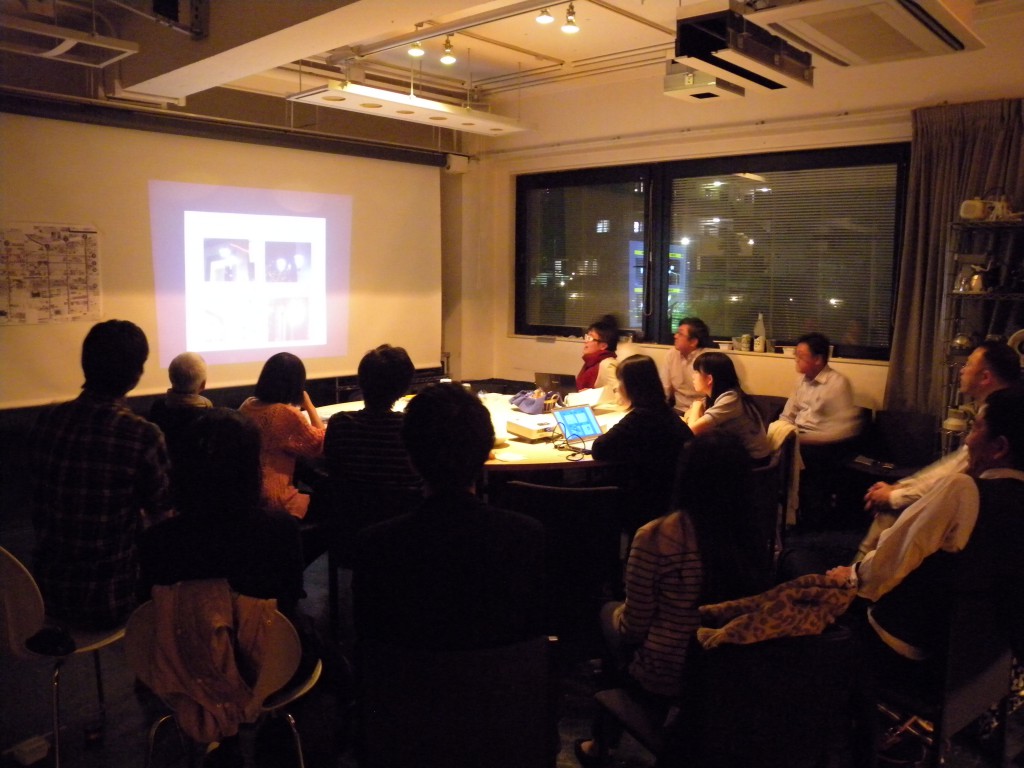
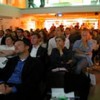
Round Table Discussion will be held on 6 SEP(WED)19:00-21:00 @ LPA .
If you would like to attend, please send mail to office@shomei-tanteidan.org
Looking forward to hearing from you.

Round Table Discussion will be held on 6 SEP(WED)19:00-21:00 @ LPA .
If you would like to attend, please send mail to office@shomei-tanteidan.org
Looking forward to hearing from you.
Orange lights brighten the plains and continue on towards the horizon, creating the Chicago nightscape. Notorious for cold winds, the Chicago nightscape was unified early on with high-pressure sodium streetlights. For crime prevention, the amount of light slowly increased with each passing decade, but outdoor lighting technology in Chicago is considered very progressive. Orange axes of light extend toward the horizon. High pressure sodium streetlamps are used beautifully throughout the citystreets of Chicago. The highmast lighting pole at the base of the John Hancock building is functional and glareless. Highly efficient streetlights illuminate State Street, creating a unified environment.
Rich in local history and cultural facilities, Ueno Park covers a large area in the middle of Tokyo. Even though located in an urban setting, we anticipated a lighting environment completely different than the lights of downtown. Between the trees and darkness of the park there are patches of Tokyo`s bright night sky, but the hushed silence is isolated from the city`s hustle and bustle. Ueno Park`s quiet presence gently sleeps next to Tokyo`s vibrant downtown. Approaching Ueno Park from the JR train station. The large overhang of the Tokyo Bunka Kaikan is brightly illuminated in contrast to the surrounding darkness of the park. A view o f northern Tokyo over the Shinobazu Pond from an elevated Ueno terrace. The bright lights of a vibrant downtown are seen in the distance beyond the dark trees of the park. However, through the darkness a bright, orange, sodium lamp illuminates the Benten Shrine near the pond. Looking towards the water fountain plaza from the Tokyo National Museum. A slightly bright night sky, characteristic of most metropolitan areas, opens over head with a dark belt of trees and tiny dots of light below. Young couples seeking a quiet spot away from the lights, snuggle up together on near benches.
Candle Night Summer Solstice 2010 June 19, 2010 “Turn off the lights and take it slow.” This is the campaign slogan for Candle Night, a movement started in 2003 on the summer solstice by an environmental NPO. Nationally, the event is unofficially planned for the summer and winder solstices, and persistence from local groups have turned it into a huge event to enjoy a different kind of evening by candlelight. Candlenight@OMOTESANDO-Eco Avenue Candle Night along Omotesando was held for two hours on June 19th, 2010 from 8pm to 10pm in the evening. The Harajuku / Omotesando Candle Night started on the 2003 winter solstice. This year marks the 10th event along the popular shopping street. The theme for 2010 summer solstice was “Encounters with Candles x LEDs.” In contrast to candles, which have been used for hundreds and hundreds of years, LEDs are the latest gadget in optical technology. This year visitors encountered hybrid installations using both candles and LEDs along the zelkova lined street. For the event, 611 staff members, mostly art university students in the Tokyo precinct, were recruited and collaborated to present a unified, coexistence of warm candlelight and techno LED installations. Candle Installations The theme this year was “Encounters with candle x LED,”so it wasn`t just candle light along the street, but a combination of candles and LEDs for a variety of installations. Installations included, stacked wine glasses with candles inside and softly emitted blue LED…
Theme:Self-Promotion as a Designer Interviewer: Yuichi Anzai Anzai:Today I`d like to talk about something that is troubling me as a designer with not a lot of experience. I`d like to talk about self-promotion, something that I am lacking in. When I was an exchange student in NYC we had many opportunities to present our ideas in class or while job hunting, but each time I failed miserably at presenting an appealing picture of myself. There were language barriers, but I think it was more a fundamental lack of composer and confidence and an inability to communicate about myself or dictate to the audience. I think, as a designer, the ability to promote oneself is necessary to persuade clients about new projects and to strengthen trust while working together. Mr. Mende, when you were new to the profession or just starting to build up LPA did you have any specific troubles or points of strength? Mende:I`m not one for a showy sales pitch, but I wanted to do good work on good projects. At my previous job I was able to meet and work with several architects, so I had a good base to work with when I started LPA. Just being oneself is ideal for self-promotion. As a designer, getting good feedback and reviews from the public is not because one has a showy sales pitch, but it reflects good results which speak for themselves. Good results, does not only…
16 September, 2010 Previously in March 2006 the Lighting Detectives navigated the Nihobashi and Kanda Rivers. It was such a unique experience leaving the Lighting Detectives wanting more, that we have tweaked the Tokyo river float tour to include the Sumida River and a view of the Rainbow Bridge, for a dramatic 3-hour tour. While most of the elevated highway system puts a cap on portions of the center of Tokyo, this creates dark spots with a colorful nightscape in the background, best viewed from, where else, but on the rivers. Survied by: Noriko Higashi, Haruka Sakoda, Genki Watanabe The 3-hour Tour. Lighting under the elevated highway system. Kanda River Kanda River Ochanomizu Station Platform Akihabara Rainbow Bridge Starting from Hamamatsucho Station, 40 Lighting Detectives boarded a houseboat rented from Nawasada Houseboat Company to navigate the Nihonbashi, Kanda, and Sumida Rivers of Tokyo in the cold and sprinkling rain. The Nihonbashi River, which is shielded mostly by the elevated highway system, started off the tour. From there, we navigated the more open canal of Kanda River, past Ryogoku Bridge, back to the Sumida River, and headed towards Asakusa. After viewing the Sky Tree, still under construction, the captain made a U-turn floating directly towards Odaiba and the Rainbow Bridge. In spite of the rain and cold weather, tour participants, all decked out in rain ponchos, boarded the boat and continuously snapped photos along the tour route, all seemly enjoying the…