date of Issue:May 16, 2018
・Activity 1 / The 60th Night Walk: Jiyugaoka(2018/04/06)
・Activity 2 / The 58th Salon: Jiyugaoka Night Walk Review (2018/04/16)
・Activity 3 / Lighting Detectives General Meeting & Introductory Workshop (2018/05/08)
The 60th Night Walk: Jiyugaoka
2018/04/06 Naoko Oguchi + Shinichi Sakaguchi + Daisuke Miura + Wenyuan Zhang

Night Walk Map
Jiyugaoka, a neighborhood renowned for being fashionable. Each street has a name, such as Jiyudori, Gakuen-dori, Marie Claire-dori, Maple-dori, and Megami-dori. They are lined with a high concentration of shops selling miscellaneous goods, cafes, and sweets that make you want to stop and browse.
We investigated whether the nighttime lighting was as stylish as the neighborhood’s reputation. Jiyugaoka also ranks high on lists of “most desirable places to live.” This time, we conducted a Night Walk Survey on the various streets extending from Jiyugaoka Station, focusing on their “stylish” appeal.

Member Oguchi Explaining the Night Walk Survey Overview

Hiro Street, which received many votes as a hero

Streetlights Attached to Residences on Shirakaba Street

In the side alleys, there were also small streets that felt like you were being drawn in by the light of the paper lanterns

The Unbalanced Streetlights of Green Street

People Relaxing on Benches on Green Street

Street light at residential area (4300K、19lux at ground level)

Too many spotlights were installed on the wall surface

The Get-together After the Night Walk Survey
■Team A (Shirakaba Street, Gakuen Street, Residential Area)
Team A first walked along Shirakaba Street, a small path between the station rotary. It’s a street where old and new stores coexist, and we saw a rare sight in Japan: old-style streetlights attached directly to the walls of residences. The color temperature of the light from the streetlights, signs, and shops was high and created a glaring impression, but it did provide a sense of security for walking.
Next, we walked along Gakuen Street. The light from the facades of each store gave a calm impression with their warm, incandescent colors, but the regularly spaced streetlights had been replaced with high-color-temperature LED sources with strong glare, which detracted from the scenery. However, we felt that the glare from the streetlights was slightly reduced when the ratio of light from the facades was higher.
The streetlights on Sunset Alley, a small street off Gakuen Street, had also been replaced with highcolor- temperature LEDs, but they used full-cutoff-type pole heads that only shine downward, which was a nice consideration to prevent glare for pedestrians. We also found that the warm light spilling out from the tenants softly illuminated the street, creating a comfortable brightness.
The only residential area we passed through didn’t feel particularly unique to Jiyugaoka; the lighting environment was similar to what you’d find in any other city. We felt that if there were more andon-like lanterns with soft light, the night paths would be more pleasant.
Finally, on Hiro Street, we noticed that the streetlights had signs with the street’s arc-shaped name, which created a clear outline for the street and showed a clear design intention.
Jiyugaoka is a place where various cultures coexist, with cutting-edge stores changing rapidly alongside a surprising number of older residences. This Night Walk Survey gave us an opportunity to reconsider the impression of it as a “stylish neighborhood” from a lighting perspective. (Naoko Oguchi)
■Team B (Megami Street, Cattleya Street)
While we expected every street in Jiyugaoka to be unique, we found that although the types of streetlights varied, the color temperatures were mostly high, and the streets were filled with white light. I felt that most people would prefer a warmer color, but personally, I thought this was acceptable for streets with a lot of vehicle traffic (though I still think a warmer color would be better for streets without cars). We noticed that the small alleys connecting the main streets also had highcolor-temperature streetlights. I felt that these could definitely be changed to a warmer color.
However, these alleys had a nice atmosphere compared to the main streets, probably because of the clever use of brick and cobblestone pavement. I think the atmosphere would change considerably just by altering the pavement (the same is true for train platforms). I wish the streetlight color temperature was decided in conjunction with the pavement.
We felt that individual shops, perhaps to maintain the “Jiyugaoka brand,” had warm, attractive lighting that drew people in, especially those who are sensitive to fashion and trends. Recently, urban development projects around stations have been undertaken in various places, such as near Toranomon Hills and Kashiwanoha Campus, where we previously conducted a Night Walk Survey.
In that sense, I felt that Jiyugaoka is a city from the Showa era, and in a way, it feels a little dated. You can feel this atmosphere on the streets near the station that are lined with old department stores and pubs. Personally, I have the impression that Jiyugaoka has lost some of its former energy. I wonder how it will change in the future. Jiyugaoka has moved from the Showa era to the Heisei era and now into the new one. It’s a city whose future changes I’m looking forward to. (Shinichi Sakaguchi)
■Team C (Marie Claire, Green Street)
Team C was in charge of the area south of Jiyugaoka Station. We conducted a Night Walk Survey to determine which street we thought was the most stylish, with each member looking for their favorite street and the reasons behind their choice. Our route started at Jiyugaoka Station, took us through Marie Claire Street, Jiyu Street, Suzukake Street, Green Street, and finally Hiro Street before returning to the station.
Each street in Jiyugaoka has its own character. The atmosphere changes dramatically as you move from one street to the next, with different streetlight designs and color temperatures, so it was never boring. We found it quite difficult to select the most stylish street because a change in perspective— whether we were up close or far away—could make a hero turn into a villain. In a town where heroes and villains are chaotically mixed, our team members recommended Marie Claire Street and Green Street, among others. We also felt that beyond the entire town and its main streets, the unique lighting designs and ingenuity of the shops scattered throughout Jiyugaoka—even in the small alleys off the main roads—captured the true essence of Jiyugaoka.
Overall, Jiyugaoka feels like a city that has developed naturally over time. New shops stand alongside old ones, a single street away from a quiet residential area. Near the station, fashionable hair salons sit next to cram schools, and in between, people hold cherry blossom viewing parties while looking at the station. Stylish commercial spaces and everyday life exist here without borders, and we felt that Jiyugaoka’s “style” comes from how all these different lights come together to create the town.
If you’re interested, you might find it fun to conduct a Night Walk Survey in Jiyugaoka—a fascinating town where heroes and villains exist in chaos—to find your own favorite street. (Daisuke Miura)
■Team D (Maple Street, Suzukake Street)
Team D walked along Wakakusa Street, Shirakaba Street, Maple Street, and Suzukake Street. The lighting cleverly used different color temperatures to match the vibrant atmosphere of the low-rise commercial buildings and the calm of the upscale residential area, highlighting the beauty of the lush, green streets.
On Maple Street, the lighting was mostly low-color-temperature, which created a sense of unity. Many buildings had spotlights and bracket lights to illuminate their facades, which created a lively and glamorous atmosphere for the entire street. However, there were some areas with an excessive number of spotlights, mixing high-color-temperature lights into the low-color-temperature spaces. For example, a patio that many of us considered a “hero” had small, sparkling LED lights that were integrated with the interior lights (2700K and 50 lux on the ground), but spotlights with a color temperature of 4000K and a ground illuminance of 320 lux were also placed nearby, causing a glare. After a while, Maple Street turns into a quiet residential area. Here, the lighting was used to create a harmonious atmosphere between the greenery and the architecture by using spike-type spotlights to illuminate the trees. However, the high-color-temperature streetlights still stood out starkly in the dim surroundings and felt like a very disappointing villain.
Suzukake Street had relatively few commercial buildings, but thanks to unique shops with ethnic or traditional Japanese styles, the atmosphere was dramatic with a comfortable level of darkness.
Overall, it seemed that each shop and building was designed with lighting in mind. The charm of Jiyugaoka might be the drama between architecture and people that arises from the contrast and harmony of light and lush greenery. (Wenyuan Zhang)
The 58th Salon
Jiyugaoka Night Walk Review
2018/04/16 Mikine Yamamoto + Noriko Higashi
Jiyugaoka is a popular town, even in Tokyo. It was totally worth the hype. It was bustling with many people during our Night Walk Survey. This time, with “style” as our theme, did each team manage to discover a stylish street?

24 people met on the second floor of LPA for a Night Walk Survey review
We reviewed the Jiyugaoka Night Walk Survey that was held on April 6. The theme of the survey was “Find the Stylish Street.” Was Jiyugaoka’s night scene as stylish as we had imagined? We announced the best stylish street chosen by each team, from A to D, who were separated for the Night Walk.

Highlights from a Presentation
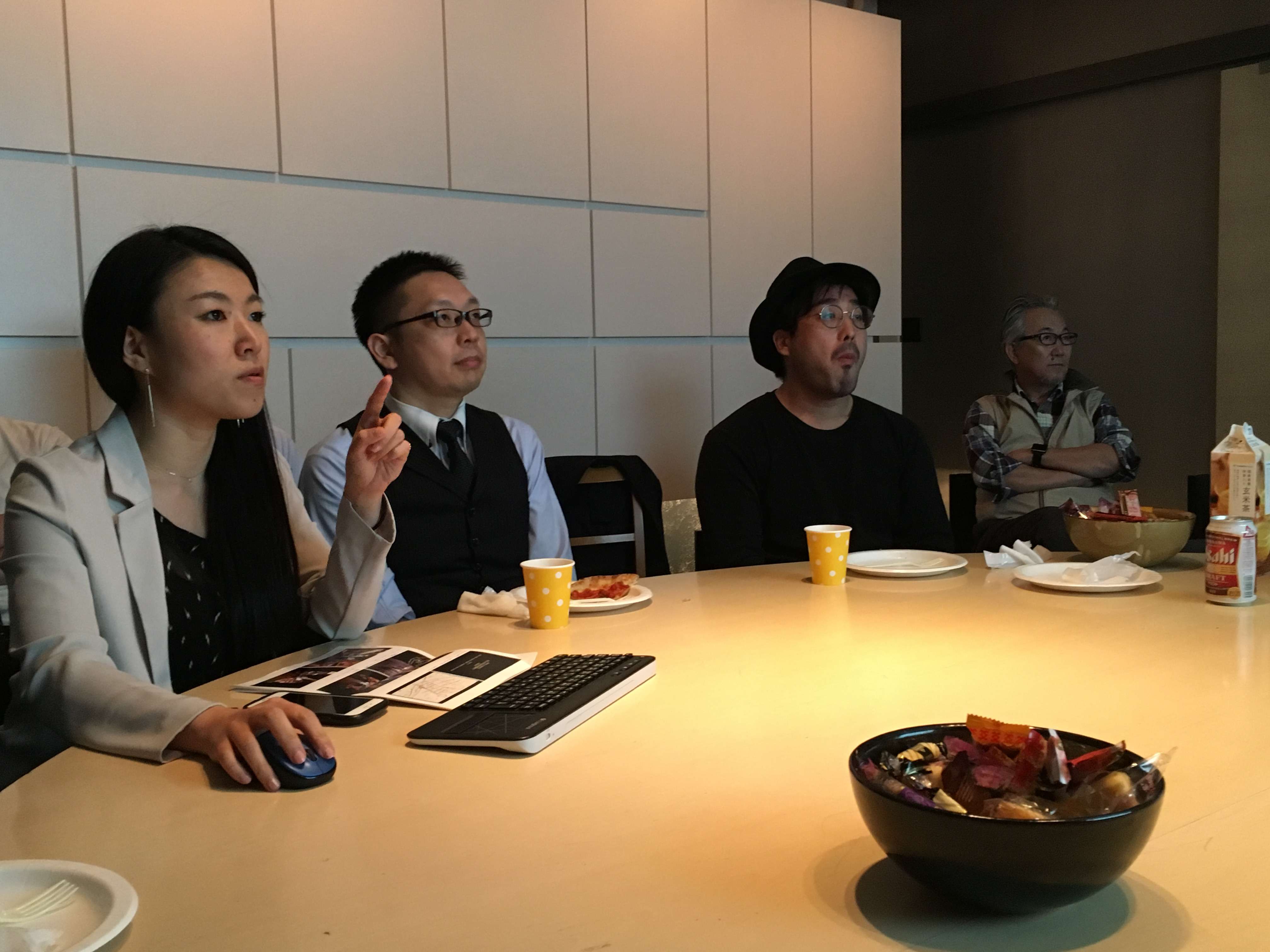
A presentation of the compiled impressions and opinions from the Night Walk Survey by each team

The presentation materials show great ingenuity

It was a pleasant gathering while having light meals
The cobblestone and brick-style streets, which are often seen in Jiyugaoka, look stylish and create a fashionable atmosphere without any extra effort compared to streets paved with asphalt. We heard comments that the streetlights on these streets used shades that directed light only downwards, which was likely done to prevent glare and light pollution, showing consideration for pedestrians.
In general, Jiyugaoka’s streetlights have a high color temperature, while the light spilling from the shops is often low in color temperature. Although there was a difference in color temperature, many members felt that the brightness was comfortable for walking at night. However, some also felt that the lighting in residential areas and on major streets was still too bright and glaring, ruining the atmosphere.
Jiyugaoka has the impression of a place where new shops constantly open to set trends, but surprisingly, there is also a wide presence of older streets, like the long-standing Jiyugaoka Department Store, Hikari-gai, and small alleys reminiscent of the Showa-era red lantern streets. We heard opinions that Jiyugaoka’s charm lies in its human-scale environment, with few tall buildings and a mix of unique shopping streets, alleys, parks, and quiet residential areas. We also heard that the small cluster of lights—from the signs placed in front of shops to the soft light spilling from the storefronts—creates a sense of comfort.
It seems that on streets where the center is a promenade with street trees and benches, and is well-maintained, the space becomes a comfortable place to enjoy a takeout meal outside, even at night.
There was also an opinion that the town is a borderless mix of stylish, new shops and old shops and residences that have been around since the Showa era. Chief Mende commented that when Jiyugaoka was first developed, it was a town filled with new things and a townscape that actively incorporated things like Western-style cobblestone streets. But now that those have gotten old, it gives the impression of a “town that used to be stylish.”
The final conclusion was that rather than giving the impression of being stylish, the town as a whole felt like a “good town” with a number of comfortable streets and spaces where people could enjoy spending time outside at night. Each salon is a place where Night Walk Survey team leaders can actively share their thoughts and opinions and where we can have lively discussions about what worked well and what could be improved. We feel the materials that have been compiled are also excellent, so we plan to actively publish them on our website. (Noriko Higashi)
■Reflections on Participating in the Salon
This was my first time participating in a report session (salon) after joining a Lighting Detectives Night Walk Survey for the first time in 10 years. This salon was a report session for the Jiyugaoka Night Walk Survey, with presentations on survey findings and reflections from four teams.
The atmosphere of the places we saw during the Night Walk Survey came across clearly, as they carefully explained the characteristics of the streets, and the heroes and villains, with photos and comments. The members’ perspectives and comments on the town were also diverse, ranging from unique to professional. Also, since suggestions for improving the town came up, it was a very stimulating and substantive report session. (Mikine Yamamoto)
Lighting Detectives General Meeting & Introductory Workshop
2018/05/08 Simeng Huang + Noriko Higashi
Since we felt there weren’t enough chances to hear from our members directly, we decided to hold the first “General Meeting” in Lighting Detectives’ history. It was a lively event where the conversation flowed freely, and everyone had a great time enjoying delicious food and drinks.

An easy-to-understand explanation of photography tips you should know for a Night Walk Survey
We also presented on tools such as illuminance meters and luminance meters

They shared the stories behind why they joined the organization

We also exchanged ideas about which cities the Lighting Detectives should visit next
We held a Lighting Detectives General Meeting & Night Walk Survey Introductory Workshop at the LPA office in Shibuya. This was the first-ever general meeting and the first introductory workshop in four years since the last one in 2014. A total of 24 people, including chief Mende, participated. For the first time, we live-streamed the entire event on Facebook and Instagram simultaneously, which allowed those who couldn’t attend in person to participate. By the end, over 160 people had watched the stream.
First, chief Mende gave a presentation on the history and activities of the Lighting Detectives, from its founding to its current publications. He reported that the group, which was formed with just six members in 1995, has grown into a large organization with 980 members this year. After that, there were detailed explanations of the group’s “seven tools” (optical instruments, surveying equipment, notebooks & memos), as well as how to take measurements, choose a location, and other tips.
Next, we were given a detailed explanation of photography methods, which are crucial for a Night Walk Survey record. Since lighting photos are taken in a dark, nighttime environment, photography techniques are important. Various shooting techniques and recommended settings were explained for different situations, such as taking a beautiful nightscape photo with a tripod or taking a handheld snapshot.
Finally, there was a presentation on how to summarize the Night Walk Survey. They introduced ways to utilize the data collected from the surveys, such as creating panels, holding online votes on the website, and creating a database, in addition to social gatherings and salons. Following the introductory workshop, we held a general meeting (social gathering). After the Lighting Detectives’ activity plan for 2018 was explained, all the participants introduced themselves. They shared why they joined the Lighting Detectives and their aspirations. The reasons for joining and the backgrounds of the members were diverse, ranging from a person from a completely different field who wanted to explore the effects of light on people, to a person with an architectural background who reflected on not having paid much attention to lighting after attending one of chief Mende’s lectures. This really made us realize the depth of the Lighting Detectives’ membership.
Since the destination for this year’s Night Watching Tour was undecided, we asked for opinions on places they would like to do a Night Walk Survey. We heard many opinions that people wanted to see fire or natural light, such as at traditional Japanese festivals or firework displays, rather than urban light environments. In Tokyo, locations such as Akabane, Yanaka-Sendagi, Sancha, and Ikebukuro were suggested. We will use these suggestions for our future planning. It was a very meaningful session for the secretariat as we were able to directly hear so many opinions and suggestions. Thank you to everyone who participated and watched! (Simeng Huang + Noriko Higashi)