RELATED POSTS
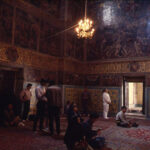
Pillar palace
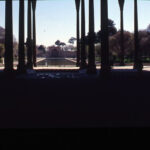
Khaju Bridge
Khaju Bridge
YOU MIGHT ALSO LIKE
TOKYO : MARNOUCHI & TOKYO TOWER
The Marunouchi district in the center of Tokyo has been transformed in recent years from a business and financial center to the latest redevelopment to intertwine commercial and office space. Our survey started in Marunouchi, as we closed in on the infamous Tokyo Tower to view the sprawling Tokyo nightscape. Marunouchi Central Street is enclosed on both sides by buildings all at the same height of 31 meters. Facade lighting and streetlights throw an even light over the street, creating a flat nightscape with no rhythm of light and shadow. Quite possibly occupying the staring role in the production of the Tokyo nightscape is the Tokyo Tower. The ironworks structure of this tower is illuminated from underneath, beautifully generating a glowing symbol for the city. At 250 meters, looking down on Tokyo from the tower is a beautiful site. Glare is blinding and there is no visible unified pattern to the lights of Tokyo, but lights twinkle all over the city and continue as far as the horizon. Things always look better from a distance and the Tokyo nightscape is one of them!
Vol.82 – Learning Lighting Design from Cinematography Part 2 “Tokyo Story”
In the warm family picture painted by Yasujiro Ozu there are two types of natural light; glaring, bright sunlight and the incandescent lamp, symbolic of a cozy family. In the film, daytime scenes always seem very carefully calculated. Doors and windows are always wide open and abundant light streams into the rooms. Family life is constructed against this bright external background. In other words, even indoors the presence of nature outside is sufficiently felt, as if one is outside when they are actually inside. So, in the film when a outdoor scene directly follows and connects to an indoor scene there is nothing unnatural about it and the screen flows uninterrupted. Nothing feels so good as when the sliding paper doors, sliding lattice doors, and storm shutters are all completely open in the house. Fresh air rushes in and moves about freely. This is characteristic of Japanese lighting culture and unique to old family homes built using a wooden framework construction style. The “Tokyo Story” uses this feeling of openness during the daytime extremely well. The presence of the outdoors is sensed by bright sunlight or a cloudy sky and these backgrounds and natural light subtlety expose the delicate emotional bonds of the family. After sunset, the second form of natural light emerges in the film. Compared to the feeling of openness during the day, a single incandescent lamp represents the warm family bonds. I typically call lamp light the…
Vol.008 – Waterscapes with Light
Interviewer: Misuzu Nakamura Thme:Waterscapes with Light Nakamura Ok. So, today I thought we could talk about waterscapes with light. I just got back from a trip to survey the urban lightscape of Bangkok. The scenery along the rivers and surrounding waterscape, such as the Chao Phraya River and the floating markets in outlying areas, was very impressive. The river water was very murky, but the reflection of lights on the surface at night was so pretty. Right now, I am also working on a project where the waterscape is a very important feature of the project. So I have been thinking a lot lately about what is so charming about waterscapes with lights. Mende Water and lighting design are deeply rooted. In terms of urban lighting, the most prominent cities that underwent development long ago were surrounded by water. In terms of Bangkok, the lighting along the waterscapes is not especially good, but the illumination of Wat Arun and the elevation along the riverside reflects beautifully in the water. Nakamura Upon reflecting in the water the lighting then becomes beautiful. Mende In lighting design glass and water are two very important materials. Their properties are also very similar. Both are not very easy to work with, but very interesting. Frosted glass or textured glass is very good at replicating light, but clear glass is not. It doesn’t reflect light at all. Nakamura Glass will uniformly receive and transmit light, but the surface of water simmers, creating…
City Night Survey : Koyasan
2022.10.01-10.03 Shunichi Ikeda + Genki Watanabe Koyasan (Wakayama Prefecture), a sacred site of Japanese Buddhism with a history of 1,200 years, was inscribed on the UNESCO World Heritage List in 2004 and again in 2016, and is one of the world’s most renowned religious cities. It is also a popular tourist destination, attracting many international visitors prior to the COVID-19 pandemic. Through the distinctive light environment created by the numerous temples and shrines, as well as through the experience of staying at temple lodgings (shukubō), we conducted an investigation into this extraordinary lighting culture from the perspective of the Lighting Detectives. Koyasan is a town situated in a mountain basin at an altitude of 800 meters, surrounded by peaks of around 1,000 meters in northern Wakayama Prefecture. It was founded about 1,200 years ago, in the early Heian period, by the Buddhist monk Kōbō Daishi (Kūkai) as a sacred site of Japanese Buddhism, with Danjō Garan serving as the central temple complex of this religious city.Originally, the entire area of Koyasan was considered part of the grounds of Kongōbu-ji Temple.For us, this was the first time to focus on a religious city in an urban lighting survey. We wanted to examine what the nightscape of this temple town looks like and how the lighting culture of Japan and Buddhism manifests itself in various aspects. ■Okunoin, Kongōbu-ji, Head Temple of Koyasan Shingon Buddhism Okunoin is an expansive cemetery stretching about 2…
Exhibition-Lighting Detectives
The Lighting Detectives Makes Its Appearance in Ginza Date: March 6-April 29, 1997Place: TEPCO Ginza Building, 2F ‘Electric Scene’ Seven years of accumulated Lighting Detective’s research and activities were exhibited in a viewer-friendly show, ‘Shomei Tanteidan Exhibit?The Lighting Detectives Make an Appearance in Ginza’. Six exhibition corners were set-up in the TEPCO Ginza Building, 2F Electric Scene Room. 01 Concept of Lighting Detectives As a corner to introduce the concept of the Lighting Detectives, we have visualized the results of the Lighting Detectives over 6 years with 14 keywords in a box of 30 cm on a side. Look through the holes in the box and ask them to think about the meaning of the keyword. 02 World Nightscape Here, 20 carefully selected night views of the world and night expressions seen by the Lighting Detectives are exhibited. A beautiful night view of a beautiful city, a night view created by natural light such as the moon and stars, Aurora and blue moments … Enjoy many night expressions 03 Variety things emit light in the city There are so many “light things” lurking in the city. Here they meet and communicate with each other. The seven tools used by the Lighting Detectives are also on display. 04 Light Experience Tunnel The cities are getting brighter and brighter in Japan. The lights of vending machines, convenience stores, lights of gas stations and light-ups overflow in a city that does not sleep for 24 hours. Do…