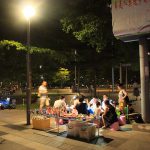
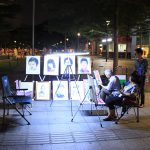
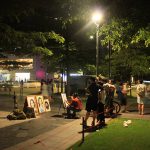
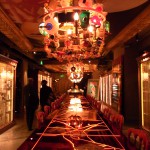
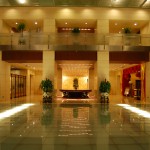
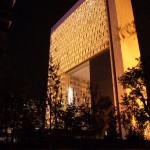
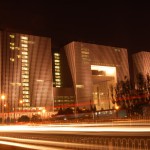
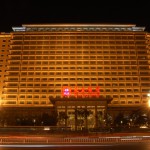
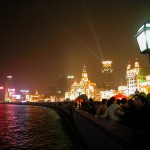
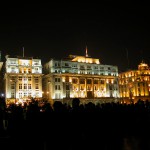
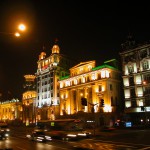
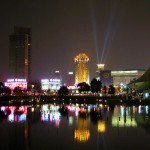
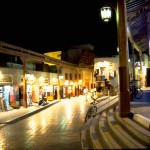
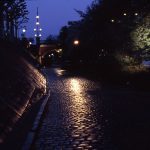
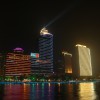
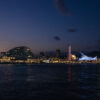
2023.01.18-01.20 Yumi Honda + Misuzu Nakamura Kobe is famous for the night view from Mt. Rokko as the “10 Million Dollar Nightscape” and for its waterside nightscape as a port city. Nightscape guidelines have been established in 2012, and efforts are being actively made to improve the lighting in the city. We walked around the city, which continues to be updated, and explored the components of a nightscape that is uniquely Kobe. ■“Instagrammable” NightscapePort Tower, Maritime Museum, Oriental Hotel, Hotel Okura, Ferris wheel, sightseeing boats, and the “BE KOBE” monument…. When people think of the city of Kobe, they probably think of Meriken Park. Meriken Park is the face of Kobe, and even at night many people were visiting the park to take commemorative photos. Many of the park’s symbolic monuments were lit up and color lighting was used extensively, but the colors and color schemes were mainly neutral, not primary colors, so it was nice to enjoy the colorful light without getting an overpowering impression. To complement the color lighting, the ground lights of the pole lights, handrail lights, and bollard lights were uniformly lit with light bulbs, creating a subdued brightness. Both decorative lighting and functional lighting emitted little excessive glare, allowing us to concentrate on the illuminated objects. It seemed like seeing the nightscape and taking pictures of it could be the purpose of a visit to this place. In this age of breathlessly uploaded photos and videos…
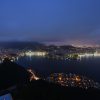
2018/10/13-23 Mikine Yamamoto + Kouki Iwanaga This was our first South American survey in about 15 years. We tracked the light expression of Rio de Janeiro, a port city marked by both entertainment and poverty, which hosted the FIFA World Cup in 2014 and the Olympics in 2016 and has become increasingly international. While possessing famous coasts like Copacabana and Ipanema and being counted as one of the world’s three most beautiful harbors, it also has the “favela” slums covering its hillsides. Surrounded by magnificent nature, Santiago, Chile’s largest city, has annual rainfall of only about 360mm, meaning it is sunny for most of the year. We investigated the lighting situation of this city blessed with natural light. The nightscape from Pão de Açúcar: A beautiful contrast created by the rich topography Viewing Copacabana Beach from Pão de Açúcar Favelas built on the mountain slopes ■Rio de Janeiro / Brazil Rio de Janeiro is an international tourist city that hosted the Carnival and the Olympics in 2016. It is said to be a microcosm of the country, where light and darkness coexist: scenic areas with beautiful topography blending nature and culture are situated next to slums. We surveyed the light expressions of this city, which has various faces, including the glamorous light of tourist and resort areas, and the strangely glowing light of the favelas (slums) where poor communities gather, reflecting the lives of the people.The suburbs leading from the…
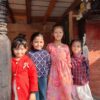
Nightscape in Jingmai Mountain2023.12.08 – 12.13 Kyoko Takubo + Hongna Chen Located on the southwest border of China, Jingmai Mountain is the birthplace of Pu’er tea, where the indigenous people have created an ancient tea forest cultural landscape, which was registered as a UNESCO World Heritage Site in September 2023.While working on the project, we became interested in the local culture. So we decided to survey the villages at night and to observe and report the impact of tourism development on the local nightscape. ■Introduction Visiting Jingmai Mountain isn’t easy. First, spend the night in Kunming, then leave early morning for the destination by plane or train.We had planned to fly from Langcang Jingmai airport, but our flight was suddenly cancelled. So we had to travel to Pu’er by train and grab a cab to Jingmai Mountain.During our stay, we were based in Huimin Town where our project TEA CELLAR is located. We visited Nuogang Village, Wengji Village, and Jingmai Village to observe the people’s daily life and the nightscape there. ■ Nuogang Village Nuogang Village is a historic village of the Dai tribe, where the villagers have maintained their traditional lifestyle. The first floor of the house, with its distinctive gabled roof, is used for tea production and for the teahouse. The second floor with a tiled roof is a living space.The owner of the teahouse told us that the first floor is open to guests and the family…
Chong Qing Lighting Survey 重庆史光: Re-Celebrating History of Light 2019.07.04 – 2019.07.05 Clement Lee + Iwata Masahiro Located in the upstream of Yang Tze Basin, Chong Qing serves as one of the manufacturing, transportation and commercial hub of China. Caught within rapid infrastructure changes, this survey seeks to uncover the methods for Architectural and Lighting preservation efforts to reflect the ancient Clement Lee + Iwata Masahiro traditions from the dynasties. Ci Qi Kou Old Town highlighted with linear architecture facade lighting contrasting the light blue canvas sky of the evening Old town of Ci Qi Kou (磁器口): Cultural Hub of Chong Qing Chongqing is a technologically advanced city situated in the mountains of southwest China. With a rich history of being a major economic hub, Chong Qing was propelled to earn a place in the top 13 megalopolises of China. With the theme of understanding and exploring the cultural traditions of Chong Qing, we set out to discover its customs and efforts to preserve the rich traditions which create the unique character that separates this Sze Chuan-influenced province from the other major cities of China. We began at the heart of the city: the old district of Ci Qi Kou. This old town is currently filled with shops sells goods and traditional food of the old Chongqing. A modernized trading hub that reflects the bustling old port to trade porcelain along the Yangtze River. It was a commercial hub for pioneers back in the…
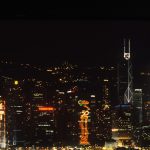
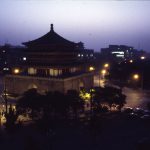
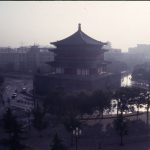
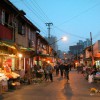
Muslim District within New Development Context2025.11.06-11.09 Quratuaini Jamil + Xu Sunny The survey aims to examine the Muslim Quarter District with a focus on its religious, cultural, and urban context, while assessing how it integrates with the emerging modern development within Xi’an. ■ Brief Summary of Lighting SurveyWith a vast metropolitan population of 12.9 million—of which 4.45% reside in the urban center—Xi’an is a renowned historical and cultural hub in China that pursues an urban planning strategy blending tradition with modernity. The city integrates its rich heritage with the demands of contemporary development while carefully safeguarding key cultural areas. A prime example is the Muslim Quarter, which plays a crucial role in preserving living heritage, ethnic diversity, and the traditional urban fabric. Xi’an’s planning approach emphasizes “development within preservation and preservation within development,” reflected in the harmonious coexistence of new growth and historic architecture. Accordingly, this research focuses on how the old and new parts of the city—particularly distinct areas like the Muslim Quarter—are effectively integrated. ■Xi’An Muslim QuarterOn the first day, we observed the Friday congregational prayer at the Great Mosque of Xi’an. This visit provided a valuable opportunity to study the mosque’s internal spatial organization and architectural characteristics. The Great Mosque of Xi’an is distinctive for its unique synthesis of traditional Chinese architectural language and Islamic religious functions. It differs markedly from the Middle Eastern style—characterized by prominent domes and tall minarets—commonly seen in places like Singapore. Instead,…