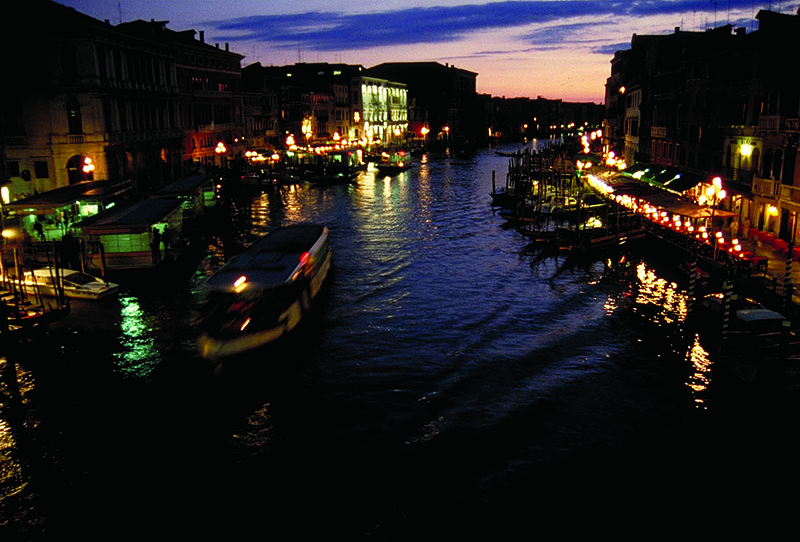
Ponte di Rialto
RELATED POSTS
Prague downtown
Prague downtown
Prague downtown
Prague downtown
Prague downtown
Prague downtown
Prague downtown
Prague downtown
Prague downtown
Prague downtown
YOU MIGHT ALSO LIKE
YOKOHAMA CHINATOWN 2011
The largest Chinatown in Japan has become an established feature of the Yokohama downtown area, but still an area with its own culture and identity. We surveyed Yokohama to discover the Chinese style of lighting environment alive within Japan. At night, there are many hanging lanterns with soft glowing light. This “Light with a Shape” or, through colorful shades, “Light with Color” is a staple of Chinatown and helps to create excitement and a sense of elation. Along the main street there is no specific street lighting, but shop lighting and luminous signage create a natural ambiance along the street. Most structures have columns painted red and use warm tone lighting, but the facade design and signage is all different. This unification of the streetscape through color temperature creates a balance and lasting impression of Chinatown.
City Night Survey : Tashkent, Uzbekistan
2025.11.09-11.14 Jiang Kunzhi + Lin Huangyi This survey aims to explore the interaction between Soviet culture and Islamic culture within the urban space of western Tashkent, with a particular focus on whether this cultural layering has given rise to region-specific lighting approaches and expressions of the luminous environment. Therefore, a systematic field survey and documentation were carried out across the urban areas of Tashkent. As the capital of Uzbekistan, Tashkent reflects both Soviet modernism and Islamic architectural traditions. The city features large Soviet-era public buildings alongside religious architecture that blends tradition and modernity. In addition to above-ground buildings, this survey also examined the Tashkent Metro, Central Asia’s first metro system opened in 1977, where refined lighting and rich materials create museum-like underground spaces. (Jiang Kunzhi) ■Aerial night view of Tashkent Viewed from the TV Tower, Tashkent’s nightscape appears as a network of “lines” and “points” rather than a continuous illuminated façade. The road system forms the clearest visual structure: main roads and ring roads read as linear light bands, while bridges and major intersections appear as brighter nodes, creating a legible traffic framework over the city’s flat skyline. These linear elements strongly define the city’s sense of direction and scale. In contrast, most buildings remain dark at night, with their presence defined only by entrance lighting, limited window glow, and reflected ambient light. As a result, the overall background luminance stays low, allowing a few landmarks—such as tall structures or media…
The Singapore Pavilion at 17th International Architecture Exhibition La Biennale di Venezia
2021.05.22-2021.11.21 Reiko Kasai, Mayumi Banno, Sun Young Hwang, Sherri Goh, Shosaku Takahashi ©gardestudio Pre-opening set-up In late November 2019, we were invited by the National University of Singapore (NUS ) Department of Architecture curatorial team to submit a proposal for the Singapore Pavilion under the theme To-Gather: The Architecture of Relationships. Our pitch was shortlisted amongst 16 other participating architects and designers. We began work at the start of January 2020 to design and fabricate the installation scheduled to exhibit in Venice from 23rd May to 29th November 2020. The brief was to question how our work responds to the dialogue of: how will we live together? Our Response In Singapore, terms such as “light pollution” and “loud lights” are now used to describe the lit environment in Singapore. There is a pressing need to re-evaluate and balance the current situation with our needs and wants. Do we need to examine if such an increase in light actually provides us with more pleasant nights? Designing the installation The format conceptualized by the curators was of the iconic Singapore hawker center. Hawker centers are integral to the Singaporean way of life pertaining to everyday dining. All participants are assigned a table with stools arranged around it, mimicking a typical layout in hawker centres. We updated the lengthy lighting chronology exhibited at Lighting Planners Associates…
Newsletter vol.94
Date of Issue:February 7, 2019 ・Activity 1/City Night Survey:Rio de Janeiro/ (2018/10/13-10/23) ・Activity 2/TNT Forum 2018 in Santiago(2018/10/17-10/18) City Night Survey:Rio de Janeiro/ Santiago 2018/10/13-23 Mikine Yamamoto + Kouki Iwanaga This was our first South American survey in about 15 years. We tracked the light expression of Rio de Janeiro, a port city marked by both entertainment and poverty, which hosted the FIFA World Cup in 2014 and the Olympics in 2016 and has become increasingly international. While possessing famous coasts like Copacabana and Ipanema and being counted as one of the world’s three most beautiful harbors, it also has the “favela” slums covering its hillsides. Surrounded by magnificent nature, Santiago, Chile’s largest city, has annual rainfall of only about 360mm, meaning it is sunny for most of the year. We investigated the lighting situation of this city blessed with natural light. The nightscape from Pão de Açúcar: A beautiful contrast created by the rich topography Viewing Copacabana Beach from Pão de Açúcar Favelas built on the mountain slopes ■Rio de Janeiro / Brazil Rio de Janeiro is an international tourist city that hosted the Carnival and the Olympics in 2016. It is said to be a microcosm of the country, where light and darkness coexist: scenic areas with beautiful topography blending nature and culture are situated next to slums. We surveyed the light expressions of this city, which has various faces, including the glamorous light of tourist and resort…
City Night Survey : Azabudai Hills~Toranomon Hills
Observe the nightscape of the newest spot, Azabudai Hills~Toranomon Hills2024.0 5.10 Shinichi Sakaguchi + Amane Kotani+ Naoko Oguchi+ Yuko Nakayama Eight months have passed since the last city night survey in September last year. The first city night survey in a while took place in Azabudai Hills and Toranomon Hills Station Tower, two of the hottest areas in this year. A large group of 43 people enjoyed walking around this newest spots. A walking tour of two new hot spots in Tokyo, Azabudai Hills and Toranomon Hills Station Tower.Due to the abundance of sights, most groups focused on Azabudai Hills, and ended up speed-walking through Toranomon Hills Station Tower as time ran out. ■ Group 1 Group1 focused on Azabudai Hills. At the entrance to the Garden Plaza, the first building in Azabudai Hills, the unanimous hero of the survey was the lighting embedded only in the automatic doors as a “modest welcome mat”. Conventionally, downlights on the ceiling surface would be used to illuminate the entrance, but integrating them with the doors keeps the doors out of the shadows and makes for a more beautiful entrance. By using this method, there is no need to worry about interference from guide lights, etc., and the floor can be well illuminated. Once you pass through the garden plaza and step outside, the lighting in the landscape is much more subdued, and you are drawn to the lighting of the stores. What…