2018/09/30-10/08 Shosaku Takahashi + Masafumi Yamamoto
Morocco is located on the African continent but retains a strong influence from European countries such as neighboring Spain and France. It can be said that the cities have been formed under the influence of various cultures. This survey started in the major city of Marrakech, crossed the Atlas Mountains to visit the vast Sahara Desert inland, and then continued for ten hours and another 600 kilometers across the continent to reach the blue city of Chefchaouen. We experienced the climate, culture, and lifestyle of this country, which shines on the shores of the Mediterranean Sea while benefiting from the sun, and investigated the relationship between lighting and people’s lives.
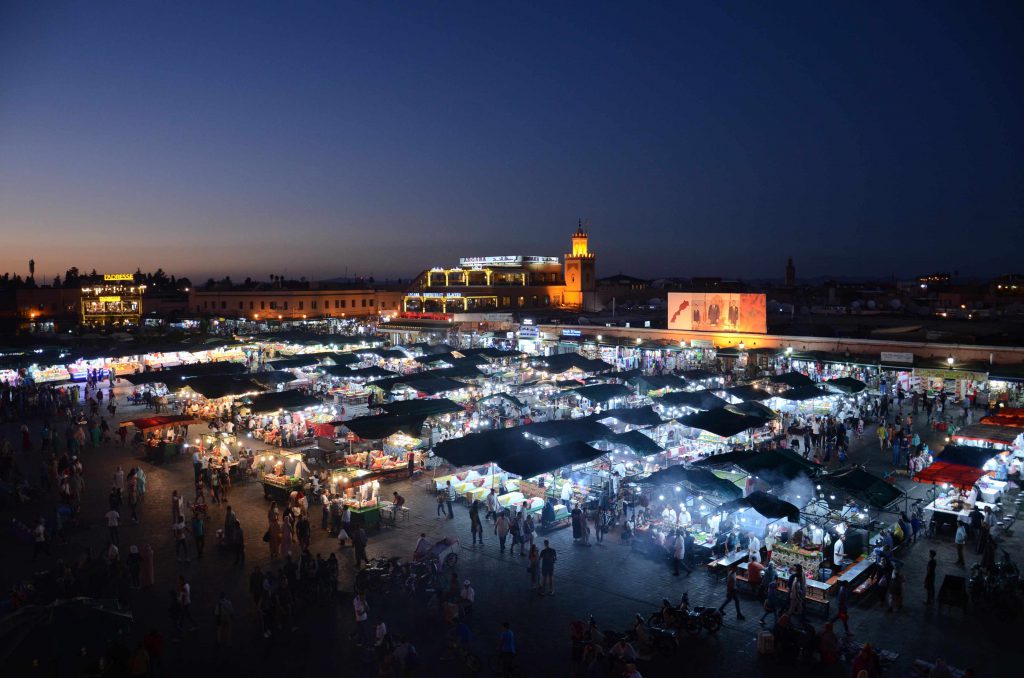 Djemaa el-Fna Square
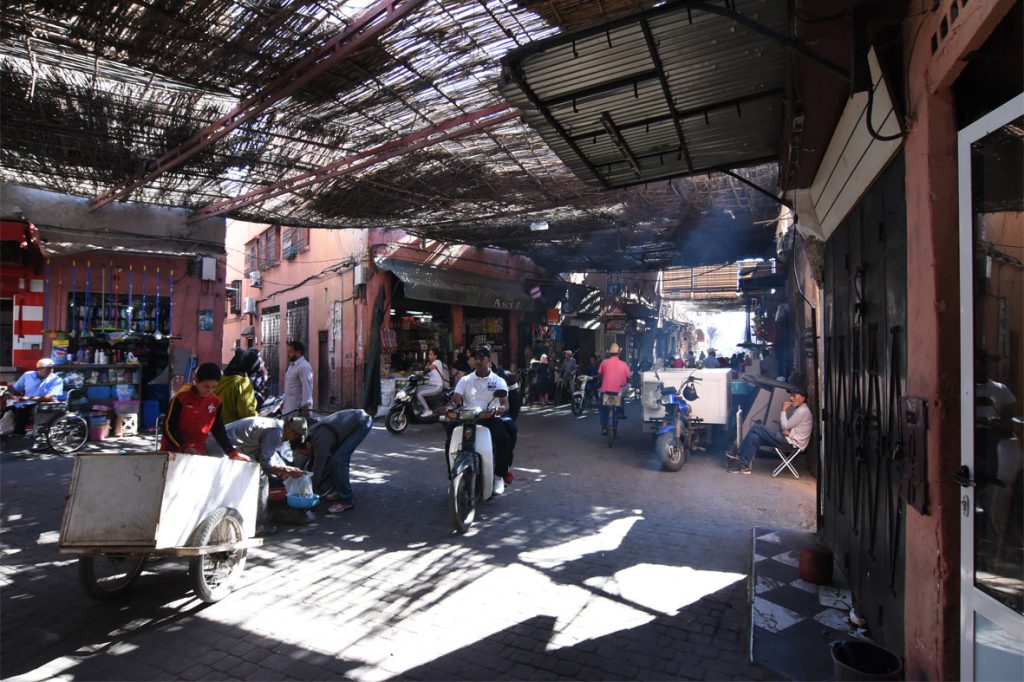 Many of the Old Town’s paths are covered with sunscreens
 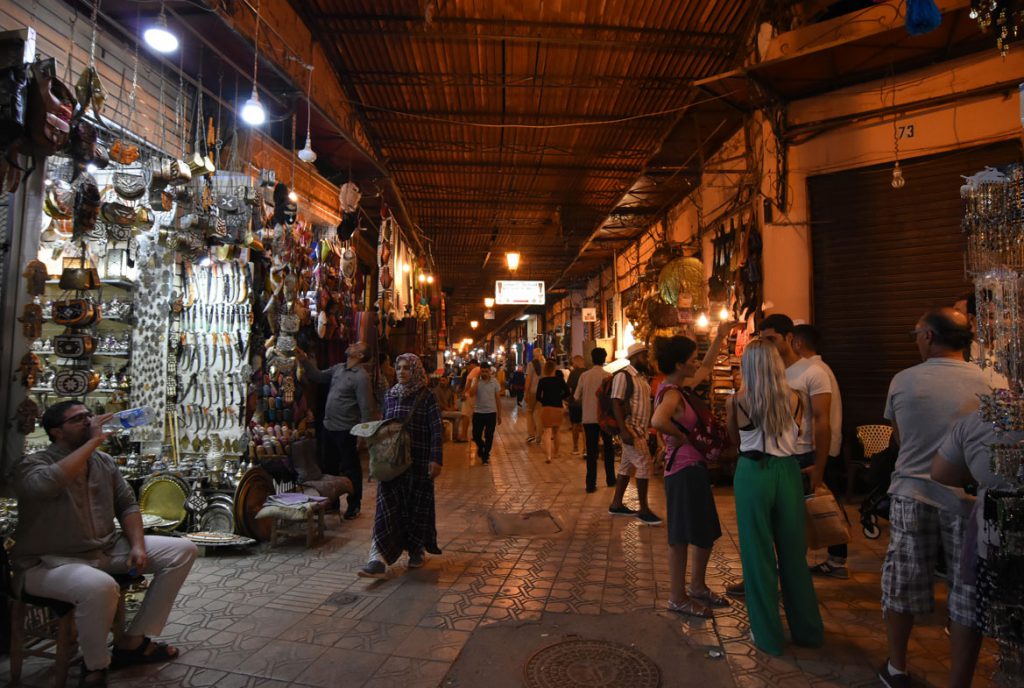 The souk is bustling with people at night
 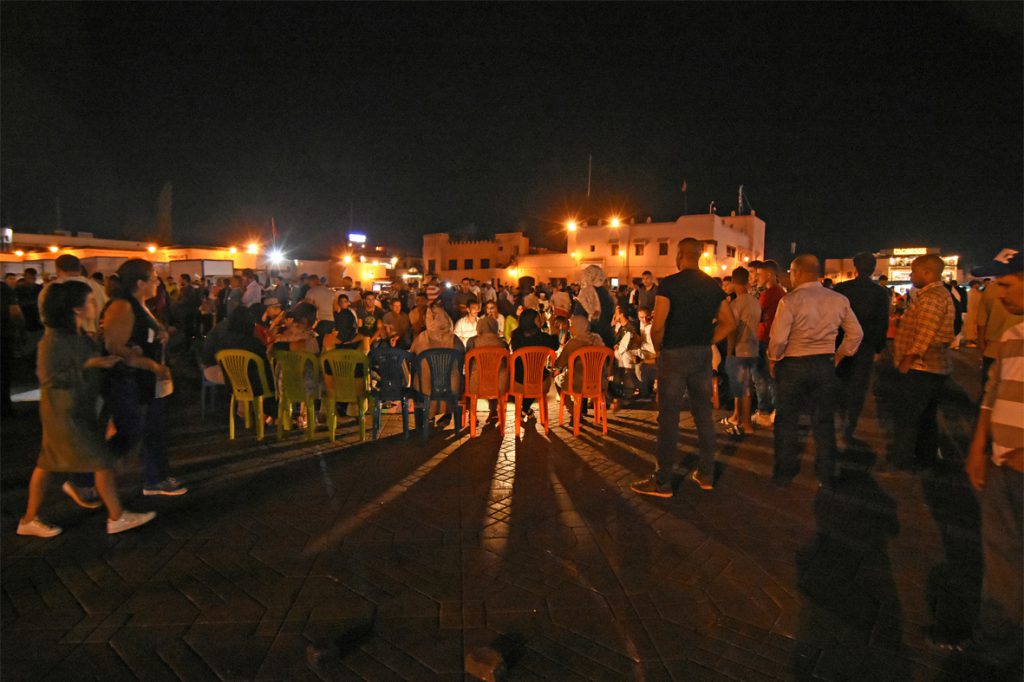 People watching street performers
■Arrival in Marrakech
After driving four hours from Casablanca Airport, we saw the reddish-clay streetscape of the major city of Marrakech pop up in the middle of the wilderness. The moment we got out of the car in the old town, swarms of flies started hitting our bodies. The smell of rotting fruit and raw fish stung our noses. Crowds of people moved through the narrow alleyways, as motorcycles sped past, honking their horns. The air was thick with dust and exhaust fumes. Flies immediately swarmed the tuna sandwich we bought from a nearby stand for a late lunch.
■Old Town Streetscape and the Souk
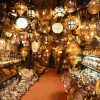
The old town, or Medina, is densely packed with two- or three-story buildings. A maze of winding paths continues, and you quickly lose your sense of direction as you walk. Cloth or boards are hung between the buildings to block the intense sunlight, and people are chatting underneath on the small paths. Eventually, the residential atmosphere disappears, and you emerge into the Souk (market), where shops selling miscellaneous goods line the streets. Various specialized shops for ironware, casting, pottery, leather, and clothing line the alleys. Goods spill out onto the paths. These items are adorned with intricate and beautiful patterns, showing signs of careful handiwork. In the brass craftsmen’s souk, lampshades are lined up densely in the narrow shops, covering even the ceiling. The light from countless incandescent bulbs shone through the brass.
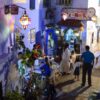
The old town at night presented a desolate scene, with white LED fixtures attached to the exterior walls of the buildings illuminating the street surface. However, the sight of people chatting next to the light of a lampshade beside a doorway was very impressive. The lighting in these places, which serve as gathering spots for people, must surely embody the warm spirit of the Moroccan people.
■The Night at Djemaa el-Fna Square
The square’s bustle only increases as the sun sets. The noise and unique smells are dizzying. Flutes and drums play melodies rich with exotic charm. Street performers display their acts under small lights, drawing large crowds. Smoke billows up from the food stalls, which are randomly illuminated by exposed incandescent and white light bulbs. The mixture of various lights seems to add further color to the energy of the people gathered there. The square is filled with dazzling light; you could call it an oasis of light that has magically opened up in the middle of the large city of Marrakech.
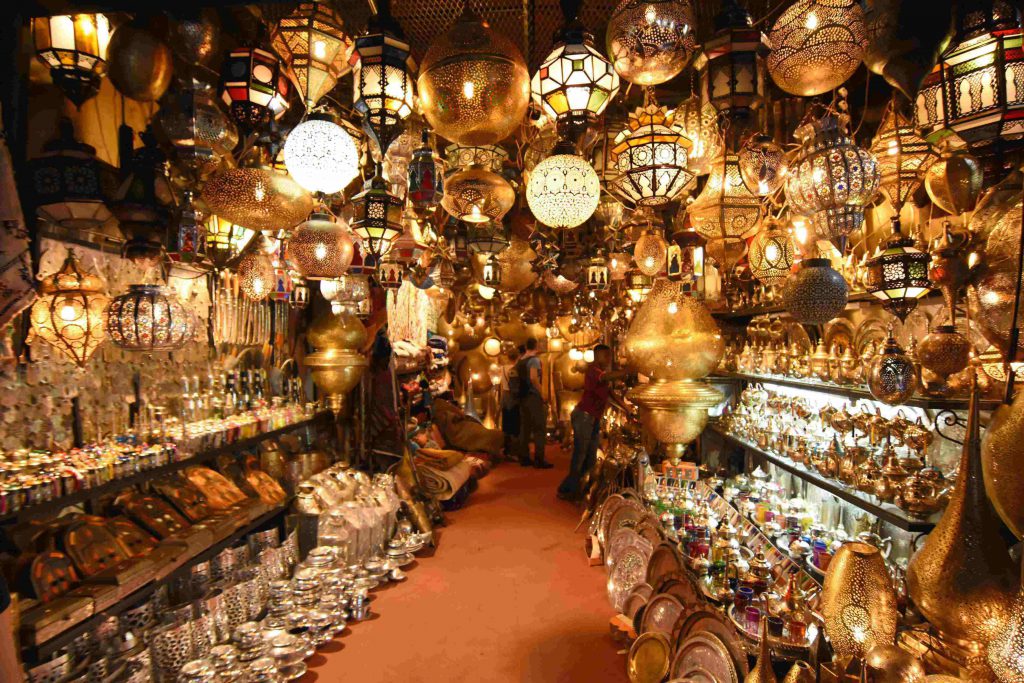
The brass craftsmen’s souk is packed with lampshades
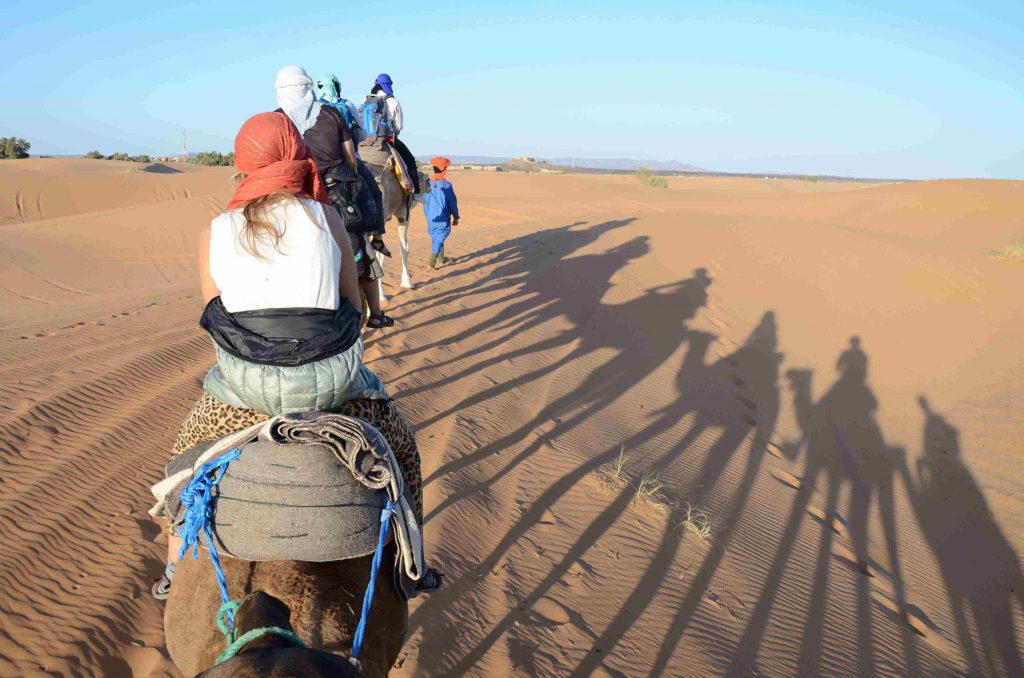 Traveling by camel from a nearby town to the desert
 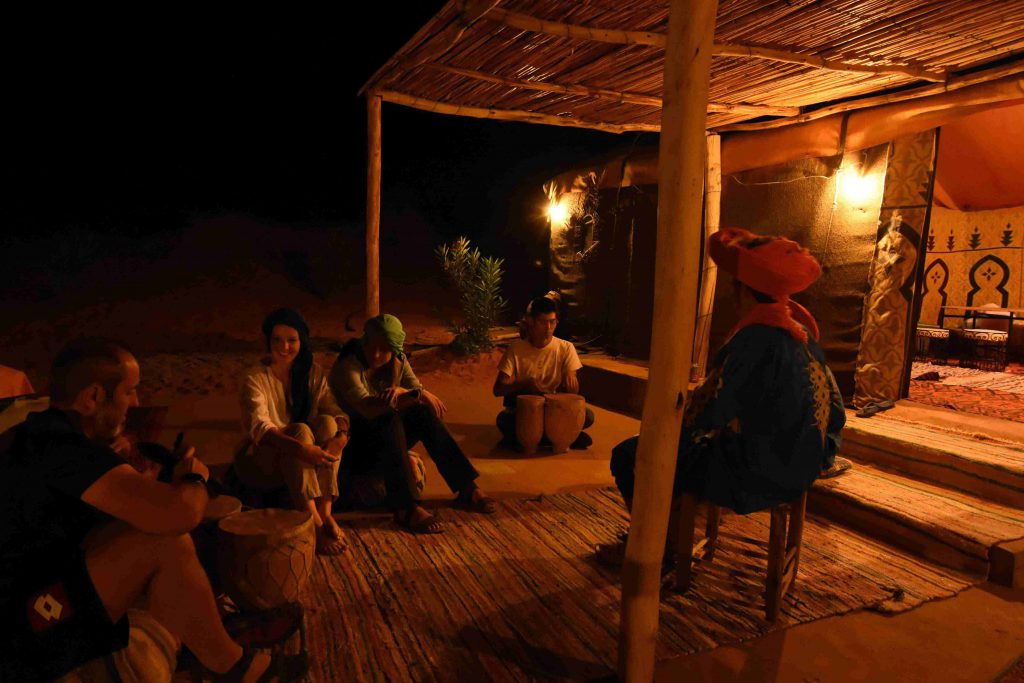 Chatting while listening to traditional Berber music after dinner
 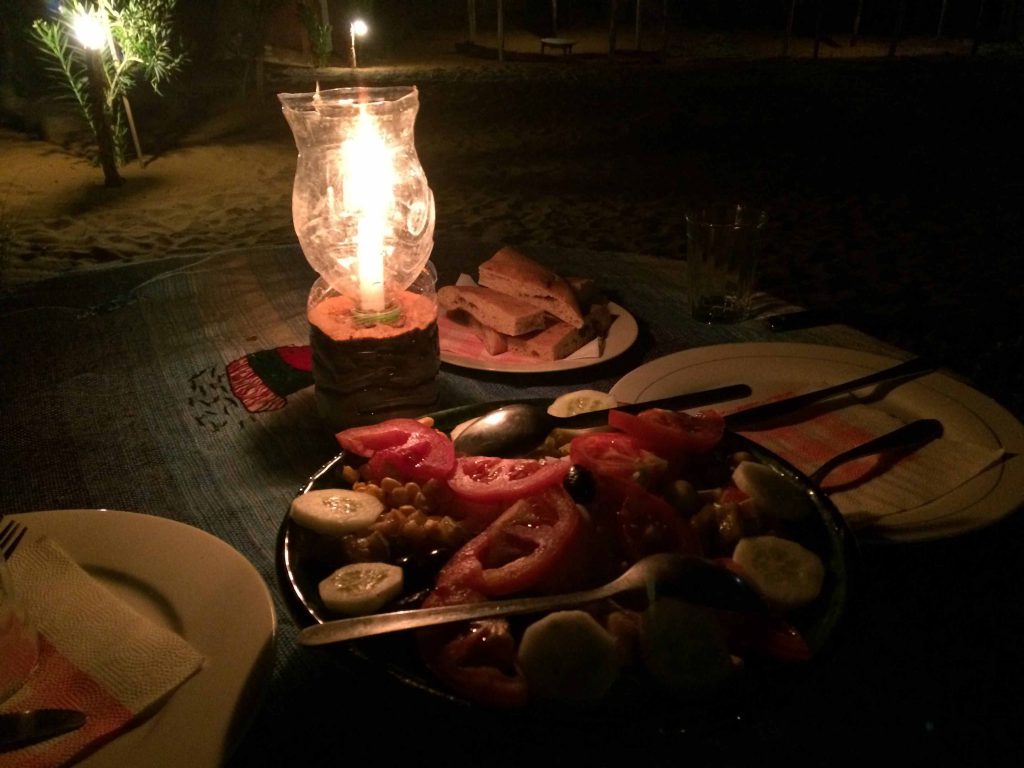 The light of a candle flickering next to a tagine
■Heading for the Sahara Desert
We left Marrakech at 7:30 a.m., just as the sun began to rise. We sped along unpaved mountain roads. Our destination was far beyond the Atlas Mountains, which reach 2,000 meters in elevation. We drove out of the city and through date palm groves. As we continued, the scenery became monotonous. A chain of mountain peaks could be seen in the distance, beyond the vast, rocky desert. Our car sped up to make it in time for the sunset. About 10 hours after our departure, the desert finally came into view. The sun was starting to set in the western sky. We got out of the car after driving over one large dune.
■Sunset
the desert, only the occasional faint sound of the wind could be heard. We rode camels further inland, and the surroundings gradually grew darker. After climbing a large sand dune, we started to see city lights far in the distance. When we sat down at the top, a sky full of stars so close we could almost touch them spread above us. The stars scattered across the hemispherical night sky slowly twinkled. Because the stars were so distinct, the night sky felt closer than usual.
The night sky we saw on the first night in Marrakech was no different from that of Tokyo. However, the desert night sky, far from artificial light, was vastly different—it was nature in its purest form. A sky full of stars has been erased by the lights of our daily lives, transforming it into a scene of special value. Even as we live in cities that never stop developing, we can try to keep the original appearance of nature in our hearts. This kind of small effort, for instance, might lead to the desire to conserve electricity, which could be the starting point for changing the urban nightscape.
■Desert Candle Night
One light source in the desert truly stayed with me: the impromptu candle holder placed on our table by a local person during dinner. It was made by cutting a plastic bottle in half, filling one side with desert sand, and inserting the drinking end of the other half into the sand to hold a candle.
Though simple, it was functionally beautiful, using only travel essentials to shield the flame from the wind and secure the candle and shade with sand. The warm light from the candle was preserved perfectly, beautifully illuminating our tagine (Moroccan stew).
■Sunrise
The next morning, the desert was thoroughly chilled. We left the tent while the stars were still out and climbed the sand dunes again. Before sunrise, the sand had a subtle, damp texture with faint shadows. Eventually, the sun appeared from beyond the dune peaks. The contrast of the sand’s undulations gradually sharpened. Even the wave-like patterns on the sand’s surface, created by the wind, became distinctly visible.
In our daily lives, we are sometimes moved by the constantly changing appearance of the morning sun as it enters the bedroom. However, in the desert, far from life’s hustle and bustle, we were reminded that a delicate passage of time exists even within the sun’s trajectory of just a few minutes. There is drama in unassuming things. The desert taught me many things I had overlooked in the rush of daily life. (Masafumi Yamamoto)
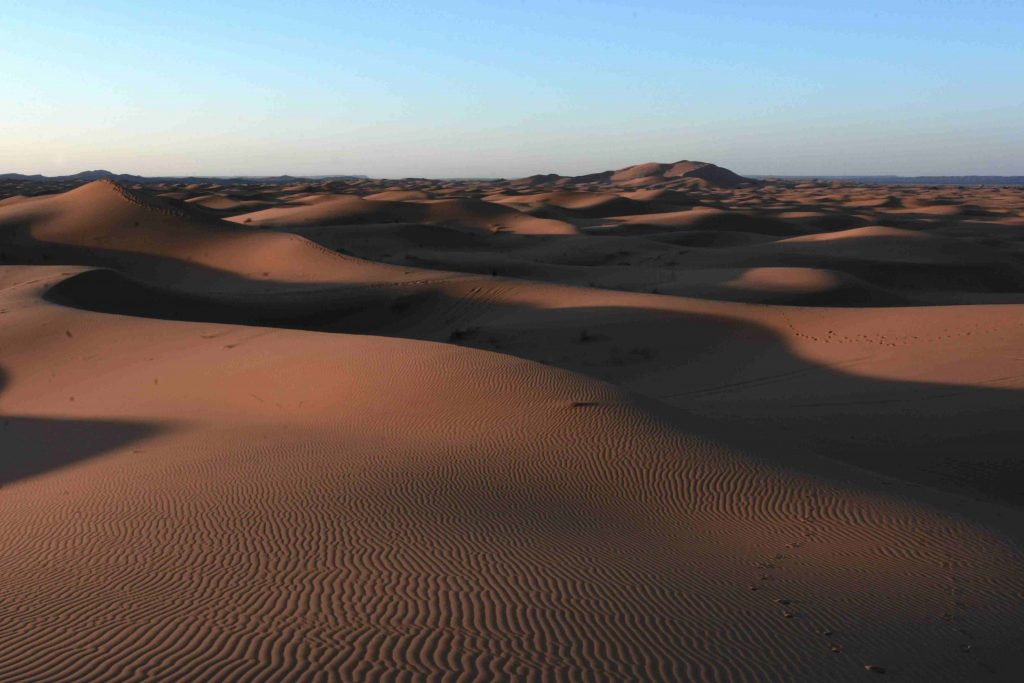 As the sun rises, the sand’s undulations begin to show strong contrast
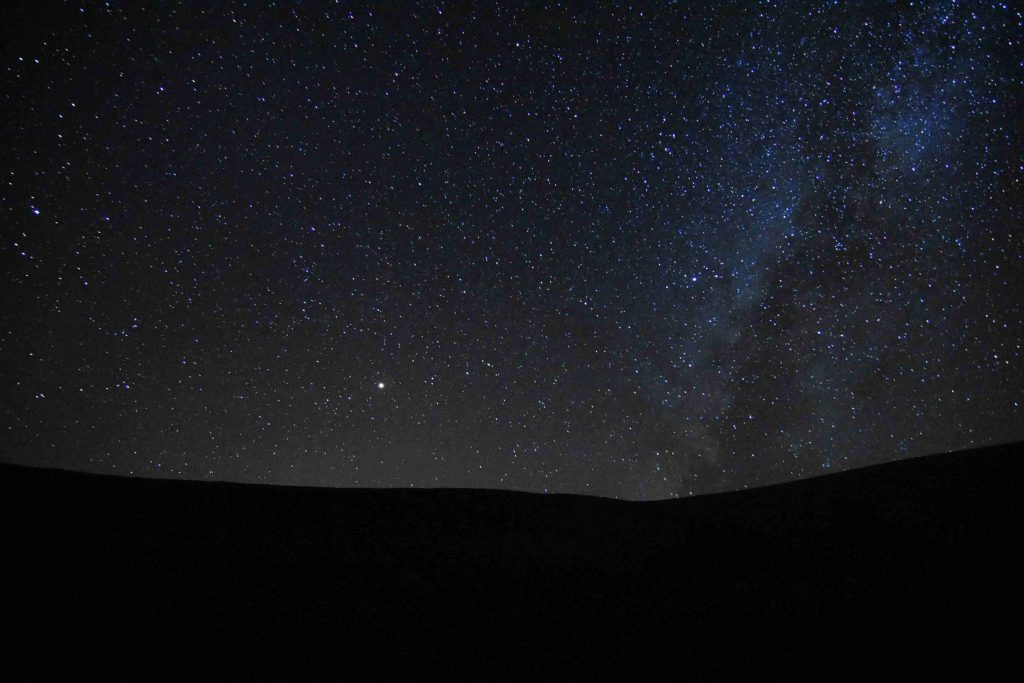 Starry sky pouring down overhead
■Chefchaouen, the Blue City
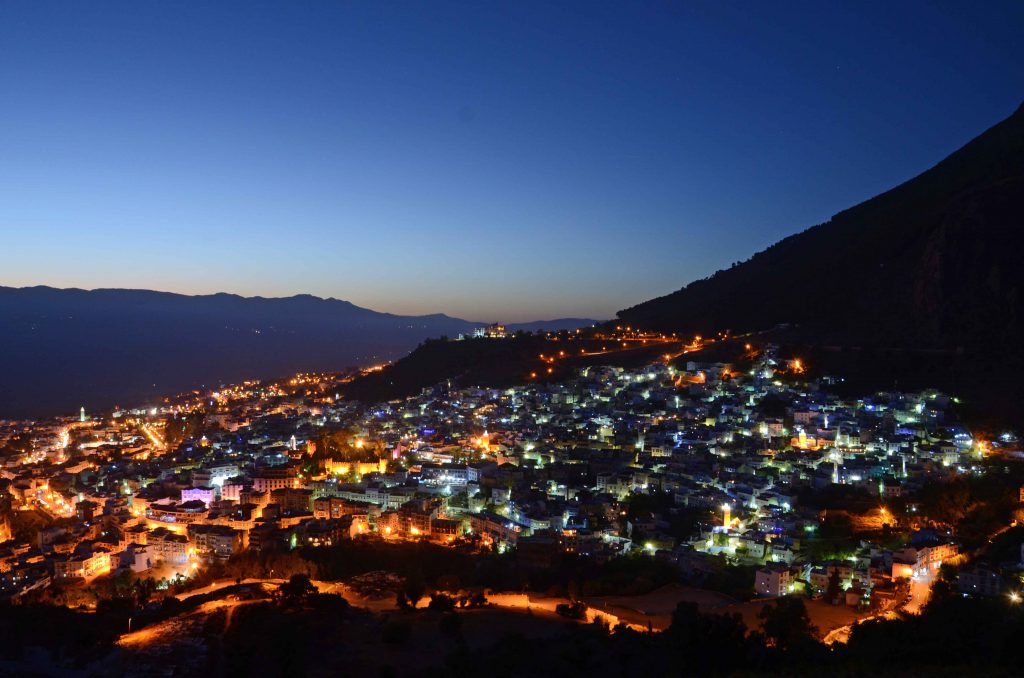
A view of Chefchaouen from the hill, where it is clear that most of the lighting in the city center is white
Chefchaouen is one of Morocco’s most iconic tourist destinations. This town, built on a hill, is famous for having all its exterior walls painted in shades of blue and light blue. The landscape, with primary-colored vases and fabrics scattered against the blue walls, makes you feel as though you’ve wandered into a fairy tale.
In the city center, there is almost no orange light from sodium lamps; instead, pale-blue fluorescent or LED lights are used. Since sodium lamps are used for the mosque light-up and the plaza in front of the mosque, it appears that a distinction is made in color temperature, using white light within the blue town. Illuminated by pale light against the blue walls, the town at night has a somewhat chilly atmosphere, transforming completely from its cute daytime charm. The paths are lit with minimal brightness, falling below 1 lux in the darker areas. With many shops closed after sunset and few people around, the city left the impression of being lonely and unsafe at night.
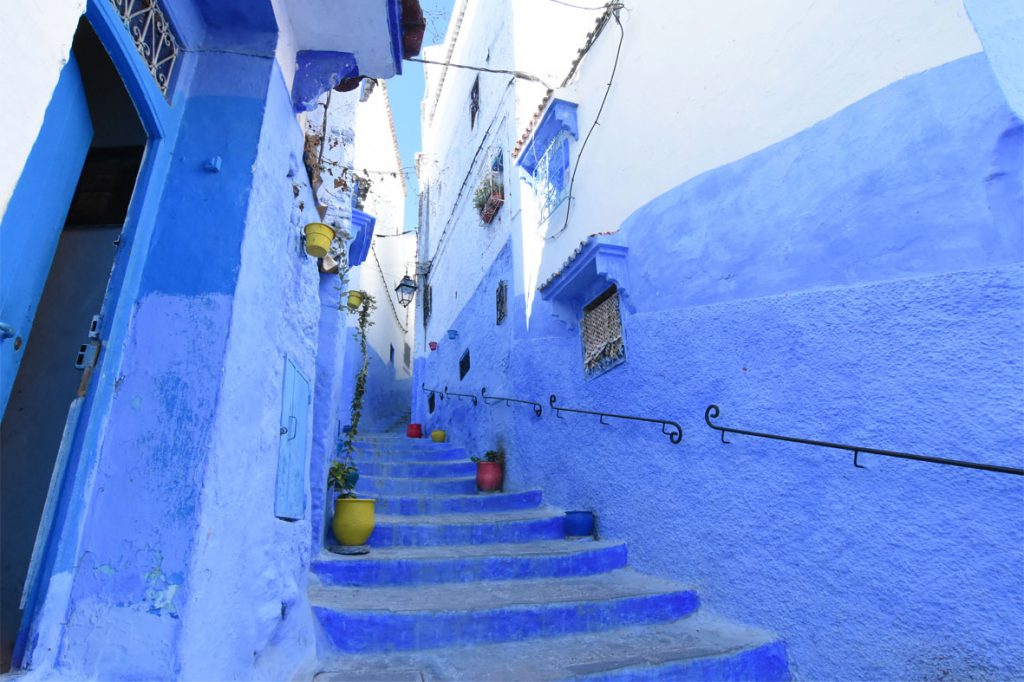 A path with both the walls and the floor painted blue
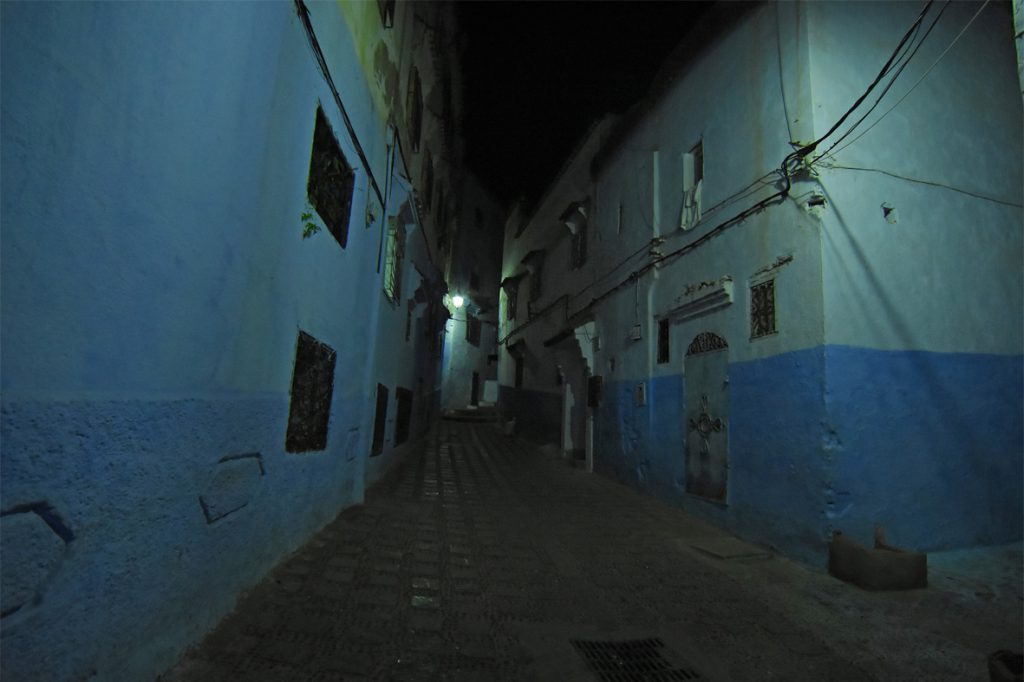 A chilly atmosphere pervades at night
■Casablanca, the Economic City
 The Hassan II Mosque in Casablanca, the largest in the country, with a vast plaza stretching out in front of it
Casablanca, the commercial and financial center of Morocco with an international airport, gives a more modern impression than any other city we visited in the country. Along the coast, new construction of condominiums, offices, and commercial facilities is underway, showing that development is actively progressing. Every city we visited had an old and a new town, but the difference was most noticeable in Casablanca. In the new town, we saw large stores with neon signs, people enjoying street performances, and crowds chatting on brightly lit terrace seats under fluorescent lights.
In stark contrast, the adjacent old town was dimly lit only by sodium lamps, where everyday goods and groceries were sold on the roadside amid scattered trash. It was surprising to see such different worlds existing just a few minutes’ walk apart. I was struck by how all the various products were dyed a single shade of orange under the poorly color-rendered light, but perhaps this is a trivial matter for the easygoing Moroccan people. Throughout the city, the lighting primarily consisted of sodium lamps (around 2100K) used for streetlights, and compact fluorescent or LED bulbs (5000–6000K) used in shops. Therefore, we often saw a scene where streets bathed in orange light were lined with shops emitting stark white light. The white light felt somewhat unbalanced and bland against the old streetscape of the old town. However, these hanging bulb-shaped fixtures not only illuminated the goods but also the surrounding area, seeming to fulfill the function of lighting for safety and nighttime vibrancy.
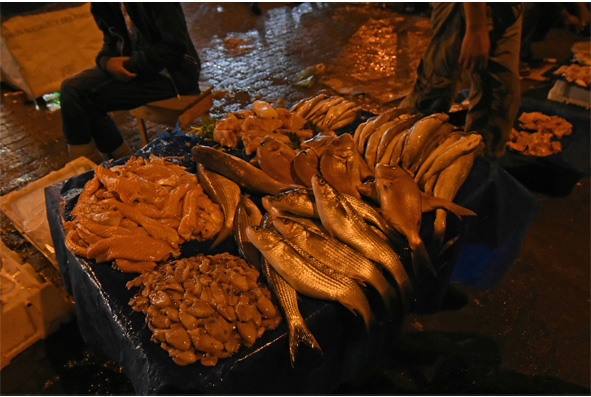 Fresh fish whose original color cannot be distinguished
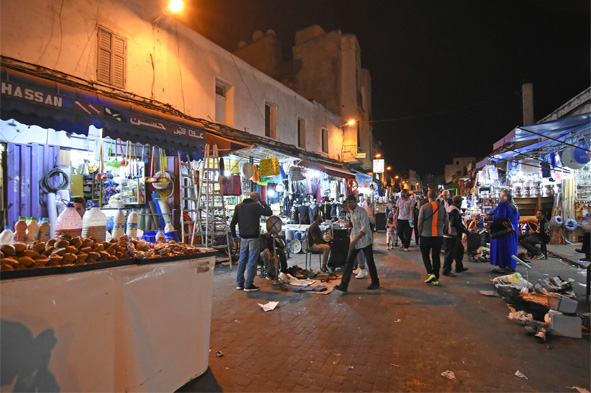 The Souk (market) in Casablanca
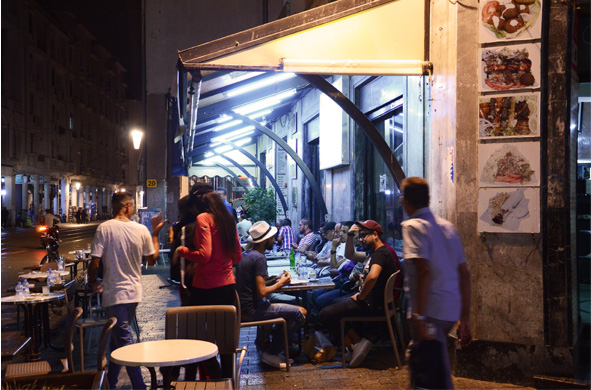 People chatting at the terrace seating
■Summary
With its beautiful Islamic architecture, unique sounds, and unforgettable scents, it’s clear why so many travelers are captivated by Morocco. The inevitable ingenuity developed for living under the intense sunlight has taken root in the Moroccan land as culture, creating a variety of natural light scenes. The nightscape has a completely different character between the new and old towns, and this chaotic environment can be seen as part of Morocco’s rich, exotic charm. With many areas designated as cultural heritage sites, we hope that the lighting environment will continue to develop by embracing both the new and the old, while preserving the best aspects of the old town. (Shosaku Takahashi)