Date of Issue:23 July, 2019
・Activity 1 / City Night Survey : Saitama-Shintoshin (2019/04/11)
・Activity 2 / TNT Forum 2019 in Shenzhen(2019/05/17~2019/05/19)
City Night Survey : Saitama-Shintoshin
2019.04.11 Lin Hu + Hikaru Kimura
Saitama Shintoshin is a district established around the year 2000. Centered on JR Saitama-Shintoshin Station, it is an intensively structured urban area featuring a variety of functions, including large-scale commercial facilities, a major multi-purpose arena, government office complexes, and hospitals. This survey examined how this planned city has evolved from the perspective of lighting.

Nightscape over the heliport from the Saitama Government Office Complex
Light Linking Spaces
A pedestrian walkway system is installed around Saitama-Shintoshin Station, utilizing an active pedestrian-vehicle separation plan that allows for smooth circulation from the second-floor station gates to various facilities. While the ground level is brightly illuminated by roadway pole lights, the pedestrian walkways feature lower-level lighting such as uplights and footlights—excluding some decorative pole lights in park areas—creating distinct expressions of light for each zone.
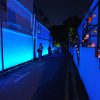
Saitama-Shintoshin Station is connected to Kita-Yono Station by a walkway spanning approximately 600m. A continuous cantilevered glass canopy allows pedestrians to walk without getting wet in the rain or being stopped by traffic signals. Along this route, there is a straight path of about 100m running parallel to the railway tracks. Here, despite the cantilevered canopy structures being identical—likely due to differing construction phases—the lighting techniques varied across three distinct types. Although the architectural design is similar, the change in lighting methods results in varying levels of brightness depending on the location. While achieving uniformity may seem important, using different lighting techniques for similar designs along a long, linear path can be interpreted as a deliberate effort to avoid monotony. Specifically, it may serve to: (1) provide a sense of distance, (2) prevent visual fatigue during the walk, and (3) act as a visual reference for specific locations.

Connecting walkway between Keyaki Hiroba and Kita-Yono Station (Near Kita-Yono Station)

Connecting walkway between Keyaki Hiroba and Kita-Yono Station (Near the plaza)

Connecting walkway around Saitama Red Cross Hospital


Expanding City and Sense of Unity
In 2017, the Saitama Red Cross Hospital—a large-scale facility providing advanced medical care—was constructed. This development led to the expansion of the pedestrian walkways, where a canopy was installed to match other areas. Unlike the cantilevered glass ceilings found elsewhere, the canopy in this newly developed zone features a metal panel ceiling supported by columns on both sides. The lighting scheme consists of downlights, which make the area under the canopy so bright that the surrounding environment feels dark by comparison. Since there is no need to walk directly under the canopy except on rainy days, it felt as though a better balance of light is needed to allow for a more comfortable and free movement across the wide pedestrian walkway.

A wide, bright walkway with over 1 lx of illuminance even in the center due to ambient light

The vibrant commercial facilities on the east side, viewed from the Government Office Compl
Darkness and Safety
The area surrounding Saitama-Shintoshin Station functions as a major urban hub. However, we received the impression that daily maintenance of the lighting fixtures is not thoroughly managed. Particularly in the zone where administrative institutions like government office complexes and post offices are concentrated, there were many non-functioning fixtures—whether intentionally turned off or simply due to blown-out lamps—resulting in considerable darkness. The high contrast made facial recognition difficult, raising concerns regarding safety. On the other hand, in open plazas surrounded by high-rise buildings, the spill light from office windows provided just enough brightness to walk safely. While likely not a planned lighting effect, it felt akin to a form of “urban moonlight.”
Lighting Disparities by Area
The area to the east of Saitama-Shintoshin Station is a bustling commercial hub. As a relatively new development expanded between 2004 and 2015, almost all lighting has been upgraded to LED and is meticulously maintained.
In contrast, the west side—the focus of this survey—primarily serves a steady flow of commuters and has a much less commercial atmosphere. Likely due to this lower commercial priority, many original fixtures are unlit and have not yet been converted to LED. Furthermore, there are several disappointing instances where broken original lights have been replaced by glaring security lamps with mismatched color temperatures, creating a disjointed nighttime environment.
Lighting as a “New Urban Center”
Approximately twenty years have passed since the completion of Saitama-Shintoshin Station, and it seems the lighting environment has reached a point where change is inevitable. While government institutions may face a difficult position regarding public spending scrutiny, we hope that a district bearing the name “New Urban Center” (Shintoshin) will evolve into a city that leads the way in continuity, innovation, and new ways of experiencing the night. (Lin Hu, Hikaru Kimura)

A high-contrast walkway where all lights except for spill light are turned off

The concourse of Saitama-Shintoshin Station has been upgraded to LED
Transnational Lighting Detectives Forum 2019 in Shenzhen
2019.05.17 ~ 2019.05.19
Atsushi Itakura + Mayumi Banno + Bran Yan + Yu Ye + Simeng Huang + Noriko Higashi
The Transnational Lighting Detectives Forum celebrated its 15th anniversary this year. Held over three days from May 17th to 19th in the rapidly developing city of Shenzhen, China, the forum was themed around “Shenzhen Nightscape 2030.”

Shenzhen, China, is at the forefront of IT and drone development. Its history is brief—having evolved from a fishing village into one of the world’s leading cities in just 30 years—and it continues to attract global attention. In this city where many possibilities swirl, 11 core members of the Lighting Detectives scattered around the world also gathered, mainly with Chinese university students, and held a forum to think about the Shenzhen Nightscape of 2030.

Introducing the core members of the Lighting Detectives
Day 1: Orientation & City Walk
All participants gathered to receive briefings on Shenzhen’s lighting plans and city-walking methodologies. Following this, the 90 participants—primarily students—were divided into six groups. Each group conducted self-introductions and discussed the characteristics and expected conditions of their assigned survey areas.
Initially, participants were somewhat stiff due to communicating in English, which they were not accustomed to. However, perhaps driven by a desire to absorb as much as possible from the core members of the Lighting Detectives, they became more active as time passed, serving as an excellent icebreaker. After the orientation, each team set out for their respective city walks, covering six distinct and characteristic areas of Shenzhen.


Team A:Shennan Road
The first developed area in Shenzhen
Team A was responsible for the area known as the “Birthplace of Shenzhen,” which includes the city’s second and third tallest skyscrapers. The group of buildings, brightly illuminated by media facades and RGB floodlights, overwhelmed the architectural characteristics, making them villains.
In the plaza in front of the theater, crowds of citizens were bustling about, enjoying activities such as chatting, dancing, badminton, and exercising. However, it was disappointing that the only lighting for the plaza came from ambient light reflected from the surrounding facades.
As the “Hero” of Group A, facade lighting was selected that effectively used both warm white and daylight colors to enhance the architectural features. (Mayumi Banno)
Team B:Huaqiang Area – Electronics District
Team B walked through an area that once flourished as Shenzhen’s premier electronics district but has now been transformed into a series of nondescript shopping malls. While few traces of its history as an electronics hub remained and the area lacked a distinct character, many members noted that the 950m-long, 55m-wide pedestrian walkway holds significant potential. With improvements, it could become a space where people can relax at night without worrying about vehicle traffic. The group reached a consensus that the entire area has the potential to become a Hero, as even slight enhancements could transform it into an incredibly comfortable space.
Listed as Villains were the unplanned and inexhaustible signage and facade lighting, as well as the poorly maintained linear lighting under the benches. Many other suggestions were also raised to help this district reclaim its status as Shenzhen’s most cutting-edge area. (Noriko Higashi)
Team C:CBD Area – Government District
Team C began their city walk by observing a magnificent light show taking place in the heart of the CBD area. Large-scale lighting fixtures are installed on the facades of high-rise mixed-use buildings, telling the story of Shenzhen’s development over the past 30 years.
However, the lighting in public spaces lacked sufficient brightness, and the buildings lacked a sense of architectural unity. The team reached a consensus that lighting should be added to the plaza in front of the Museum of Contemporary Art and the Children’s Palace. Members expressed the view that lighting should be something that invites the people who use the space. By adding lighting that connects each building, we felt that the CBD area could be integrated into a single, cohesive community. (Bryan Yan)
Team D:Shenzhen Bay – Bay Area
Team D surveyed the Dasha River Park and the MixC shopping mall area, which are adjacent to the Shenzhen Bay area—the fastest-developing part of the city where futuristic landscapes are emerging.
In the shopping mall area, numerous light art installations were observed, adding color to the otherwise inorganic urban landscape. At Talent Park, facing the Shenzhen Bay waterfront, many experimental lighting techniques were seen, but the overall impression was one of a lack of planning. We discovered lighting that was either too glaring for pedestrians or insufficient for walking safety, as well as methods that resulted in light pollution and wasted energy, suggesting significant room for improvement in terms of lighting design.
In contrast, the Dasha River Park featured a well-planned lighting design that met its intended purpose. It appeared to provide a comfortable and calm space for residents at night. (Atsushi Itakura)
Team E:OCT Area
Located in the center of Shenzhen, the Overseas Chinese Town (OCT) area features lush green streets lined with stylish restaurants and design studios, giving it the atmosphere of an “art village.”
While it is darker at night compared to other parts of Shenzhen, the participants discussed a future vision for lighting that would enhance safety and comfort without destroying this gentle darkness. (Yu Ye)
Team F:Shuiwei Village
An area retaining its historic roots
Within the rapidly modernizing city of Shenzhen, Shuiwei Village preserves the image of a village from 40 years ago and serves as a primary hub for young dreamers arriving from the countryside.
We explored a future vision that protects these disappearing landscapes found nowhere else, organizing the various haphazardly installed lighting elements while allowing residents and visitors to enjoy different light environments tailored to their needs. (Simeng Huang)
Day 2: Team Discussion
Each team gathered to review photos from the previous day’s city walk and discussed what constituted the “Heroes” and “Villains” of light in their respective areas. They analyzed why these elements were categorized as such and worked on defining keywords that captured the essence of their findings.
While discussion styles varied by group, every team engaged in proactive and spirited debate. Rather than simply condemning the “Villains,” the discussions extended to practical methods for improvement. Furthermore, teams brainstormed to develop proposals envisioning the state of their assigned areas for the “Shenzhen Nightscape 2030.”
The results of these discussions were compiled onto two large 3×6 presentation boards to be displayed at the following day’s presentation venue. Every team produced several sketches illustrating their proposals for the Shenzhen Nightscape 2030. The refinement of the presentation content continued late into the night, as everyone was fully immersed in the preparations.

Summarizing ideas during a group discussion

Creating panels for the presentation
Day 3:Presentation & Panel Discussion
The presentation, serving as the culmination of the three-day workshop, was held at the Harbin Institute of Technology. Each team had 15 minutes to explain the current lighting environment of their assigned area and present their proposals for the “Shenzhen Nightscape 2030.” Following each presentation, the core members of that team provided a critique, offering their opinions and impressions of the proposal.
Some teams proposed relaxing nightscapes where starry skies would be visible, while others explored entirely new possibilities using cutting-edge technologies, befitting Shenzhen’s status as a global leader in innovation. Listening to these diverse proposals, participants likely envisioned their own future versions of the Shenzhen nightscape and reflected on how they should approach lighting design in the future. The presentations served as an excellent opportunity to once again think deeply about the nightscape.
During the panel discussion, seven panelists engaged in a debate, sharing their predictions and expectations for the future trajectory of Shenzhen’s pioneering nightscape. Although the time was limited to just three days, the enthusiastic participation of everyone involved made it a fantastic workshop, marking the 15th forum as a significant and successful milestone. (Noriko Higashi)

Core members giving feedback on presentations

Seven panelists participating in a discussion on the Shenzhen Nightscape 2030
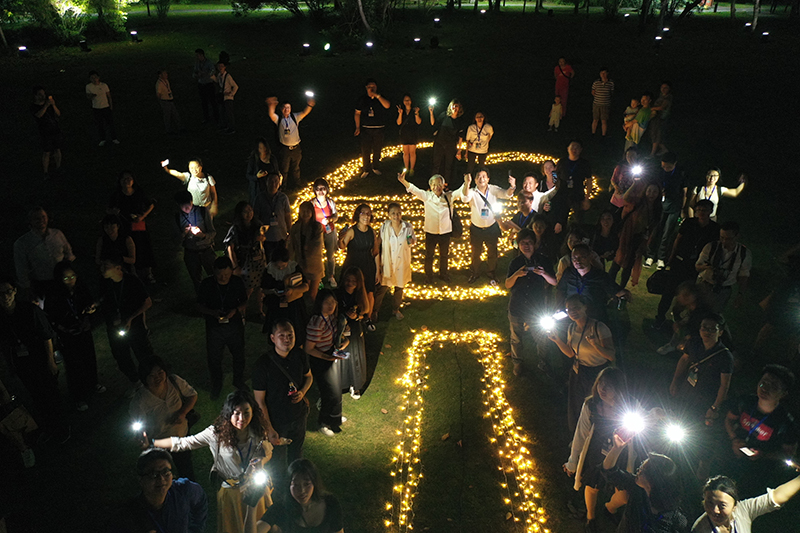
After-party in the campus courtyard following the presentations