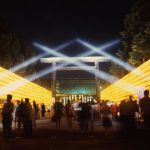
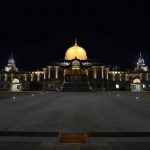
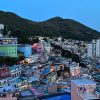
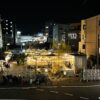
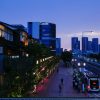
2024.05.16 – 05.19 Mari Kubota+ Noriko Higashi Busan, South Korea’s second-largest city, is one of the world’s major port cities. In recent years, it has also gained fame as a hub for tourism and film. We surveyed the lighting in Busan, which is also a member of LUCI (Lighting Urban Community International). South Korea is a close neighbor, just 1.5 hours from Tokyo by plane, making it a popular destination for quick and affordable trips. Busan, the second-largest city in South Korea, is not only a tourist destination but also a major port and an entertainment center, hosting film festivals. As a member of LUCI, Busan has been focusing on urban lighting as part of its urban planning. In 2015, the city developed an extensive overview of its nightscapes, resulting in the Busan Urban Light Policy for 2030. This policy has been updated several times, reflecting the city’s ongoing efforts in implementation and improvement. The guidelines divide Busan into several zones, each with lighting tailored to its specific characteristics.We traveled to Busan to assess whether the city’s lighting contributes to safety, beauty, attractiveness, and the local economy at night. ■Jagalchi Market Jagalchi Market is South Korea’s largest seafood market, selling both fresh and dried fish. After purchasing seafood on the first floor, visitors can have it cooked and served on the second floor. The market attracts many tourists. White lights are used to illuminate the seafood, making it look as…
2022.10.27 Genki Watanabe+ Chuanyi Liu+ Yuki Ito This Tokyo night walk survey took place in Shimokitazawa, a neighborhood especially popular among young people. Known as one of Tokyo’s most culturally rich districts, the area is filled with vintage clothing shops, eateries, theaters, niche cinemas, and art galleries.The Lighting Detectives previously conducted a survey here in 2009. This time, we examined how the area has changed since the Odakyu Line was relocated underground. We also focused on the newly developed Shimokita Senrogai area, which opened on May 28, 2022, assessing its lighting design and comparing it with the older shopping streets to explore the contrast between new and traditional urban atmospheres. ■Map around Shimokitazawa Station With the Odakyu Line moved underground, a new neighborhood called Shimokita Senrogai was developed between Higashi-Kitazawa Station and Setagaya-Daita Station. Driven by the desire to support the community, redevelopment progressed step-by-step while listening to local residents’ voices. The entire area officially opened on May 28, 2022.Alongside the railway line, new facilities such as daycare centers, a hot spring inn, commercial spaces, student dormitories, and event venues were established. ■Development of Shimokita Senrogai The Shimokita Senrogai area we surveyed is a newly developed space created by moving the Odakyu Line underground. It was designed with the intention of reconnecting the northern and southern parts of the neighborhood that had previously been divided by the railway tracks, resulting in developments that encourage smooth pedestrian circulation throughout. The development features…

2025.06.26 Yumi Honda +Qiaoxi Wang+ Momoe Nomura We observed and recorded the nighttime light environment of the newly developed commercial complex Senkyaku Banrai in the Tokyo Bay Area and its surrounding public spaces (green plaza, station area, and Gururi Park). We conducted a multifaceted analysis, including the placement of lighting fixtures, illuminance, and the impression of the space, to determine how light affects the atmosphere of the facility and the city in the Toyosu area, which is being developed as a tourist hub. The Toyosu area is a point of interest where the latest urban spaces and the lively atmosphere of shitamachi (old downtown) coexist due to redevelopment. We walked through the area around Toyosu Market Station, the green plaza, and Gururi Park, observing how light design impacts the impression, comfort, and safety of the town. ■Senkyaku Banrai Senkyaku Banrai is a commercial facility that opened in 2024 next to the Toyosu Market. It’s a spot where both tourists and local residents can enjoy the array of restaurants and souvenir shops. Through architecture and lighting design incorporating traditional Japanese motifs, it exudes a uniquely Japanese warmth and vitality, even within the contemporary urban nightscape. The lighting plan inside the facility is unified, as befitting a new commercial complex, and was designed with both aesthetic appeal and functionality in mind. The main path lighting uses warm, incandescent colors, creating a nostalgic atmosphere reminiscent of a Showa-era shopping street. This fosters a…
2023.01.20-01.22 Yuichi Anzai+ Chuanyi Liu ■Kozushima Village Kozushima is located about 180 kilometers south of central Tokyo with a population of about 1,800. The terrain is complex, with almost no flat land. The village is located in the center of the island at the foot of Mt. Tenjo. The impetus for the starry sky protection activities on Kozushima came from a comment made during a student internship program by the Tourism Foundation in 2016, that the night sky was as beautiful as a planetarium. The starry sky, a common sight on the island, has become a tourism resource. An island-wide effort to protect the sky began. Specific efforts include replacing streetlights and security lights with fixtures with 0% upward luminous flux and 2,700K color temperature, holding explanatory meetings for residents and regular workshops with experts to gain their understanding and cooperation in light pollution and starry sky protection activities, training islanders as guides, and holding star gazing events to protect the night sky from light pollution and communicate the appeal of the starry sky both on and off the island. The island is also working to protect the night sky from light pollution and convey the charm of the starry sky to the public. The “Light Pollution Prevention Ordinance to Protect the Beautiful Starry Sky of Kozushima Village,” which specifies the responsibilities of residents and businesses to prevent light pollution, will be enacted in 2019, and rules are being developed to…
2023.01.26-01.29 Masafumi Yamamoto + Yuki Ito Okinawa is a place where diverse cultures and histories are intertwined. In Okinawa, each region has its own unique streetscape, and this is due to the fact that each region has a completely different historical background. The following is a simplified explanation of the historical background of each area. The Naha area was severely damaged in the war and was rebuilt; the Koza area was influenced by the U.S. military base and retains a strong American culture; and the Bise and Imadomari areas retain the traditional streets of the Ryukyu Islands. By comparing the light environment of each area, this survey sought to determine what kind of lifestyle culture and light features each area has, and what kind of light is unique to Okinawa. ■Sakae-machi MarketSakae-machi Market, located in Naha City, is a shopping street that was established during the postwar reconstruction period and has remained almost unchanged since then. Today, the market is a lively place where locals gather during the daytime, but at night it transforms into a more local haunt, drinking district that is quite different from the impression it gives during the daytime. The only light at night is from the taverns and the faint fluorescent lights in the upper part of the shopping street. (Floor illumination: approx. 20 lx) The illuminance alone gives the impression of dimness, but the actual atmosphere was not as dark as the impression given by…