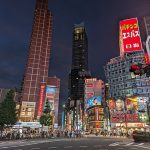
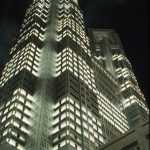
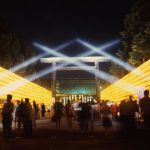
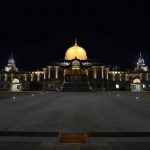
Under a rush of redevelopment, this is a huge period of transition for the area surrounding Shinjuku. On this survey, we were met by soft light filtering out of tall skyscraper windows, brilliant signage on facades and rooftops, and crowds of people along the streets and alleyways. Shinjuku Station South Entrance is in the middle of a redevelopment project scheduled to be complete in 5 years. A multitude of fluorescent lights line the pedestrian walkways with such an intense brightness that the surrounding scene is almost invisible. Six o`clock in the morning and waiting for the sun to come up on Yasukuni Street. Calm is finally starting to settle over Kabukicho, but still brightly lit signage are but glaring reminders of the nightlife. Brilliant advertising and signage along Yasukuni Street acts as an entrance gate to Kabukicyou. The bight lights entice many, who are aimlessly swallowed up by Kabukicho.
2018/09/30-10/08 Shosaku Takahashi + Masafumi Yamamoto Morocco is located on the African continent but retains a strong influence from European countries such as neighboring Spain and France. It can be said that the cities have been formed under the influence of various cultures. This survey started in the major city of Marrakech, crossed the Atlas Mountains to visit the vast Sahara Desert inland, and then continued for ten hours and another 600 kilometers across the continent to reach the blue city of Chefchaouen. We experienced the climate, culture, and lifestyle of this country, which shines on the shores of the Mediterranean Sea while benefiting from the sun, and investigated the relationship between lighting and people’s lives. Djemaa el-Fna Square Many of the Old Town’s paths are covered with sunscreens The souk is bustling with people at night People watching street performers ■Arrival in MarrakechAfter driving four hours from Casablanca Airport, we saw the reddish-clay streetscape of the major city of Marrakech pop up in the middle of the wilderness. The moment we got out of the car in the old town, swarms of flies started hitting our bodies. The smell of rotting fruit and raw fish stung our noses. Crowds of people moved through the narrow alleyways, as motorcycles sped past, honking their horns. The air was thick with dust and exhaust fumes. Flies immediately swarmed the tuna sandwich we bought from a nearby stand for a late lunch. ■Old…
2024.05.16 – 05.19 Mari Kubota+ Noriko Higashi Busan, South Korea’s second-largest city, is one of the world’s major port cities. In recent years, it has also gained fame as a hub for tourism and film. We surveyed the lighting in Busan, which is also a member of LUCI (Lighting Urban Community International). South Korea is a close neighbor, just 1.5 hours from Tokyo by plane, making it a popular destination for quick and affordable trips. Busan, the second-largest city in South Korea, is not only a tourist destination but also a major port and an entertainment center, hosting film festivals. As a member of LUCI, Busan has been focusing on urban lighting as part of its urban planning. In 2015, the city developed an extensive overview of its nightscapes, resulting in the Busan Urban Light Policy for 2030. This policy has been updated several times, reflecting the city’s ongoing efforts in implementation and improvement. The guidelines divide Busan into several zones, each with lighting tailored to its specific characteristics.We traveled to Busan to assess whether the city’s lighting contributes to safety, beauty, attractiveness, and the local economy at night. ■Jagalchi Market Jagalchi Market is South Korea’s largest seafood market, selling both fresh and dried fish. After purchasing seafood on the first floor, visitors can have it cooked and served on the second floor. The market attracts many tourists. White lights are used to illuminate the seafood, making it look as…
2022.10.27 Genki Watanabe+ Chuanyi Liu+ Yuki Ito This Tokyo night walk survey took place in Shimokitazawa, a neighborhood especially popular among young people. Known as one of Tokyo’s most culturally rich districts, the area is filled with vintage clothing shops, eateries, theaters, niche cinemas, and art galleries.The Lighting Detectives previously conducted a survey here in 2009. This time, we examined how the area has changed since the Odakyu Line was relocated underground. We also focused on the newly developed Shimokita Senrogai area, which opened on May 28, 2022, assessing its lighting design and comparing it with the older shopping streets to explore the contrast between new and traditional urban atmospheres. ■Map around Shimokitazawa Station With the Odakyu Line moved underground, a new neighborhood called Shimokita Senrogai was developed between Higashi-Kitazawa Station and Setagaya-Daita Station. Driven by the desire to support the community, redevelopment progressed step-by-step while listening to local residents’ voices. The entire area officially opened on May 28, 2022.Alongside the railway line, new facilities such as daycare centers, a hot spring inn, commercial spaces, student dormitories, and event venues were established. ■Development of Shimokita Senrogai The Shimokita Senrogai area we surveyed is a newly developed space created by moving the Odakyu Line underground. It was designed with the intention of reconnecting the northern and southern parts of the neighborhood that had previously been divided by the railway tracks, resulting in developments that encourage smooth pedestrian circulation throughout. The development features…

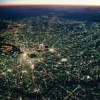
The Diversity of Condominium Lighting in the Tokyo Area Condominiums play a leading role in housing for the Tokyo Area. As the city grew, busy shopping, business, and entertainment districts are supported by the residences, which live in densely populated residential areas. As the population density increased so did the proportion of condominiums for housing. According to reality statistics, condominiums account for 70% of the housing within the 23 wards of Tokyo. For this survey we stepped away from the bustle of the big city and investigated 3 relatively large, densely populated condominium complexes. The three areas all have a different history and commuting distances from the center of Tokyo. What can we discover about the lighting environment of these three totally different condominiums and the surrounding residential area? Toyosu Once an industrial area built on reclaimed land, housing redevelopment started in 2003 and the first of several residential blocks was completed in 2006. Toyosu is a “new city”, built from scratch and popular with younger families and couples. The number of condominiums is astounding, but the development is not just large, but a luxurious residential area as well. Color temperature viewed from the condominium windows: Orange: 80% White: 16% Bluish: 4% The tower condominiums are immediately visible upon leaving the station. Relatively close to the center of Tokyo, these tower condominiums were built during a boom in condominium real estate. Each tower has a luxurious entrance lobby and…