2025.09.12 & 09.18 Lin Hu + Jiang Kunzhi + Lin Huangyi
Shenzhen evolved from a fringe town into a high-tech metropolis in about 45 years, and its bold, sustainable urban lighting planning stands out nationally. A two-day field study examined nightscape patterns in its three CBDs, media façades in Futian, and the functional lighting design of the new Gangxia North Metro Station.


Unlike older, historically rich Chinese cities, Shenzhen started as a peripheral town and in just about 45 years has become a high-tech modern metropolis. Thanks to its local legislative autonomy, Shenzhen’s urban planning is highly experimental and often serves as a model for other Chinese and even international cities.
In urban lighting planning, Shenzhen is a national frontrunner: its nightscape design is bold and innovative, yet the city has also enacted special regulations for ecological protection and light pollution control, showing a clear commitment to sustainability. However, some lighting projects still spark social debate over energy consumption, light pollution, and the use of public resources.
To understand more of Shenzhen’s current nightscape, the Shenzhen office team conducted a two-day field study with Mende-san and Kasai-san, focusing on three themes:

- The overall nightscape patterns of the three major CBDs (Luohu, Futian, Nanshan)
- The role of media façades in Futian in shaping the city’s nightscape and public space
- The nighttime lighting performance and impact of newly built public buildings
1. Nightscape of the three main CBDs
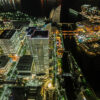
We visited the observation deck at 540 m on the Ping An Finance Center in Futian to take in the scale and layout of the city at night. Looking east toward Luohu, the skyline shows a mix of old and new high-rises, reflecting Shenzhen’s commercial history—rather than flashy upgrades, the strategy here focuses on using and enhancing existing lighting.
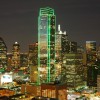
The city’s planning axis runs north–south past the Civic Center, and Futian, as the administrative core, features broad plazas, parks, and high-rise clusters. These towers create an intentional media façade zone. At the same time, we can also see major public buildings lining both sides of the central axis, such as the Shenzhen Library & Concert Hall designed by Arata Isozaki, and the Shenzhen Museum of Contemporary Art and Urban Planning designed by Coop Himmelb(l)au.
To the west is Nanshan, the tech and high-industry district, where many tall buildings with internal lighting. Shenzhen Bay Park also contributes to Nanshan’s nightscape in a landscaped form. Importantly, in Shenzhen’s lighting master plan there are strict restrictions on lighting near ecological areas (like bird migration corridors or wetlands). Some uplights, fixtures without spill-light control , lasers, and media façades are under control, and during migration season, dynamic lighting may be limited or switched off.


2. Media façades in Futian
The Futian District’s media façades are centrally planned and managed by the Urban Management Bureau. Coordinated with major buildings, they form a unified, rhythmic night visual system. Outside of holidays, these façades often display gentle animations like “meteor showers,” which are subtle and elegant. During festivals, they show special content to create city-scale dynamic visuals. In recent years, drone light shows have also become part of the nightscape, drawing many locals.
On social media, people often call Futian’s nightscape “cyberpunk” — the futuristic lighting adds technological allure, but some residents criticize the aggressive, dynamic lighting for increasing light pollution and energy use, questioning whether it really benefits everyday public life.
3. Lighting of new public architecture – Gangxia North Metro Station
We also studied Gangxia North Metro Station, a major interchange hub in Shenzhen’s subway system. Its station hall features an atrium called the “Shenzhen Eye” that brings in daylight. At night, the same space is lit to extend that feeling of light flowing from above into the station. We measured lighting levels in key areas and concluded that, while the design feels modern and functional, it doesn’t rely on spectacle—it’s more of a work-oriented nightscape, focused on serving transit and daily use.


■ Conclusion
In this survey, we focused on Shenzhen’s central areas, where public events are most concentrated and media façades are densest, to experience the real light environment behind social-media “filters.” From the street level, large-scale media content often does not form a readable visual image, yet being immersed in such a dynamic lighting setting is undeniably striking. At the same time, despite its brilliance, we observed that colored light reflected off glass façades spills into many corners of the streets and even into residential areas. Converting entire high-rises into media surfaces can also diminish the architectural form and its inherent aesthetic value.
As social media becomes increasingly influential, more Shenzhen residents are no longer passive recipients of top-down nighttime scenery. Instead, they are actively reflecting on the light environment around them and voicing concerns about poor lighting conditions. We hope that, as the most direct users of the city, citizens’ opinions can gradually influence Shenzhen’s lighting environment from the bottom up, allowing it to become genuinely more comfortable and humane through thoughtful planning and design—rather than relying solely on lighting wonders or oversized advertising. (Lin Huangyi)