2017.02.15 Eiki Takeuchi + Kanako Zakoh
This night walk shifted its perspective from the usual city streets to focus on how lighting is used to enhance exhibits. We explored the specific techniques behind these visual displays and investigated where “Lighting Heroes and Villains” might exist within such a setting. To study these indoor facility lights—which offer a different flavor compared to urban street lighting—we headed to Sumida Aquarium, located at the foot of Tokyo Skytree.

A view inside the exhibit where you can observe penguins perched on the rocks from eye level
 The overall space is dark, yet light is precisely directed where it is needed
■Overall Impression
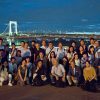
The night walk survey was a great success, with over 30 members gathered for the event. This time, we divided into four groups, with two groups each focusing on the themes of “Lighting to See” and “Lighting to Enchant.” Sumida Aquarium spans two floors (5th and 6th), with three different routes connecting them, allowing visitors to explore freely without a fixed path.
While all groups started together in the natural aquascape zone, they eventually branched off to survey at their own pace due to the open layout. Since it was evening, the entire interior was bathed in a blue light for atmospheric effect. We were surprised by the complete absence of any unpleasant odors typically associated with indoor penguin and fur seal pools. In front of the “Ogasawara Sea Life,” chairs were provided, and we observed many visitors taking their time to enjoy the view. It was clear that the aquarium had been designed with great care for the five senses.
Perhaps because of this immersive environment, although we initially thought we might have excess time, most groups ended up conducting thorough surveys right up until the last minute. The aquarium felt like a place where one could easily lose track of time and relax. With many first-time participants, some seemed a bit nervous at first, but once the group surveys began, everyone seemed to relax and enjoy the investigation in the pleasant atmosphere of the aquarium. (Kanako Zakoh)
 The immersive underwater-style production heightens the sense of anticipation
  The jellyfish tanks transformed into an art piece by Ms. Mika Ninagawa. Opinions were divided on whether this was a hero or a villain
■From the Entrance to the Exhibit Rooms
Along the corridors and staircases leading from the entrance gate to the first exhibit room, shimmering blue-based images reminiscent of being underwater are projected. This creates a powerful effect, drawing visitors into an aquatic world and inviting them into an extraordinary experience; as an introductory light performance, it was very pleasant. However, because the projectors are aimed in the direction of travel, anyone looking back is met with the direct glare of the light source. While its “enchanting” effect was undoubtedly a hero, the installation and execution had to be labeled a villain.
■Natural Aquascape
As if the previous immersive introduction had never happened, the area immediately at the top of the stairs opened into a space brilliantly lit with lighting that mimicked intense, high-noon sunlight. The lighting fixtures shining directly onto the large tanks were exposed, and the light sources were so intensely bright that everyone unanimously agreed they were villains.
In contrast, the tanks just a little further along the path featured a design where the lighting was integrated into the housing, resulting in zero glare. As intended for the exhibit, the aquatic plants bathed in this light were performing photosynthesis and releasing oxygen, creating natural, delicate ripples. The reflection of these ripples, the vibrant green of the plants, and the small swimming fish were so beautiful that visitors found themselves enchanted and lingering for a long time. This was felt to be a hero in both “Enchanting” and “Functional” lighting.
■Jellyfish
There was a collaboration exhibit with photographer Mika Ninagawa, featuring jellyfish swaying gracefully against a backdrop of vibrant, colorful imagery. The way the translucent jellyfish merged with or occasionally reflected the visuals created a fantastical underwater landscape. It was felt to be a highly intriguing exhibit in terms of “Enchanting” lighting.
■Aqua Gallery
This area consists of a row of small window tanks set in darkness where the light level is less than 1 lux, showcasing small aquatic creatures. Among them, one tank glowed a deep red. Displayed inside were deep-sea creatures like horseshoe crabs. Since red light does not reach the deep sea, these creatures have no natural sensitivity to it; for them, it is as if the light isn’t there at all. While the creatures feel as though they are in the darkness of the deep sea, the red light allows the human eye to see them clearly. This is a “Functional” lighting hero unique to aquariums, allowing us to glimpse their actual ecology.
 The massive tank glowing within the dark exhibition room.
■Ogasawara Sea Life
A massive tank that pierces vertically through the two-story aquarium. Large creatures like rays and sharks swim leisurely within it. Looking up, a single beam of light reminiscent of the sun pierces through a deep, crystal-clear blue that feels quintessentially aquatic, making one feel as though they have become an underwater creature themselves. It was incredibly comfortable and brimming with a sense of presence—a hero in both “Enchanting” and “Functional” lighting.
■Penguin and Fur Seal Zone
In a spacious, open atrium area lies the exhibit for penguins and fur seals. The slope connecting the upper and lower floors featured blue lights embedded in the walking surface to guide the flow of visitors. However, the contrast with the dark surroundings was too strong, creating a glare that actually made it difficult to see where one was stepping. While the overall space, bathed in blue light from the ceiling, was visually beautiful as “Enchanting” light, it left an impression that it might be a source of stress for the animals.
■Reflections
At Sumida Aquarium, the lighting scenes are programmed to switch between “Day” and “Night” modes around 6:00 PM. Our night walk took place after the transition to the Night scene. Except for the Natural Aquascape area, most sections were dark and enveloped in a predominantly blue light.
While the primary focus seemed to be on atmosphere-building and entertainment for late-night visitors, the tanks and the creatures within remained brightly lit and easy to observe. I felt the aquarium achieved a well-balanced harmony between “Enchanting” and “Functional” lighting.
Although I have visited during the day before, many of the first-time participants expressed a strong desire to come back and see the Day scene for themselves. (Eiki Takeuchi)
 Aquarium floor map
 Blue-based ambient lighting
 Scattered downlights causing occasional glare
 Small mirrors placed on both sides of the corridor, creating a kaleidoscope-like space
 Light reflecting off the water surface, making the goldfish difficult to see
 Presenting the Heroes and Villains discovered during the post-survey gathering