Date of Issue: 25 December, 2025
・Activity 1 / City Night Survey : Perth, Australia(2025.10.28-11.01)
・Activity 2 / City Night Survey : Xi’An, China(2025.11.06-11.09)
City Night Survey:Perth, Australia
Urban Light and Natural light in Western Australia
2025.10.28 – 11.01 Hongna Chen + Puyu Wu

This lighting survey investigates the influence of Western Australia’s local culture and natural landscape on its lighting environment, exploring whether its relative remoteness has led to distinctive approaches in lighting design. For this purpose, field investigations were conducted in Perth and its surrounding natural areas.
■ Perth’s Geographic Location
Perth is a city in Western Australia and is often described as the world’s most isolated major city. This characterization stems from its extreme remoteness with the Indian Ocean to the west, vast outback deserts to the east, and long distances from other major cities—about 4,000 km from Darwin, 2,700 km from Adelaide, and over 3,000 km from eastern cities such as Sydney and Melbourne. The unique nightscape of such a “remote” city is the central focus of this survey.

■ Panoramic Night View
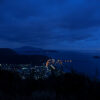
To take in the city’s nightscape from above, we chose King’s Park, the largest park in Perth. The park is a popular recreational spot for locals. On our way up, we saw many people hiking, picnicking, and sunbathing. We joined them at the hilltop to await nightfall. From Kings Park, Perth’s nighttime view clearly reveals the structure of the city’s lighting. The CBD skyline is defined by clusters of bright, cool-white light from office towers, while the streets below form a grid of warmer, yellow streetlights. The Swan River is faintly outlined by ambient light along its banks. Particularly striking is how abruptly the city lights end, fading quickly into the surrounding darkness—an immediate visual reminder of Perth’s remote location.

in downtown Perth at night.

■ Current Urban Nightscape
On another evening, we surveyed the lighting of the city’s commercial center and waterfront, including Elizabeth Quay and Yagan Square.
The waterfront lighting was surprisingly subdued. On both weekdays and weekends, only minimal linear lighting was used to trace the contours of the quay. In contrast, the commercial center was notably more vibrant, with colorful light beams creating a lively atmosphere. In addition to standard high-mast road lighting, the area integrated a variety of colored lights from commercial establishments, resulting in a dynamic and festive nighttime environment.

■ Urban District Lighting
Based on our observations of Perth at night, the city applies a highly structured, zone-based approach to lighting design. Commercial districts allow for greater visual expression, actively using colorful light beams and dynamic projections to create a vibrant atmosphere. Moving toward the CBD office areas and into residential zones, however, the lighting becomes progressively more subdued. In these areas, illumination is limited to essential functional lighting, with no use of neon or decorative lighting, clearly prioritizing practicality and minimal light intrusion.
■ The Art Gallery of Western Australia (AGWA)
AGWA is located in the Perth Cultural Centre in the heart of the cityand offers free public access, making art widely accessible. The centre also includes the State Library, the Perth Institute of Contemporary Arts, and the museum; however, the museum was under renovation during our visit, so our lighting survey focused entirely on AGWA.
We conducted detailed observations across three exhibitions—photography, painting, and installation art—each employing lighting strategies and beam angles tailored to the nature of the works.
The photography exhibition, focusing on humanistic themes, utilized uniformly soft and evenly distributed lighting to create a tranquil viewing atmosphere. In contrast, the painting exhibition featuring expressive oil works was lit with warmer color temperatures and lower ambient brightness, encouraging a more introspective experience. For the installation art, lighting was customized for each piece, with focused beams highlighting the works against a dimly lit surrounding space.
One particularly noteworthy technique was the use of indirect lighting. Light was projected to graze the white edges of the canvases, causing the frames to appear to glow and creating the impression that the paintings were floating against the wall. This demonstrated a thoughtful and creative approach to exhibition lighting.

■ The University of Western Australia (UWA)
UWA is renowned for its exceptionally beautiful campus and is considered one of Australia’s most picturesque. Its architectural identity is defined by the iconic Romanesque Revival style, characterized by sandstone buildings, grand archways, and serene cloistered courtyards.
Upon arriving on campus, we first conducted a brief external survey of the buildings and surrounding environment. One standout structure was the EZONE Student Centre, which features a facade with a hexagonal petal motif. This design is achieved through glass curtain walls and golden architectural elements, while inside, a dramatic high-ceilinged void creates a dynamic and engaging spatial experience.
Our visit to the UWA left a strong impression due to the campus’s thoughtful integration of historical heritage and natural illumination. Many buildings feature classical elements such as high ceilings, full-height windows that bring in abundant daylight, and timber-paneled lecture halls, creating an atmosphere of academic tradition and gravitas.
We observed students taking examinations in classrooms or studying in libraries, where natural light flowed generously through large windows. This daylight blended seamlessly with warm, soft indirect artificial lighting, carefully designed to highlight architectural details without overwhelming the space. Together, the classical architecture and restrained lighting fostered a calm environment that encouraged quiet reflection.

■ St. George’s Cathedral
Located in the heart of Perth, St. George’s Cathedral is a landmark of Gothic Revival architecture. Externally, it is defined by its striking sandstone facade, pointed arches, and soaring spire, clearly expressing the solemnity and vertical emphasis of the Gothic style.
During our daytime visit to St. George’s Cathedral, a few visitors and worshippers were inside, praying or observing quietly. We took this opportunity to conduct a preliminary survey of the interior lighting.
Upon entering, a serene and reverent atmosphere welcomes visitors. The interior follows a traditional basilica layout, with a high vaulted ceiling supported by slender stone columns. Soft light from stained-glass windows blends with carefully placed artificial lighting to highlight intricate wood carvings, memorial plaques, and liturgical elements. The overall effect is one of timeless tranquility and sacred grandeur.
In the evening, we returned to St. George’s Cathedral to document its nighttime lighting. Carefully positioned spotlights illuminated the slender, Gothic-style outer walls, emphasizing their verticality and architectural details. A warm amber glow enveloped the facade, extending the solemn and reverent atmosphere experienced during the day into the night. This approach demonstrates how contemporary lighting can respectfully highlight and reinterpret heritage architecture after dark. (Puyu Wu)

■Street Light
Perth’s street lighting varies by location and lacks overall uniformity.
- Walking Street
This street, which is heavily used by businesses and pedestrians, employs indirect reflected lighting, with lamps directed toward overhead reflectors. Lighting poles are 5m tall and spaced 10m apart, providing 140lux beneath the poles and 69lux at the center of the 6m-wide roadway. Illumination is further supplemented by storefront lighting. During our survey in Halloween season, festive image projections were also in operation.
Tree-mounted fixtures were present but remained unlit.We think light fixtures that do not contribute to illumination should be removed as they detract from the streetscape.

- Main Streets
Buildings frequently use a combination of colored and white lighting for facades, even outside holiday periods, likely as a planning strategy to enliven the city’s image as a “remote” urban center.


- Park Streets
Park Streets is Illuminated by 8m pole lights spaced 37m apart on one side of the street only. To preserve long city vistas across the open plain, designers replaced poles on the opposite side with recessed in-ground lighting that illuminates tree canopies and trunks. Measurements indicate 34lux beneath the poles and 15 lux at the road centerline , with an average of 25lux.
A clear contrast in color temperature—3000K for the roadway and 5000K for the trees—effectively delineates the functional zones. The warm light gently embraces the roadway, while the cooler light stands out against the trees, creating a calm and inviting atmosphere. The lighting is not harsh; instead, it produces a well-balanced, relaxing glow that encourages people to slow down and enjoy the night.

- Street Courtyard Lamps:
Many streetlights are designed to complement the architectural styles of adjacent buildings. These distinctive fixtures enhance the city’s cultural character.

■ Natural Light
The areas surrounding Perth feature rich natural landscapes with certain regions designated for dark-sky protection. In wilderness areas, the government avoids adding extra lighting for tourism or night-economy activities, instead maintaining only minimal, essential lighting at selected locations.
We selected the Pinnacles Desert for natural light survey. Its open terrain and guided tour programs support professional observation and stargazing experiences. With strong dark-sky protection, moonlight cast clear shadows and countless stars were visible to the naked eye, highlighting the quiet power and appeal of natural light.

■ Conclusion
Through our survey, we peeled back the layers of this ‘solitary’ city and found a deeply connected community. Its lighting design is carefully curated to prioritize human comfort; through the use of indirect lighting techniques, glare is minimized, creating a calm and restful visual environment. Accents of colorful illumination along the streets act as a heartbeat, enlivening the atmosphere, demonstrating that isolation does not equate to silence.
However, what truly brings life to the city is interaction with its residents. We experienced a genuine warmth and friendliness that extended beyond each conversation. We believe the lighting design reflects this spirit, serving as a silent language through which the city embraces visitors with the same kindness and warmth that characterize its people. (Hongna Chen)
City Night Survey:Xi’An China
Muslim District within New Development Context
2025.11.06-11.09 Quratuaini Jamil + Xu Sunny
The survey aims to examine the Muslim Quarter District with a focus on its religious, cultural, and urban context, while assessing how it integrates with the emerging modern development within Xi’an.

■ Brief Summary of Lighting Survey
With a vast metropolitan population of 12.9 million—of which 4.45% reside in the urban center—Xi’an is a renowned historical and cultural hub in China that pursues an urban planning strategy blending tradition with modernity. The city integrates its rich heritage with the demands of contemporary development while carefully safeguarding key cultural areas. A prime example is the Muslim Quarter, which plays a crucial role in preserving living heritage, ethnic diversity, and the traditional urban fabric. Xi’an’s planning approach emphasizes “development within preservation and preservation within development,” reflected in the harmonious coexistence of new growth and historic architecture. Accordingly, this research focuses on how the old and new parts of the city—particularly distinct areas like the Muslim Quarter—are effectively integrated.

■Xi’An Muslim Quarter
On the first day, we observed the Friday congregational prayer at the Great Mosque of Xi’an. This visit provided a valuable opportunity to study the mosque’s internal spatial organization and architectural characteristics. The Great Mosque of Xi’an is distinctive for its unique synthesis of traditional Chinese architectural language and Islamic religious functions. It differs markedly from the Middle Eastern style—characterized by prominent domes and tall minarets—commonly seen in places like Singapore. Instead, the mosque features a pagoda-like minaret positioned centrally within a courtyard. Its landscape layout is rooted in Chinese courtyard planning, culminating in a main prayer hall framed by a monumental stone gate adorned with Arabic calligraphy and dragon mandala motifs.

Inside, the timber-constructed prayer hall creates a dim atmosphere, where carved Qur’anic verses line the walls, and lighting—primarily a 5000K conventional lamp—effectively compensates for the dark interior materials. The rest of the space was also only lit up with the bare conventional lamp within its compound. Unfortunately due to the timing that we went is close to winter. Therefore, we were not able to view the internal space a night as it closes at 5.30pm during winter. We instead explore the outskirts of the mosque streets which filled with food, commercial stores and spots of entertainment attraction which is known to them as Muslim district bazaar.

■ Muslim Bazaar
At night, the bazaar in Xi’an’s Muslim Quarter transforms into a vibrant and visually dynamic space, reflecting both commercial activity and cultural heritage. The streets are illuminated with bright, warm-toned lights from food stalls, shops, and entertainment spots, creating a lively atmosphere. Neon signs, LED strips, and hanging lanterns add color and energy, drawing the eye to merchandise and culinary displays.

Street lighting is kept moderate, providing safety for pedestrians while allowing the individual shop lighting to take precedence. Traditional lanterns are incorporated along some streets and entrances, subtly reinforcing Chinese cultural aesthetics. The layered lighting effect—bright stalls set against softer ambient light—enhances depth and highlights the movement within the bazaar. Overall, the lighting strategy balances functional illumination for commerce with cultural expression, producing a nighttime environment that is both energetic and intimate. The interplay between bright commercial zones and the softer atmospheric landscape creates a unique and memorable urban experience.


■ Xi’An Museum
The Xi’an Museum presents the city’s rich historical legacy through extensive collections from the Zhou, Qin, Han, and Tang dynasties, housed within architecture that blends modern design with traditional Tang influences. Located alongside the Small Wild Goose Pagoda and landscaped gardens, the museum offers both cultural depth and a serene spatial experience. Particularly notable were exhibitions showcasing historical transformations through everyday materials such as ancient plumbing components, floor tiles, and roof eaves, as well as the use of AI technology to enhance historical interpretation. A key highlight was the exhibition on the evolution of urban planning from the Sui and Tang to the Song dynasty, illustrating changes in city scale and spatial organization. Overall, the museum provides valuable insight into Xi’an’s development as both an imperial capital and a dynamic urban environment.

■ Tang Dynasty ‘Ever Bright City’
The “Ever Bright” area showcases exceptionally bright and vividly colored façade and outdoor lighting, emphasizing the intensity of commercial zones. In contrast, sections of the city wall are dimmer, which local photographers creatively use for shadow puppet-style effects. The Big Wild Goose Pagoda features subdued lighting in both brightness and color temperature, creating a striking contrast with the surrounding illuminated areas. Many photographers were seen using the pagoda as a backdrop for commercial tourist photoshoot.
Trees are decorated with lines of lights, apple-shaped lanterns, and 5000K outline strip lights, with canopies highlighted by yellow RGB calligraphy. The commercial buildings, inspired by ancient Chinese architecture, use spotlights to illuminate niche details and accentuate the structure. Although there is a strong contrast between the bright commercial lighting and the dimly lit landscape, the overall effect feels surprisingly balanced. This interplay creates a layered, immersive nightscape that showcases both modern spectacle and historical heritage. It appears that while Xi’an holds a minority Muslim culture, the people take great pride in their Chinese ancestry, which is clearly visible in the unique context of the city.


■ Conclusion
Xi’an’s Muslim District and city lighting remain strongly influenced by Chinese cultural traditions. This reflects the city’s large population and its preference for a festive, celebration-oriented lifestyle. Spaces are brightly lit to create a lively atmosphere and enhance safety. Emphasized vertical surfaces make buildings glow like lanterns. Multiple lighting colors—drawn from street signage and traditional accents—may seem inconsistent but are generally well received and enjoyed by the public.(Quratuaini Jamil、Xu Sunny)