Date of Issue: January 30, 2026
・Activity 1 / City Night Survey : Riyadh, Saudi Arabia(2025.11.16-11.18)
・Activity 2 / City Night Survey : Tashkent, Uzbekistan(2025.11.09-11.14)
City Night Survey : Riyadh, Saudi Arabia
Diriyah, KAFD and Metro stations Riyadh
2025.11.16 – 11.18 Gita Listia
The purpose of this Riyadh lighting survey is to explore the characteristics of old urban areas and new developments in KAFD Riyadh, with a particular focus on their metro stations. The study aims to understand how each area expresses its identity through public space lighting and how lighting strategies are applied in major infrastructure such as metro station.

■Diriyah

Diriyah is a historic area on the north-west side of Riyadh and one of Saudi Arabia’s most important cultural heritage sites. Located along Wadi Hanifah, about 15 km from central Riyadh, it reflects the early history of the city. Today, Diriyah is being developed into a vibrant heritage, cultural, and lifestyle destination, where historic preservation is carefully combined with modern urban design.
The lighting in Diriyah is designed to be subtle and heritage-sensitive. Very warm white tones are used to complement the Najdi mud-brick architecture, creating a calm and welcoming night-time atmosphere. Pole lights and bollards in Diriyah feature distinctive shapes, patterns, and warmer colour temperatures compared to typical street lighting in other parts of Riyadh. This traditional lighting character clearly signals that visitors are entering a cultural and heritage area.

■At-Turaif
At-Turaif is the birthplace of Saudi history and represents the cultural core of Diriyah. It is recognized as a UNESCO World Heritage Site. Lighting at At-Turaif is highly restrained and conservation-focused.
Soft grazing and wall-washing techniques are used to gently reveal the texture, depth, and form of the buildings.
Very warm colour tones are applied to match the natural colour of the Najdi mud-brick walls, while lighting levels are intentionally kept low. This approach preserves the authentic night-time atmosphere and ensures that the historic structures remain the primary focus, without being visually overpowered.


■ Al-Bujairi
Al-Bujairi (often referred to as Bujairi Terrace) is a heritage and lifestyle area within Diriyah, located directly adjacent to the historic At-Turaif district. It functions as a lively public space where people gather to eat, walk, meet, and enjoy the atmosphere of Diriyah.
Lighting here gently washes and accents walls, textures, arches, and towers to reveal material and form, rather than flooding the area with light. Some façades use projectors to create a more interactive experience, particularly where buildings have simple, flat mud-wall surfaces, adding visual interest while maintaining a warm and human-scale environment.


■KAFD (King Abdullah Financial District )

KAFD is a major new business and financial district located in north Riyadh. It is designed as a modern, high-density urban area, combining offices, hotels, residences, retail, and public spaces. Architecturally, KAFD is known for its futuristic and geometric buildings, designed by a range of famous international architects.
KAFD architecture is not purely Salmani style, but it is influenced by Salmani architectural principles, translated into a contemporary and international design language. Salmani architecture emphasizes local identity, human scale, geometric order, solidity, and references to Najdi architectural values, interpreted in a modern way rather than copied literally. As a result, many buildings in KAFD use strong geometric forms and clear massing, creating an impression of solidity rather than transparency. Façades often incorporate screens, fins, patterns, and depth, instead of flat glass curtain walls. Overall, the architectural image of KAFD is futuristic and global, rather than vernacular or historic.
Daylight is an important design consideration in KAFD. Most buildings are planned to allow daylight deep into interior spaces. Façade elements such as canopies, overhangs, colonnades, and podiums provide shade while still allowing filtered daylight, an essential strategy for Riyadh’s hot climate. Many buildings use glass and metal façades with shading fins, screens, or fritted glass to control glare and heat while maximizing usable daylight indoors. Beyond its architectural expression, KAFD is also a LEED-certified sustainable district, achieving Platinum recognition at both the neighborhood level and for several key buildings.


Urban connectivity is another defining feature of KAFD. Buildings are linked by an extensive network of bridges, each identified with its own colour lighting. These colour lighting may relate to different zones within the district, supporting wayfinding and spatial identity.
Lighting in KAFD is contemporary and expressive, especially when compared to heritage areas such as Diriyah. The district typically uses neutral to cooler white tones, higher light levels, and dramatic façade lighting to emphasize architectural form. Colour lighting is also introduced during festive events and special occasions. Some buildings are using flood light and some integrate concealed linear luminaires within façade joints, fins, or edges to highlight geometry and rhythm.
In public spaces, a layered approach, combining pole lighting, bollard, integrated handrail lighting, façade spill light, tree uplighting and accent lighting, creates visual depth, hierarchy, and a dynamic nighttime environment.


■Riyadh Metro Stations
A lighting survey was conducted along the Blue Line of the Riyadh Metro. Four stations were visited: King Fahd Library Metro Station, which follows a more standard station design, and three stations designed by international architects. KAFD Metro Station by Zaha Hadid Architects, Olaya Metro Station by Gerber Architekten), and Qasr Al Hokm Metro Station by Snøhetta.
Overall, lighting across the metro stations is quite uniform. There is no strict differentiation in lighting for specific functional areas, such as directly above the platform alignment zone or above the ticketing gates. Instead, lighting is distributed evenly to support general visibility and passenger movement.


enhancing visibility and passenger comfort.


In terms of colour temperature, the stations use a mix of white and warm light.
white light is mainly applied for general illumination, ensuring clarity and safety, while warmer tones are used to enhance the atmosphere, particularly around feature walls or architectural elements.
■Conclusion
Diriyah, KAFD, and the Riyadh Metro stations demonstrate distinct lighting identities that reflect their urban and cultural roles within Riyadh.
Diriyah uses warm, low-level, and heritage-sensitive lighting to preserve historical character and create an intimate night-time atmosphere. KAFD contrasts this approach with contemporary lighting strategies, higher brightness levels, and neutral to cooler tones that emphasize modern architecture and urban clarity.
Riyadh Metro stations along the Blue Line apply a more uniform lighting approach, prioritizing functionality, safety, and passenger movement.
Overall, the study highlights how lighting is used as a key design tool to express heritage, modernity, and infrastructure across different urban contexts in Riyadh. (Gita Listia)


City Night Survey : Tashkent, Uzbekistan
2025.11.09-11.14 Jiang Kunzhi + Lin Huangyi
This survey aims to explore the interaction between Soviet culture and Islamic culture within the urban space of western Tashkent, with a particular focus on whether this cultural layering has given rise to region-specific lighting approaches and expressions of the luminous environment. Therefore, a systematic field survey and documentation were carried out across the urban areas of Tashkent.

As the capital of Uzbekistan, Tashkent reflects both Soviet modernism and Islamic architectural traditions. The city features large Soviet-era public buildings alongside religious architecture that blends tradition and modernity. In addition to above-ground buildings, this survey also examined the Tashkent Metro, Central Asia’s first metro system opened in 1977, where refined lighting and rich materials create museum-like underground spaces. (Jiang Kunzhi)
■Aerial night view of Tashkent

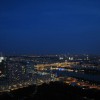
Viewed from the TV Tower, Tashkent’s nightscape appears as a network of “lines” and “points” rather than a continuous illuminated façade. The road system forms the clearest visual structure: main roads and ring roads read as linear light bands, while bridges and major intersections appear as brighter nodes, creating a legible traffic framework over the city’s flat skyline. These linear elements strongly define the city’s sense of direction and scale.
In contrast, most buildings remain dark at night, with their presence defined only by entrance lighting, limited window glow, and reflected ambient light. As a result, the overall background luminance stays low, allowing a few landmarks—such as tall structures or media façades—to stand out as highly recognizable visual anchors through contrast rather than brightness.


■Soviet Modernist Architecture
Tashkent retains many representative Soviet-era public buildings that form the foundation of its modernist urban structure through monumental scale, strict geometry, and functionalist design. While these buildings show strong architectural presence during the day, their nighttime condition is markedly different. This survey focuses on how Soviet modernist architecture performs under low-light conditions from nighttime and pedestrian perspectives.

Overall, these buildings do not form a systematic illuminated façade at night. Most lack wall washing or floodlighting, and their visibility mainly relies on entrance lighting, limited interior glow, and ambient light from surrounding streets. As a result, buildings appear as large dark volumes, with daytime structural rhythm and geometric order significantly weakened, causing them to recede into the background of the nightscape.
From the pedestrian scale, visual perception is dominated by roadway lighting, intersections, plazas, and entrance highlights rather than façades. While the low contrast makes architectural forms less legible at close range, it also avoids visual overload, creating a calm and orderly nighttime environment where infrastructure plays a primary role.

Against this low-luminance background, a few landmarks stand out clearly. The Tashkent TV Tower, illuminated through projection and a media façade, becomes the most recognizable landmark and a key directional reference at night.
The Palace of Peoples’ Friendship, in contrast, maintains visibility through restrained interior glow and upper façade lighting, reading more as an illuminated public space than a façade-driven icon. Its interior lighting quality is notably stronger than its exterior night expression.
Overall, Soviet modernist architecture in Tashkent’s nightscape is characterized by low brightness, restrained façade expression, and a priority on functional lighting. This approach gives the city a stable and orderly nighttime character, while leaving room for future enhancement through precise, small-scale lighting interventions. (Jiang Kunzhi)

■Islamic Architecture

Islamic architecture in Tashkent is mainly concentrated in the old city and religious cultural areas, represented by the Hazrati Imam Complex. In sharp contrast to Soviet modernist buildings, these structures embody the historical lineage of Central Asian Islamic culture, emphasizing spirituality, ceremonial qualities, and decorative aesthetics.
Their architectural language is more complex and symbolic, with regionally distinctive materials. In this survey, particular attention was given to how mosque materials reflect, transmit, and reveal texture under light.
1. Hazrati Imam Complex
The Hazrati Imam Complex is Tashkent’s most significant Islamic religious and cultural center, representing core features of Timurid and Islamic architectural traditions. The complex includes a mosque, madrasah, religious library, and administrative institutions, forming a symbolic center of religious and architectural culture. Rich decorative patterns—calligraphy, arabesques, geometric mosaics, and brick relief—define its artistic identity.


During the survey, lighting and mapping-show tests were ongoing for the newly built Islamic Cultural Center. Unlike historical structures, the new building incorporates more architectural lighting such as linear wall washing and façade floodlighting. However, due to structural limitations in the old buildings, wall washers were installed too close to the surfaces, resulting in overexposure, dark patches, and visible fixture-to-fixture shadow gaps, reducing lighting performance.

2. Minor Mosque
The Minor Mosque is a major 21st-century religious landmark located along the river in Tashkent’s modern district. Known for its white marble façade, pure proportions, and blue dome, it forms a “traditional × contemporary” dialogue with historical Islamic structures.
The plaza illumination is relatively low, with floodlighting only on the upper right corner of the mosque. While the darker environment preserves the quiet and sacred atmosphere, functional wayfinding and safety illumination are somewhat insufficient. (Lin Huangyi)


■Tashkent Metro Survey
The Tashkent Metro, Central Asia’s first metro system, opened in 1977 and is renowned for its diverse decorative styles, artistic spatial qualities, and thematic design. Photography was banned for military and security reasons until 2018, after which the stations could be documented and studied. The metro is not merely a transportation system but a series of “underground palaces,” representing a unique integration of engineering achievement, artistic craftsmanship, and political symbolism.
1. Kosmonavtlar
Opened in 1984, Kosmonavtlar Station is one of Tashkent’s most iconic metro stations. With deep blue tones, astronaut portraits, crystal luminaires, and futuristic décor, it forms a unique “space-themed” environment.

2. Alisher Navoi
Opened in 1987 and named after Uzbekistan’s celebrated poet Alisher Navoi, the station features a series of Islamic domes with intricate geometric patterns incorporating astronomical symbolism, regional tile craftsmanship, and an Eastern color palette of blue, gold, and white. Lighting is primarily functional, delivered through downward linear fixtures around the dome perimeter, while the dome itself is illuminated by ambient reflected light.

3. Uzbekiston Station
Uzbekiston Station follows the “underground palace” typology, featuring vaulted ceilings, symmetrical planning, and a triple-aisle spatial layout. Two types of luminaires are used: large cotton-shaped chandeliers providing diffuse ambient light, and downward-tilted luminous panels that supplement ground-level illumination. (Jiang Kunzhi)


■Samarkand Architecture
The team also conducted a supplementary survey in Samarkand, coinciding with the UNESCO General Assembly—its first session outside Paris in nearly 40 years—enhancing the cultural significance of the study. The survey focused on Timurid mausoleums and surrounding religious structures, examining nighttime lighting performance such as tile visibility under low illumination, layering of domes and arches, and how lighting enhances sacredness and narrative expression while preserving heritage.
1. Gur-e-Amir Mausoleum
The Gur-e-Amir Mausoleum, built in 1403–1404, is the resting place of Amir Timur and later his descendants. Its monumental blue dome, glazed tiles, and refined ornaments represent the height of Timurid architecture. The interior integrates daylight with artificial lighting, with pole-mounted track lighting in each corner supporting over ten adjustable spotlights aimed at the domes. The chandelier at the dome apex was not lit during the survey.


2. Registon Square
Once the royal square of the Timurid Empire, is framed by three madrasahs: Ulugh Beg, Sher Dor, and Tillya Kori. Nighttime lighting is comfortable, using a mixture of cool blue tones and warm low-color-temperature lighting that complements the buildings’ original colors. The golden dome of Tillya Kori is especially magnificent, with warm lighting enhancing its brilliance—similar to the lighting approach at the Gur-e-Amir Mausoleum.


3. Bibi-Khanym Mosque

Built between 1399 and 1405, the Bibi-Khanym Mosque was one of the largest mosques of its time, featuring glazed tiles, mosaics, and calligraphic ornamentation characteristic of the Timurid Renaissance. Unfortunately, there is no dedicated nighttime architectural lighting—only basic functional illumination. (Lin Huangyi)
■Conclusion
This survey focuses on Tashkent and Samarkand, examining Soviet modernist architecture, Islamic architecture, metro spaces, and historical heritage sites through architectural form, materials, and nighttime lighting conditions. Uzbekistan’s architecture can be read as a three-dimensional history book: Tashkent reflects the layered complexity of a modern city, while Samarkand reveals the spiritual depth of ancient civilization. In this context, urban light functions not only as illumination, but also as a medium of urban development narrative. (Jiang Kunzhi)