Date of Issue : March 14, 2019
・Activity 1 / City Night Survey : Morocco (2018/9/30-10/08)
・Activity 2 / City Night Walk Vol. 62:Shibuya River(2018/10/02)
・Activity 3 / Round Table Discussion Vol. 60 : Shibuya River Review(2018/11/29)
・Activity 4 / Lighting Detectives Jr. @ Edo-Tokyo Open Air Architectural Museum(2018/12/01)
City Night Survey in Morocco
2018/09/30-10/08 Shosaku Takahashi + Masafumi Yamamoto
Morocco is located on the African continent but retains a strong influence from European countries such as neighboring Spain and France. It can be said that the cities have been formed under the influence of various cultures. This survey started in the major city of Marrakech, crossed the Atlas Mountains to visit the vast Sahara Desert inland, and then continued for ten hours and another 600 kilometers across the continent to reach the blue city of Chefchaouen. We experienced the climate, culture, and lifestyle of this country, which shines on the shores of the Mediterranean Sea while benefiting from the sun, and investigated the relationship between lighting and people’s lives.
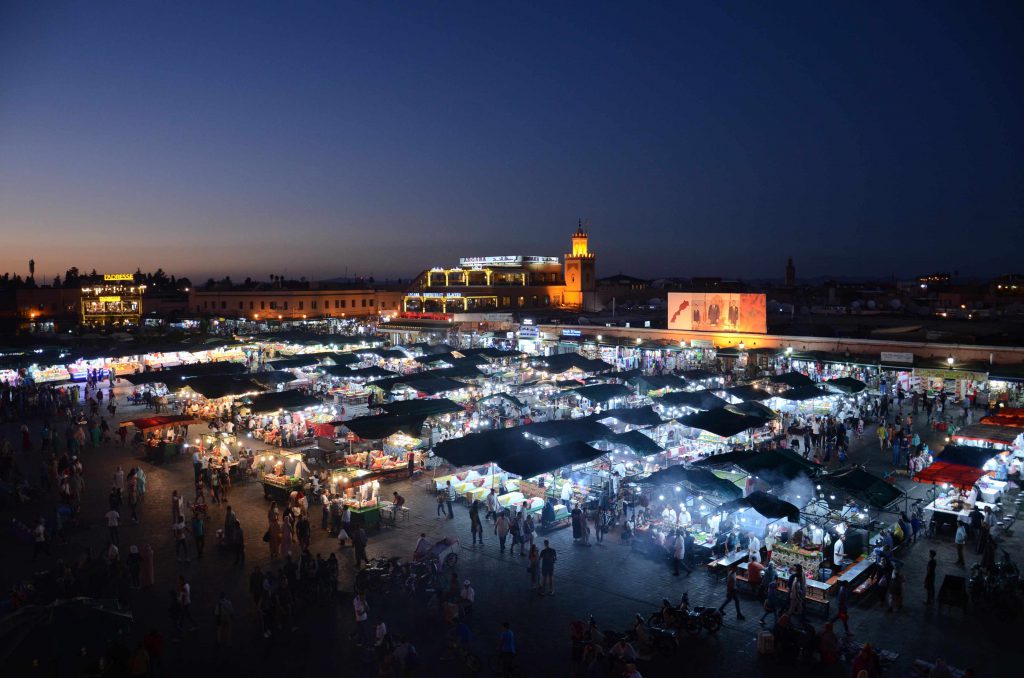 Djemaa el-Fna Square
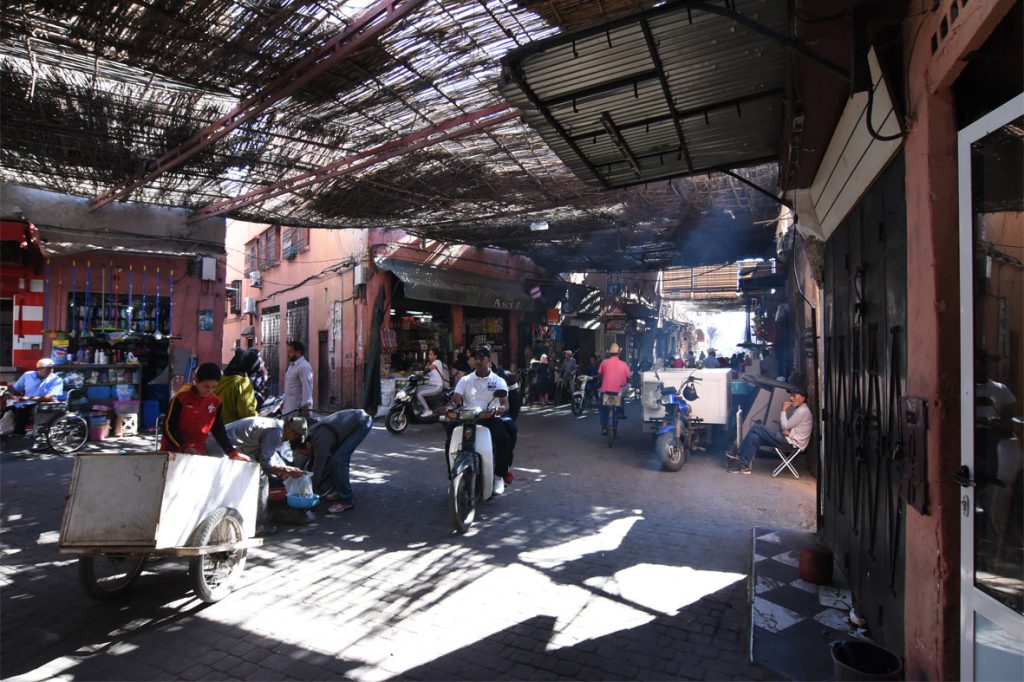
Many of the Old Town’s paths are covered with sunscreens
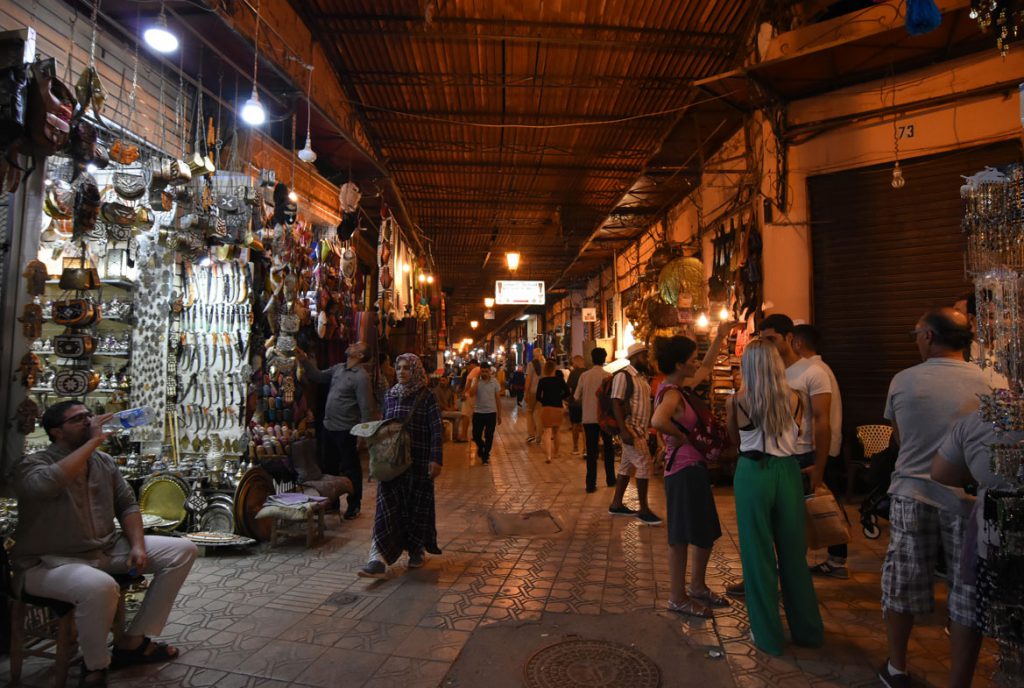
The souk is bustling with people at night
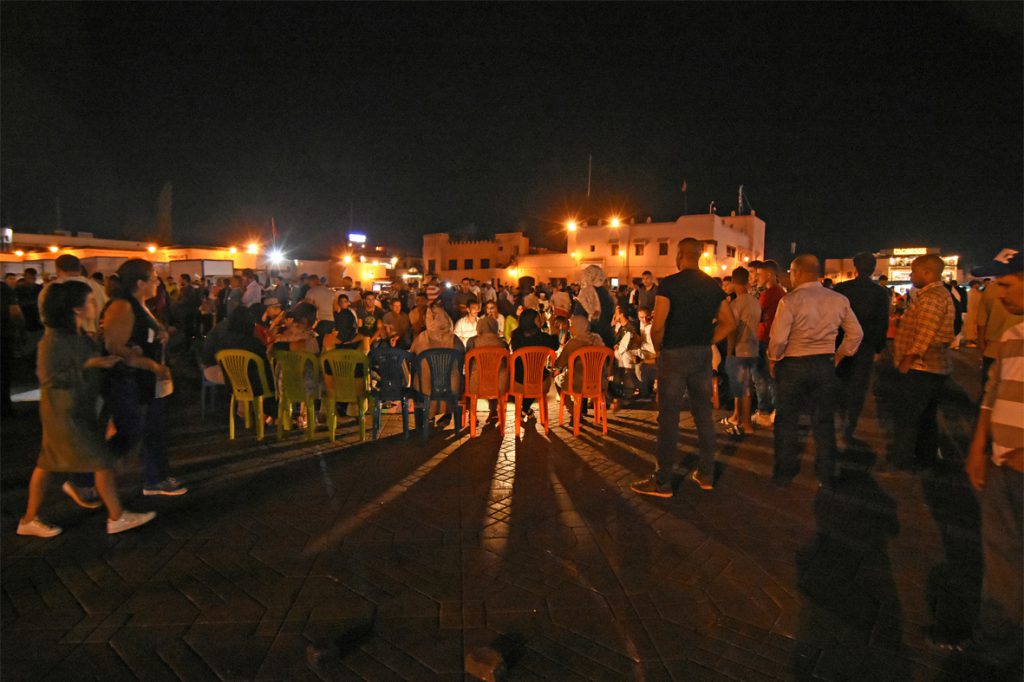
People watching street performers
■Arrival in Marrakech
After driving four hours from Casablanca Airport, we saw the reddish-clay streetscape of the major city of Marrakech pop up in the middle of the wilderness. The moment we got out of the car in the old town, swarms of flies started hitting our bodies. The smell of rotting fruit and raw fish stung our noses. Crowds of people moved through the narrow alleyways, as motorcycles sped past, honking their horns. The air was thick with dust and exhaust fumes. Flies immediately swarmed the tuna sandwich we bought from a nearby stand for a late lunch.
■Old Town Streetscape and the Souk
The old town, or Medina, is densely packed with two- or three-story buildings. A maze of winding paths continues, and you quickly lose your sense of direction as you walk. Cloth or boards are hung between the buildings to block the intense sunlight, and people are chatting underneath on the small paths. Eventually, the residential atmosphere disappears, and you emerge into the Souk (market), where shops selling miscellaneous goods line the streets. Various specialized shops for ironware, casting, pottery, leather, and clothing line the alleys. Goods spill out onto the paths. These items are adorned with intricate and beautiful patterns, showing signs of careful handiwork. In the brass craftsmen’s souk, lampshades are lined up densely in the narrow shops, covering even the ceiling. The light from countless incandescent bulbs shone through the brass.
The old town at night presented a desolate scene, with white LED fixtures attached to the exterior walls of the buildings illuminating the street surface. However, the sight of people chatting next to the light of a lampshade beside a doorway was very impressive. The lighting in these places, which serve as gathering spots for people, must surely embody the warm spirit of the Moroccan people.
■The Night at Djemaa el-Fna Square
The square’s bustle only increases as the sun sets. The noise and unique smells are dizzying. Flutes and drums play melodies rich with exotic charm. Street performers display their acts under small lights, drawing large crowds. Smoke billows up from the food stalls, which are randomly illuminated by exposed incandescent and white light bulbs. The mixture of various lights seems to add further color to the energy of the people gathered there. The square is filled with dazzling light; you could call it an oasis of light that has magically opened up in the middle of the large city of Marrakech.
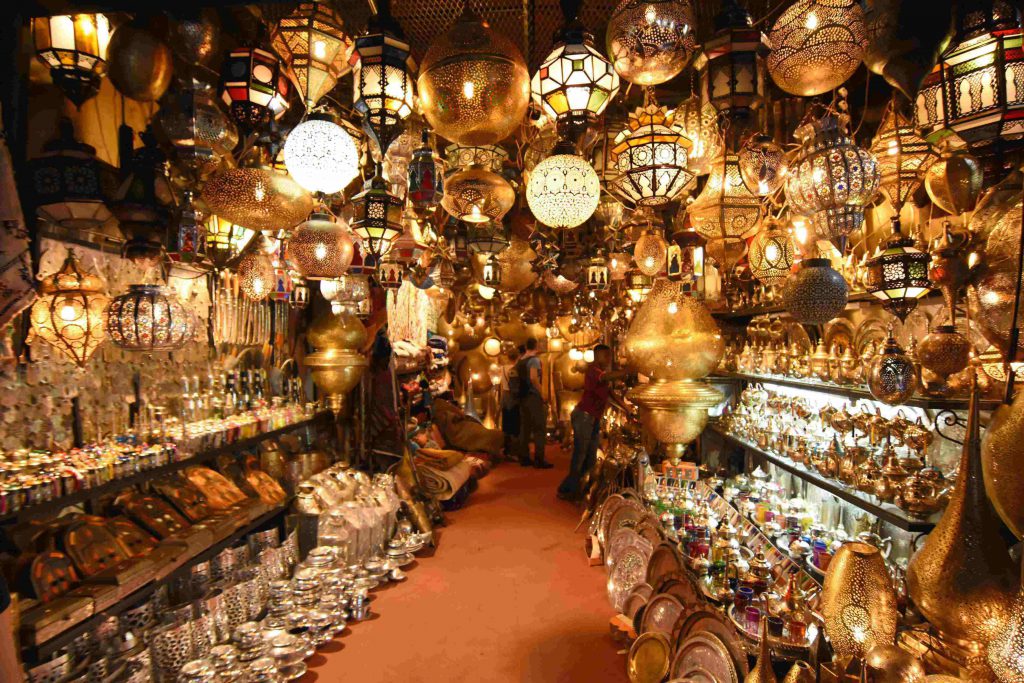
The brass craftsmen’s souk is packed with lampshades
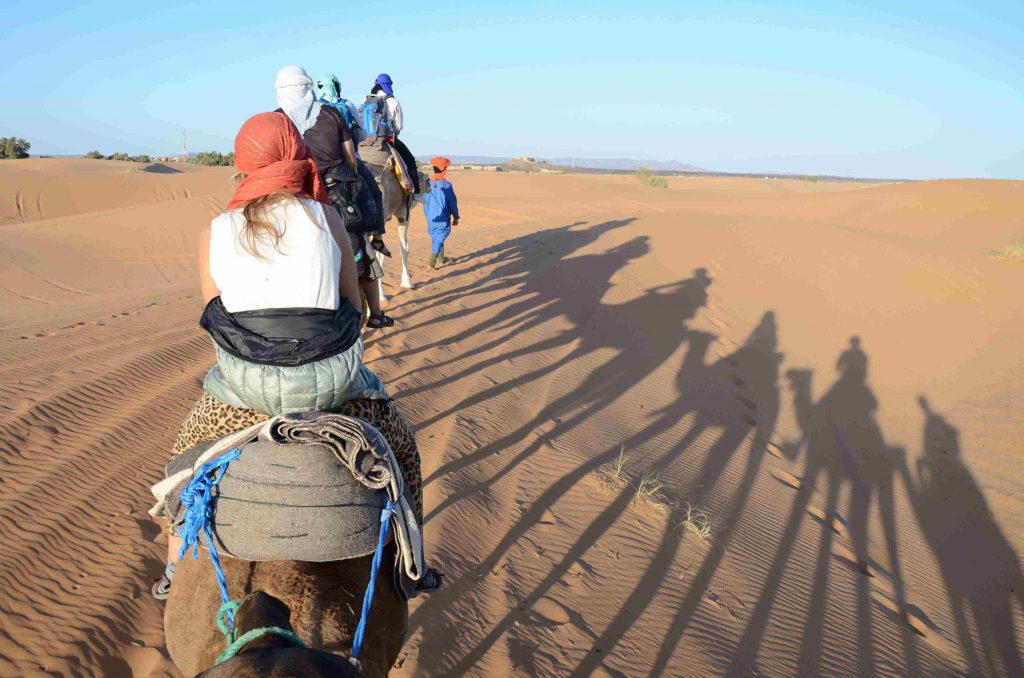
Traveling by camel from a nearby town to the desert
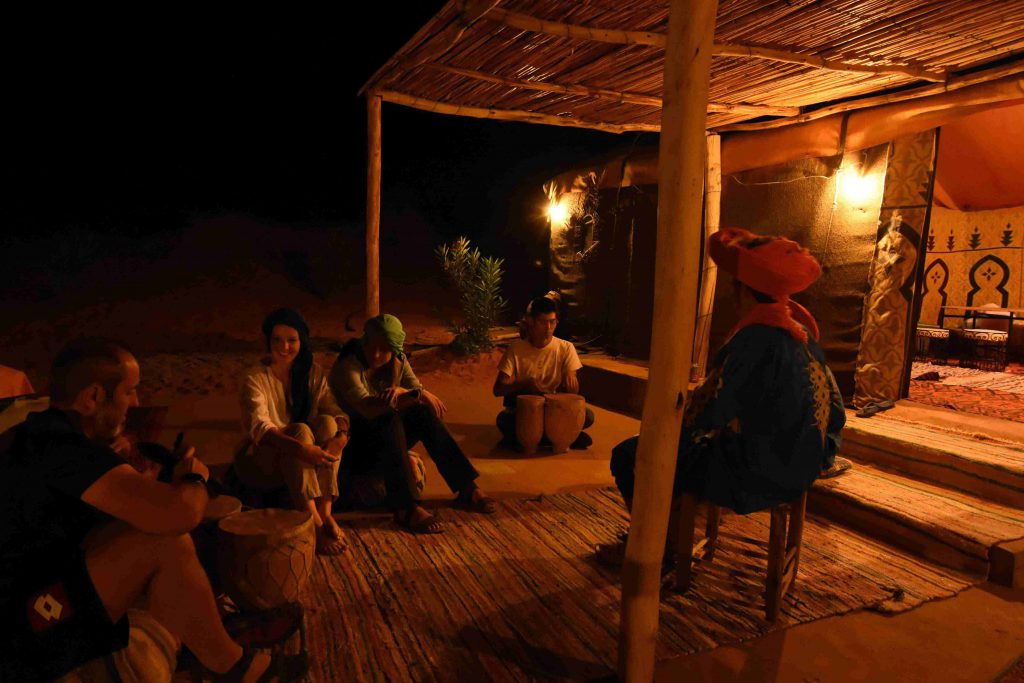
Chatting while listening to traditional Berber music after dinner
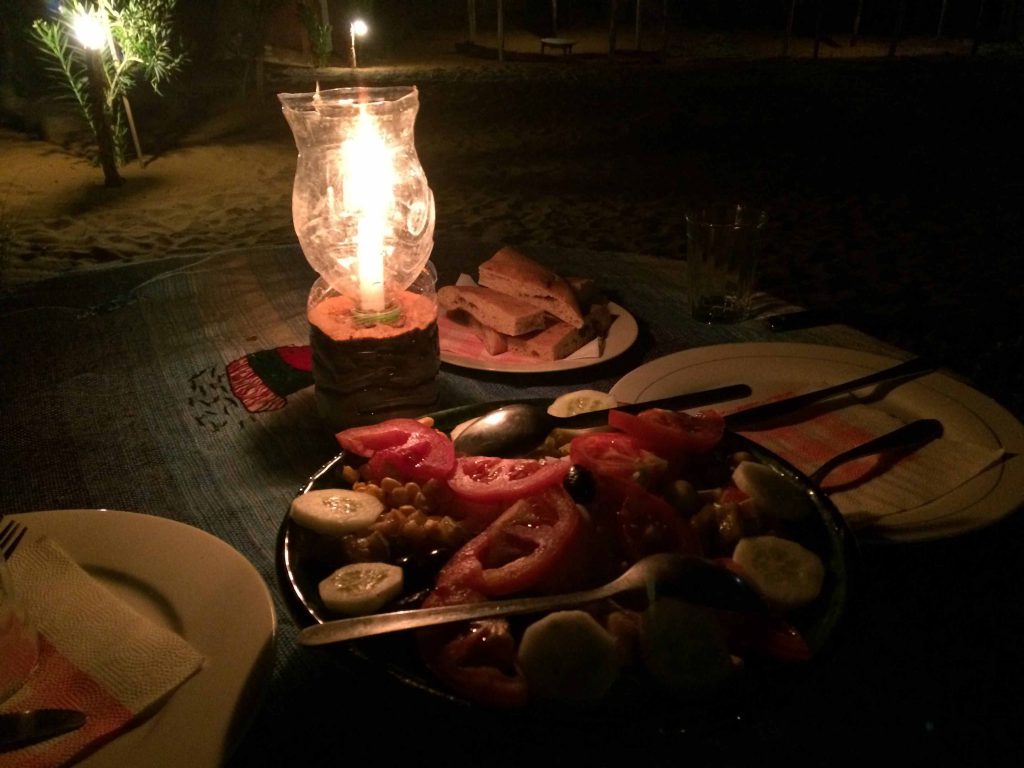
The light of a candle flickering next to a tagine
■Heading for the Sahara Desert
We left Marrakech at 7:30 a.m., just as the sun began to rise. We sped along unpaved mountain roads. Our destination was far beyond the Atlas Mountains, which reach 2,000 meters in elevation. We drove out of the city and through date palm groves. As we continued, the scenery became monotonous. A chain of mountain peaks could be seen in the distance, beyond the vast, rocky desert. Our car sped up to make it in time for the sunset. About 10 hours after our departure, the desert finally came into view. The sun was starting to set in the western sky. We got out of the car after driving over one large dune.
■Sunset
the desert, only the occasional faint sound of the wind could be heard. We rode camels further inland, and the surroundings gradually grew darker. After climbing a large sand dune, we started to see city lights far in the distance. When we sat down at the top, a sky full of stars so close we could almost touch them spread above us. The stars scattered across the hemispherical night sky slowly twinkled. Because the stars were so distinct, the night sky felt closer than usual.
The night sky we saw on the first night in Marrakech was no different from that of Tokyo. However, the desert night sky, far from artificial light, was vastly different—it was nature in its purest form. A sky full of stars has been erased by the lights of our daily lives, transforming it into a scene of special value. Even as we live in cities that never stop developing, we can try to keep the original appearance of nature in our hearts. This kind of small effort, for instance, might lead to the desire to conserve electricity, which could be the starting point for changing the urban nightscape.
■Desert Candle Night
One light source in the desert truly stayed with me: the impromptu candle holder placed on our table by a local person during dinner. It was made by cutting a plastic bottle in half, filling one side with desert sand, and inserting the drinking end of the other half into the sand to hold a candle.
Though simple, it was functionally beautiful, using only travel essentials to shield the flame from the wind and secure the candle and shade with sand. The warm light from the candle was preserved perfectly, beautifully illuminating our tagine (Moroccan stew).
■Sunrise
The next morning, the desert was thoroughly chilled. We left the tent while the stars were still out and climbed the sand dunes again. Before sunrise, the sand had a subtle, damp texture with faint shadows. Eventually, the sun appeared from beyond the dune peaks. The contrast of the sand’s undulations gradually sharpened. Even the wave-like patterns on the sand’s surface, created by the wind, became distinctly visible.
In our daily lives, we are sometimes moved by the constantly changing appearance of the morning sun as it enters the bedroom. However, in the desert, far from life’s hustle and bustle, we were reminded that a delicate passage of time exists even within the sun’s trajectory of just a few minutes. There is drama in unassuming things. The desert taught me many things I had overlooked in the rush of daily life. (Masafumi Yamamoto)
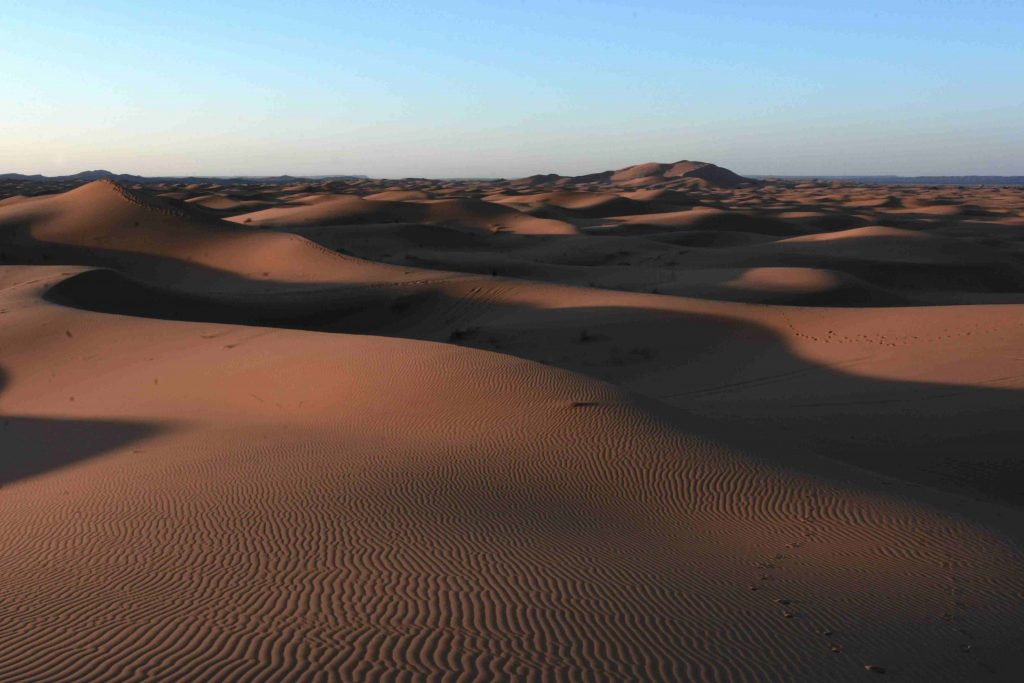
As the sun rises, the sand’s undulations begin to show strong contrast
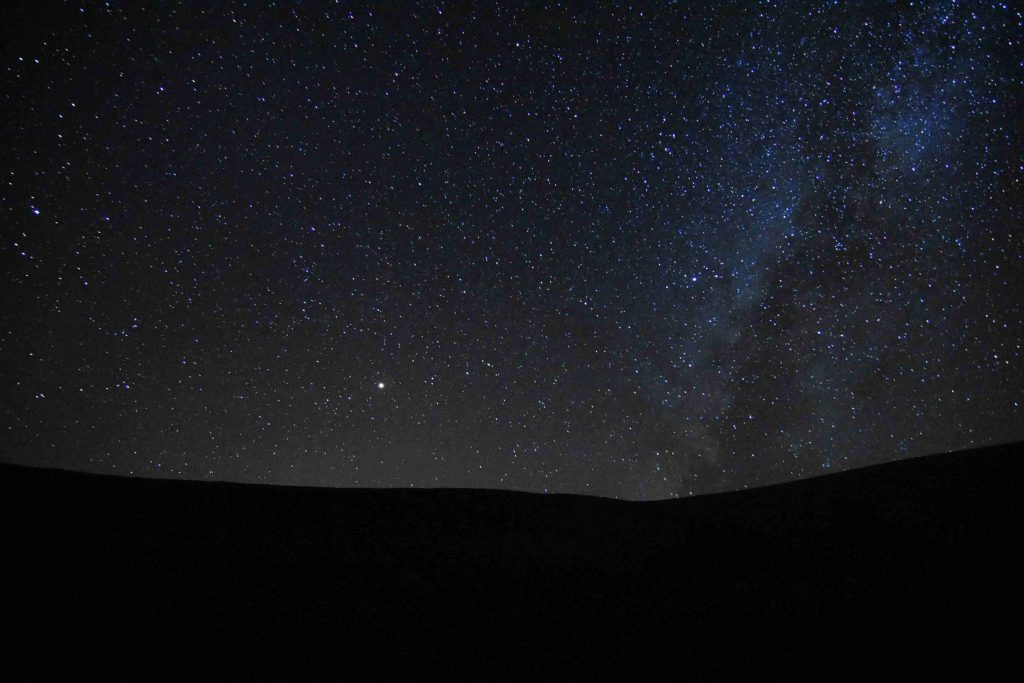
Starry sky pouring down overhead
■Chefchaouen, the Blue City
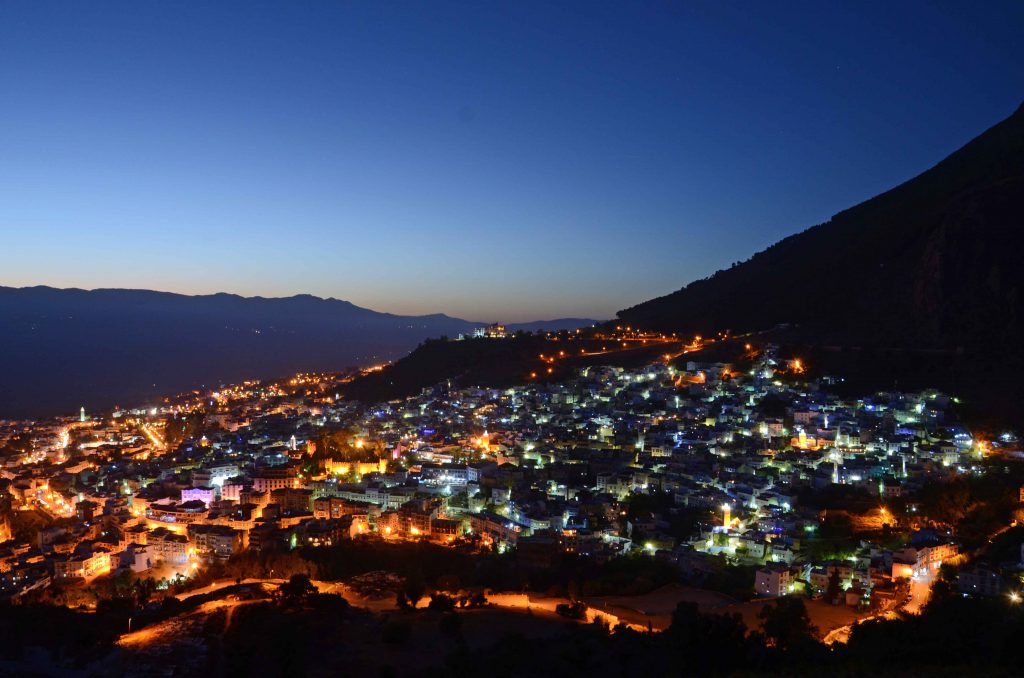
A view of Chefchaouen from the hill, where it is clear that most of the lighting in the city center is white
Chefchaouen is one of Morocco’s most iconic tourist destinations. This town, built on a hill, is famous for having all its exterior walls painted in shades of blue and light blue. The landscape, with primary-colored vases and fabrics scattered against the blue walls, makes you feel as though you’ve wandered into a fairy tale.
In the city center, there is almost no orange light from sodium lamps; instead, pale-blue fluorescent or LED lights are used. Since sodium lamps are used for the mosque light-up and the plaza in front of the mosque, it appears that a distinction is made in color temperature, using white light within the blue town. Illuminated by pale light against the blue walls, the town at night has a somewhat chilly atmosphere, transforming completely from its cute daytime charm. The paths are lit with minimal brightness, falling below 1 lux in the darker areas. With many shops closed after sunset and few people around, the city left the impression of being lonely and unsafe at night.
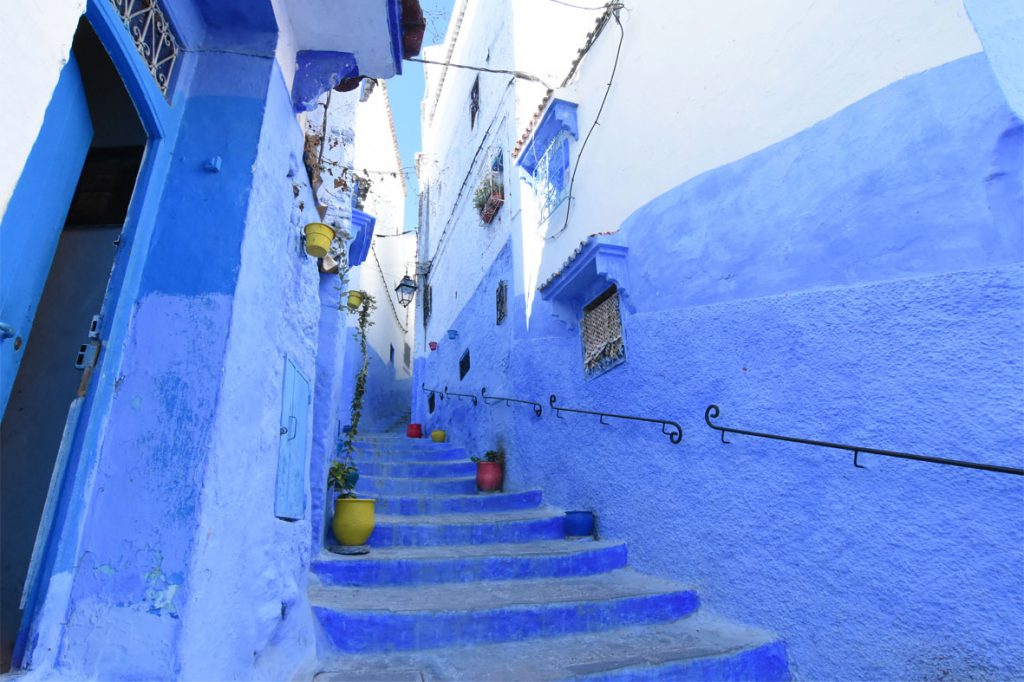
A path with both the walls and the floor painted blue
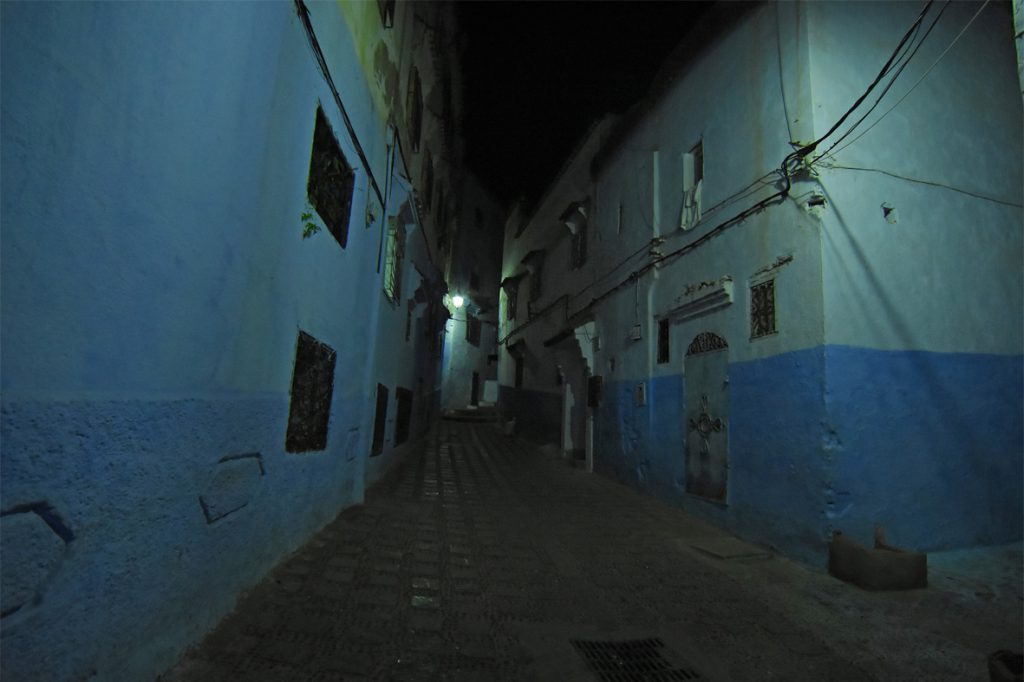
A chilly atmosphere pervades at night
■Casablanca, the Economic City

The Hassan II Mosque in Casablanca, the largest in the country, with a vast plaza stretching out in front of it
Casablanca, the commercial and financial center of Morocco with an international airport, gives a more modern impression than any other city we visited in the country. Along the coast, new construction of condominiums, offices, and commercial facilities is underway, showing that development is actively progressing. Every city we visited had an old and a new town, but the difference was most noticeable in Casablanca. In the new town, we saw large stores with neon signs, people enjoying street performances, and crowds chatting on brightly lit terrace seats under fluorescent lights.
In stark contrast, the adjacent old town was dimly lit only by sodium lamps, where everyday goods and groceries were sold on the roadside amid scattered trash. It was surprising to see such different worlds existing just a few minutes’ walk apart. I was struck by how all the various products were dyed a single shade of orange under the poorly color-rendered light, but perhaps this is a trivial matter for the easygoing Moroccan people. Throughout the city, the lighting primarily consisted of sodium lamps (around 2100K) used for streetlights, and compact fluorescent or LED bulbs (5000–6000K) used in shops. Therefore, we often saw a scene where streets bathed in orange light were lined with shops emitting stark white light. The white light felt somewhat unbalanced and bland against the old streetscape of the old town. However, these hanging bulb-shaped fixtures not only illuminated the goods but also the surrounding area, seeming to fulfill the function of lighting for safety and nighttime vibrancy.
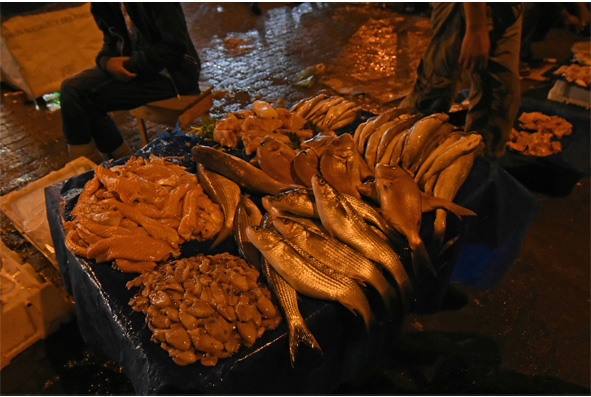
Fresh fish whose original color cannot be distinguished
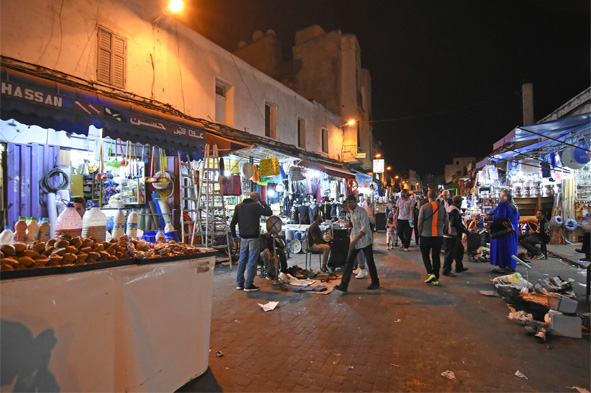
The Souk (market) in Casablanca
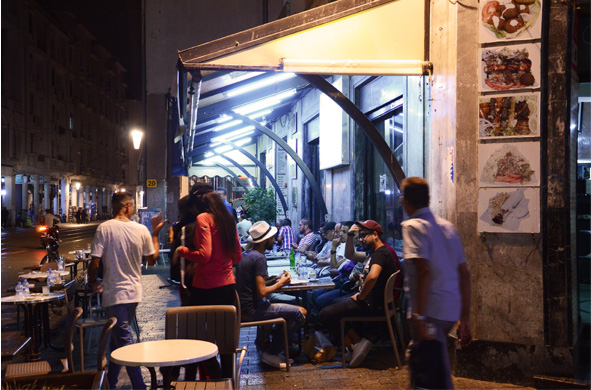
People chatting at the terrace seating
■Summary
With its beautiful Islamic architecture, unique sounds, and unforgettable scents, it’s clear why so many travelers are captivated by Morocco. The inevitable ingenuity developed for living under the intense sunlight has taken root in the Moroccan land as culture, creating a variety of natural light scenes. The nightscape has a completely different character between the new and old towns, and this chaotic environment can be seen as part of Morocco’s rich, exotic charm. With many areas designated as cultural heritage sites, we hope that the lighting environment will continue to develop by embracing both the new and the old, while preserving the best aspects of the old town. (Shosaku Takahashi)
City Night Walk Vol. 62:Shibuya River
New Face Shibuya: Searching for the Double Line of Light
2018/10/02 Tomoya Furukawa + Haruka Takano + Noriko Higashi
The redevelopment of the former Tokyu Toyoko Line Shibuya Station platform and the surrounding railway site along the Shibuya River has brought about the creation of Shibuya Stream, Shibuya Bridge, a revitalized Shibuya River, a promenade, and green spaces. In this highly anticipated area, we looked for lighting heroes and villains from three different perspectives.

The successful launch of Shibuya Stream and the Shibuya River revitalization project are turning the area into a new community hub
Redevelopment has been ongoing in Shibuya for many years. This Night Walk Survey started at Shibuya Stream, which opened in September. The walk proceeded along the Shibuya River promenade to Shibuya Bridge, serving as an examination of the “Challenge of the Shibuya River Restoration.” Taking the theme of “Searching for the Double Line of Light of the Shibuya River and the Toyoko Line Trace,” we divided the walk into three teams, each focusing on the perspective of the pedestrian, the creative worker, and the urban environment.

Members listening attentively to chief Mende’s explanation

The Shibuya River, with the river surface along the wall illuminated by blue laser light
■Team1(Creative Professionals’ Perspective)
Team 1, consisting of 11 members including chief Mende and four first-time participants, conducted a Night Walk Survey through the lens of a “creative worker,” seeking out lighting that stimulates and captivates the senses. The survey route covered Shibuya Stream → The crossing deck over National Route 246 under the Metropolitan Expressway Route 3 Shibuya Line viaduct → Excel Hotel Tokyu → The Shibuya River promenade → Shibuya Bridge → Mustard Hotel.
Shibuya Stream was open and airy with many atriums and openings, featuring a comfortable light environment with suppressed illuminance. The crossing deck over National Route 246 recreated the distinctive “kamaboko roof” (arched roof) and “shell-shaped side walls” of the former Shibuya Station platform for the Tokyu Toyoko Line, complete with embedded train rails, evoking a strong sense of nostalgia for the original design. The space was lit by spotlights aimed at the white side walls and around the rails. The resulting bounced light prevented the sense of compression often felt under viaducts, making it a “light space” (with a floor illuminance of 5–10 lux) and earning it a hero nomination. However, the Shibuya Stream logo sign installed in this space had a high luminance, and was nominated as a villain because it was “painful and glaring” to members whose eyes were dark-adapted. Additionally, an Italian-style restaurant on the second floor of Shibuya Stream presented a lighting failure: the spotlight illumination on the sign was inappropriate, meaning the shop’s vital name was invisible! This was a real waste for such a stylish establishment.
The Shibuya River, where the flow of water has been revived by a water wall, was illuminated by blue laser light from the foot of the bridges, shining onto the river wall between Inaribashi and Konnōbashi bridges. While the technique itself was debated, the affirmative side liked the “special blue light” for drawing attention to the regenerated Shibuya River.
The ceiling of the Shibuya Bridge passage featured two rows of line lighting reminiscent of overhead wires. This rhythmic light was well-matched to the architecture and naturally drew us into the depth of the building. Mustard Hotel beyond it was unanimously chosen as a hero. The entire building had a sense of uniformity, lacking excessive decoration or light, and the reception area, themed after a train ticket gate, felt playful. Although the area around Shibuya Station is undergoing redevelopment, we hope “Shibunama” (South Shibuya) will become an attractive place that provides relaxation and refreshment to creators and visitors as the only waterside area in Shibuya, making people want to hum the song “Haru no Ogawa” (Spring Stream). (Tomoya Furukawa)

The crossing deck that retains the traces of the former Tokyu Toyoko Line Shibuya Station

Line lighting in Shibuya Bridge that is reminiscent of overhead wires

Handrail lighting creates a sense of continuity and unity in the space

A relaxing space appears along the river
■Team2(Pedestrian Perspective)
Team 2’s theme was “The pedestrian perspective: establishing a pedestrian network to create new flows of people.” We investigated how Shibuya appears to pedestrians at night. Team 2 started in front of the large staircase at Shibuya Stream and followed the promenade along the Shibuya River to Shibuya Bridge. The Shibuya River promenade runs along the former route of the Tokyu Toyoko Line tracks, a history that is referenced by the remnants of the tracks continuing into Shibuya Bridge.
At Shibuya Bridge, the track motif on the floor is reflected in the ceiling lighting, which was rated as a hero for successfully carrying on the history of the site. The overall hero of the promenade was the creation of a relaxing space by renovating the previously uninviting Shibuya River bank and providing unified lighting. The handrail lighting along the promenade was consistent and illuminated the path with a comforting, calm light. The shop signs along the promenade were not overly aggressive, and the overall balance of lighting in the area to create this atmosphere was highly praised.
Conversely, the lighting villains that stood out were fixtures born from conflicting construction plans: the light from the pole lights reflecting onto the glass surface of the pedestrian bridge, and the bollard lights that stood at the same height as the handrails, which appeared to have been added later for barrier-free access.
On the day of the Night Walk Survey, perhaps because the Christmas season was approaching, a temporary illumination display was installed over the river. This installation led to a heated debate within the team over whether it was a hero or a villain. Some argued it was a villain due to its cheap, temporary look and the flickering light that hurt the eyes, while others were positive, saying it added a nice seasonal touch and looked like a beautiful path of light when viewed from above. (Haruka Takano)

The temporary sudare style illumination, which drew mixed reactions.

Inside Shibuya Stream, the design of the former Toyoko Line tracks is incorporated into key areas.
The not-too-bright lighting was highly rated

The store’s rear side is clearly visible and unattractive due to the lighting

The Grand Staircase at Shibuya Stream: An interactive installation where light and sound can be controlled by hand
■Team3(Urban Environment Perspective)
Team 3 conducted their Night Walk Survey from the perspective of the urban environment, focusing on whether the Shibuya River revitalization had successfully changed the flow of people and if the area had become a welcoming environment for evening enjoyment.
The first thing we noticed was the flow of people moving from Meiji-dori toward Shibuya Station. Perhaps because the station construction is still ongoing, few people walked through Shibuya Stream to reach the station. The vast majority seemed to use the exterior escalators. Since Stream is primarily a dining facility with few retail shops, it didn’t seem to serve as a convenient thoroughfare for workers simply heading home from the area.
However, the large staircase installation—which has light, sound, and interactive features and has become an icon for Stream—was ultimately judged a hero by Team 3, though it sparked much debate. The consensus was that while the technique of using light to attract and entertain people is not new, it is certainly effective.
Other points of contention were the Shibuya River’s laser illumination and the temporary sudare (bamboo screen) illumination. Although these two features seem to have increased attention to the Shibuya River, with people stopping to take photos, many issues were also observed, such as cheaplooking fixtures and the unsightly view of the backs of the shops being prominently exposed.
When we asked the owner of the restaurant that hosted our social gathering about the flow of people after Stream opened, he said, “Foot traffic increased right after the opening, but it has now returned to pre-opening levels. We are looking forward to the promenade extending all the way to Daikanyama.” The pedestrian path along the Shibuya River is not suitable for continuous walking, as there are no crosswalks where it intersects with roadways and fences block the way. The reason Meiji-dori Street has more foot traffic lies in the poor flow of movement and the lack of shops along the river. From an urban environment perspective, we feel there are many areas that need improvement. (Noriko Higashi)

The promenade is interrupted by a fence, making it impossible to cross

Meiji-dori Street feels more lively

The handrail and the bollard are the same height

The presentations at the social gathering
The Round Table Discussion Vol.60
Shibuya River Night Walk Review
2018/11/29 Noriko Higashi
We held a review of the Shibuya River Night Walk Survey. While there was high praise for the Shibuya River being brought back into public view, many opinions suggested there is still much room for improvement.

About 20 members gathered to exchange opinions on the nighttime environment of the Shibuya River

The sudare illumination over the Shibuya River generated mixed opinions


The Shibuya River’s laser illumination also resulted in divided opinions

The lighting environment of Shibuya Bridge received mostly high praise
We held a review of the Shibuya River Night Walk Survey. This time, instead of dividing the area to be covered, we separated the participants into three teams based on different viewpoints (Pedestrian, Creative Worker, and Urban Environment). Each team summarized and presented the lighting heroes and villains of the Shibuya River from their respective perspectives.
First, the team that focused on the Pedestrian perspective praised the successful creation of a more walkable area at night, where the formerly undesirable Shibuya River was transformed by strips of light from laser illumination and temporary displays. They also suggested that incorporating the “lines” of the former Toyoko Line and the Shibuya River into the lighting design was a good way to preserve the area’s history. The common characteristic among their villains was excessive brightness and glare from shops, signs, and lighting fixtures that ultimately undermined the atmosphere the promenade was trying to create. The team concluded that the constantly changing nature of Shibuya requires continued attention.
The team that focused on the Creative Worker perspective determined their heroes and villains by assessing whether the light environment and space—from Shibuya Stream to Shibuya Bridge (an area redeveloped to become a “sanctuary for creative workers”)—could stimulate and captivate their creative sensibilities.
As a redevelopment of a former railway site, opinions were raised that suggested the area felt successful and enjoyable due to the reuse of rails and troughs, the scattering of railway-themed items, and the preservation of the city’s memory through the original track alignment. The area as a whole seemed well-received. Shibuya Bridge, designed to look like a station platform, was also highly praised. The line lighting, which imitated the rails, and the MUSTARD HOTEL next to it were judged to be spaces favored by creators, with the hotel’s reception design—themed after an old ticket office—showing a playful touch. However, the temporary illumination and the blue laser lighting on the Shibuya River continued to divide opinions due to their cheap appearance and simplistic approach.
The team that focused on the Urban Environment noted that just two months after the opening of Shibuya Stream, the crowds had returned to Meiji-dori. While lighting was used to create a sense of vibrancy along the Shibuya River, they pointed out that the cluttered backs of the shops were made even more noticeable by the illumination, and the river promenade was not suitable for continuous walking, being blocked by roadways without crosswalks. The opinion was raised that the “back-alley feel” has not yet been fully eliminated.
The conclusion was that the attempts to revitalize the previously overlooked Shibuya River—such as using lighting to clearly separate spaces for relaxing from spaces for walking, and installing attention-grabbing illuminations—are part of a worthy trial-and-error process that should be continually improved.
A common issue raised by every team, though unrelated to lighting, was the terrible smell of the Shibuya River. While the odor seems to have improved significantly compared to the past, I doubt people will want to eat next to the river or spend leisure time on the promenade until this smell is completely eliminated. I believe the most frequent request was for immediate water quality improvement and odor control.
Our Night Walk Surveys in 2018 covered three distinctive areas of Tokyo: Jiyugaoka, Shinagawa, and the Shibuya River. With Tokyo continuing its development toward the 2020 Olympics, we plan to focus on the city’s hot areas again next year and organize more surveys. (Noriko Higashi)
Lighting Detectives Jr. @ Edo-Tokyo Open Air Architectural Museum
Darkness and Irori (Hearth) Experience Workshop
2018/12/01 Simeng Huang
This was our first children’s workshop at the Edo-Tokyo Open Air Architectural Museum in four years. To teach the children the importance of darkness and minimal light, we had most of the park’s illumination turned off after closing hours. The children were then able to experience how their five senses work in the dark.
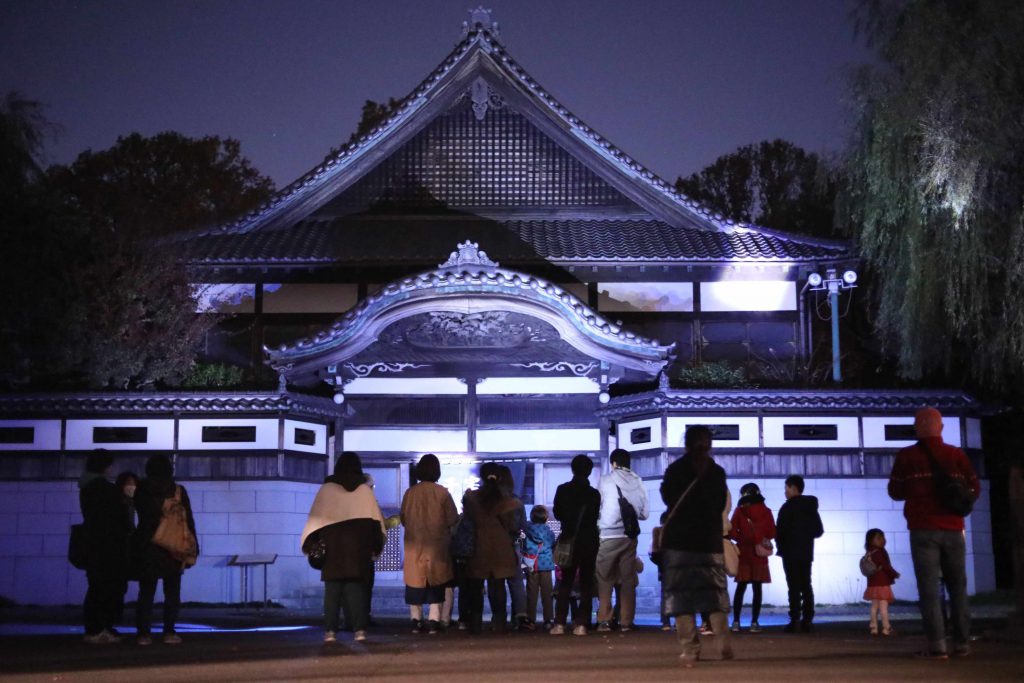
Illuminating the roof with flashlights and color filters
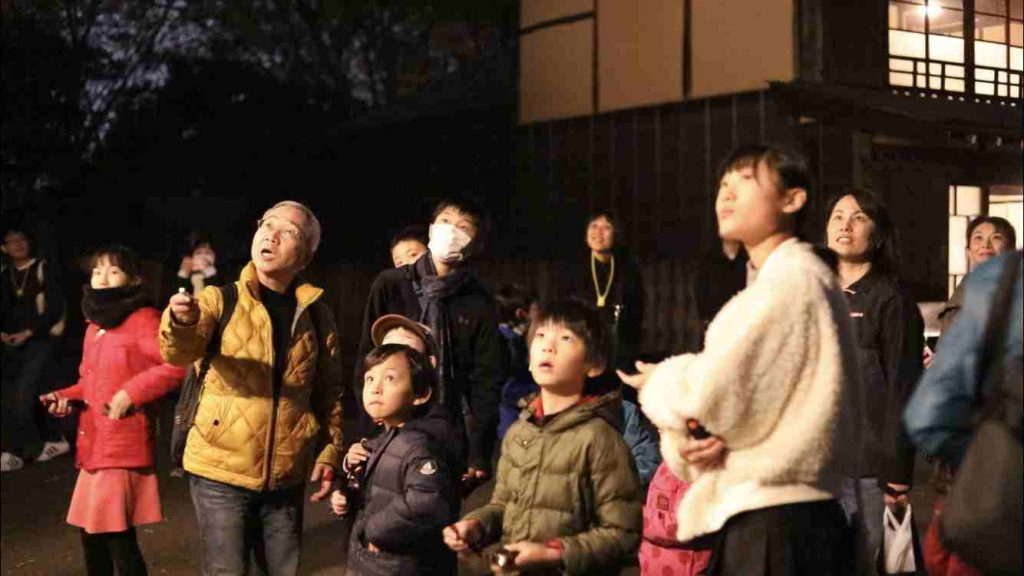
Applying the flashlight beam as instructed by chief Mende
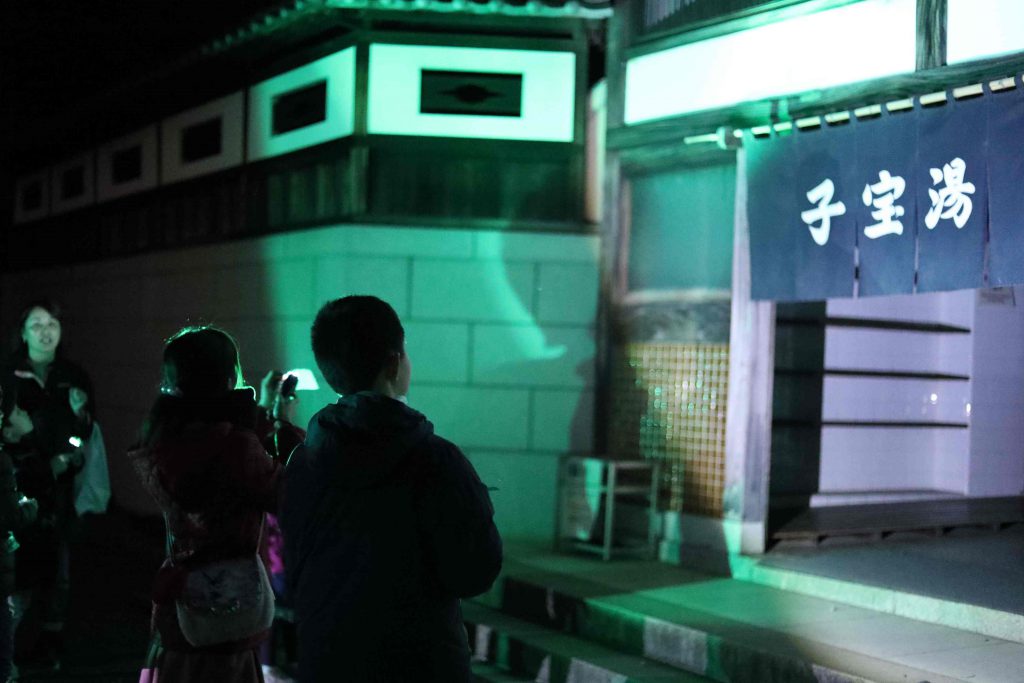
Illumination experiments using various colors
We held a children’s workshop at the Edo-Tokyo Open Air Architectural Museum on December 1st, just as the cold weather was becoming severe. This time, we conducted three activities: Light-up Ninja, Darkness Experience, and Irori (Hearth) Experience.
After the orientation, 17 elementary and junior high school students gathered in front of the Kodakara-yu (public bathhouse) in the park, carrying flashlights and color filters. Following chief Mende’s instructions, they illuminated the walls and signs of the building, changing the colors with red, blue, green, pink, and orange filters. Blue light was the most popular, and the consensus was that blue light looked best on the white plaster walls of the Kodakara-yu. When they lit up the large willow tree next to it, although we expected green to be popular, the opinion was that the white light without a filter was the best.
After the light-up, we toured the park to see the nighttime appearance of old Japanese buildings. For the children, who are accustomed to bright nights, it was like stepping back in time 400 years to old Japan. Everyone looked on with great curiosity.
Next was the Darkness Experience. Since they rarely have the opportunity to experience complete darkness, we had them walk alone through the unlit forest. The children’s reactions to the darkness were varied: some cried out of fear, some cautiously walked while being led by their older brother, and some said it was completely fine and ran through. However, the feeling that something might be lurking in the darkness seemed to be common among them.
Finally, gathered around the irori (hearth) in one of the private homes, we listened as Mr. Takahashi, the curator, explained how people spent their evenings in the past and the role of the irori. We learned just how important the irori was to old Japanese homes. In an era without electricity or heating, the irori in the center of the room was the only warm place in winter. The whole family would sit around the irori and eat their meals. In a time without mobile phones or television, that time spent around the hearth must have been lively family time, filled with conversation. The children enjoyed listening to stories of life back then, warming their hands and feet, and using the illuminance meter to measure the light around the fire.
Natural light has a mysterious way of drawing people in. Even the children, who spend their days surrounded by advanced technology, were captivated by the fire in the irori. They mumbled, “Just a little longer,” while gazing at the dying embers, but the last flame eventually went out, and the gathering concluded.
With the spread of mobile games and other technologies, scenes that were once common, like children playing outside or interacting with nature, have drastically decreased. I feel a sense of pessimism about the reality that opportunities to experience things that can’t be felt through a screen —the darkness of a forest, the warmth of natural light—are diminishing. In this context, this workshop must have been an invaluable experience for the children. (Simeng Huang)
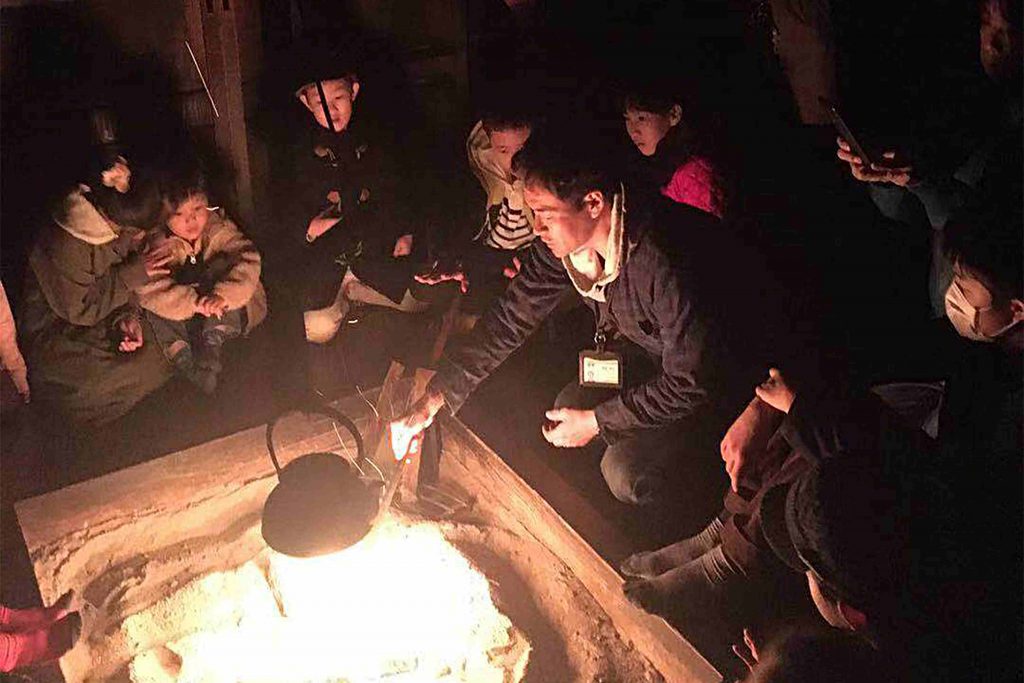
Children quietly listening to Mr. Takahashi’s stories while gathered around the irori
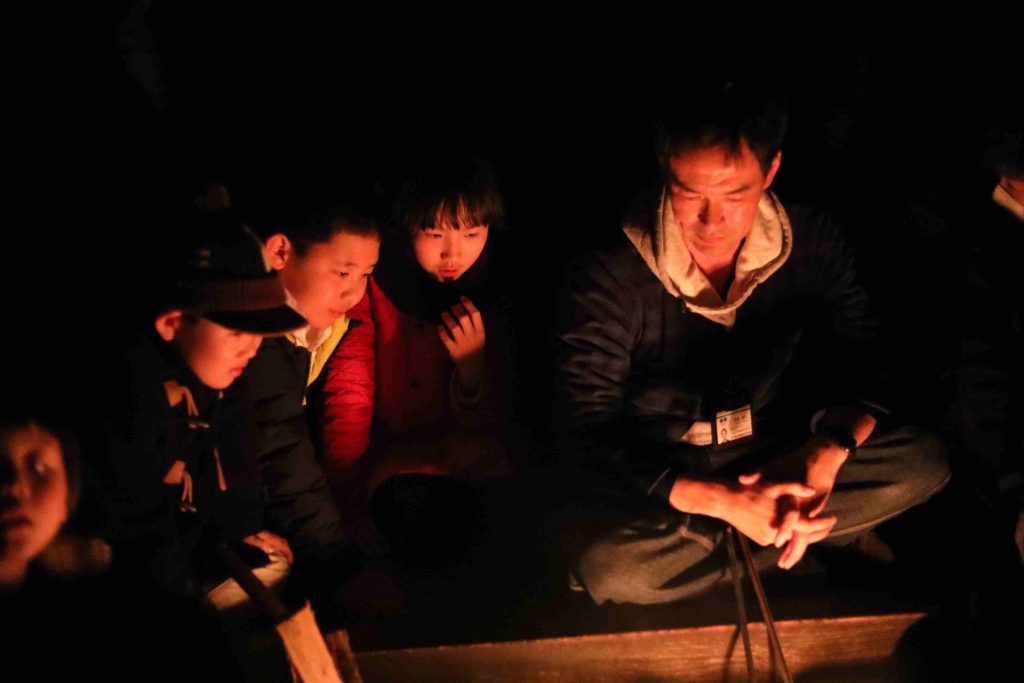
Drawn toward the irori (hearth), bodies naturally lean forward