Darkness and Irori (Hearth) Experience Workshop
2018/12/01 Simeng Huang
This was our first children’s workshop at the Edo-Tokyo Open Air Architectural Museum in four years. To teach the children the importance of darkness and minimal light, we had most of the park’s illumination turned off after closing hours. The children were then able to experience how their five senses work in the dark.
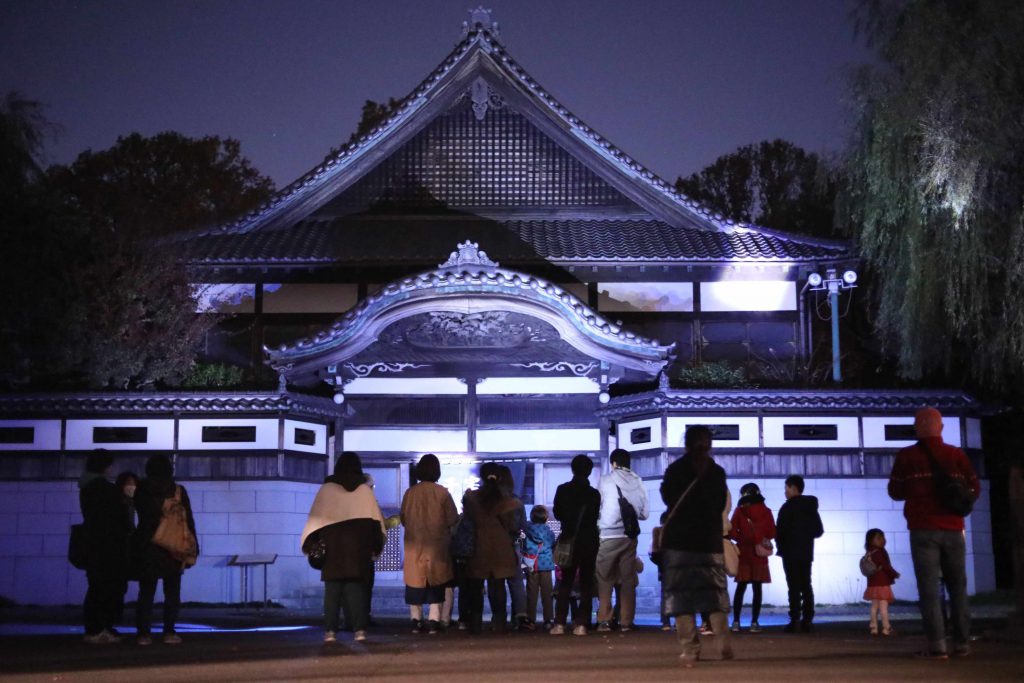
Illuminating the roof with flashlights and color filters
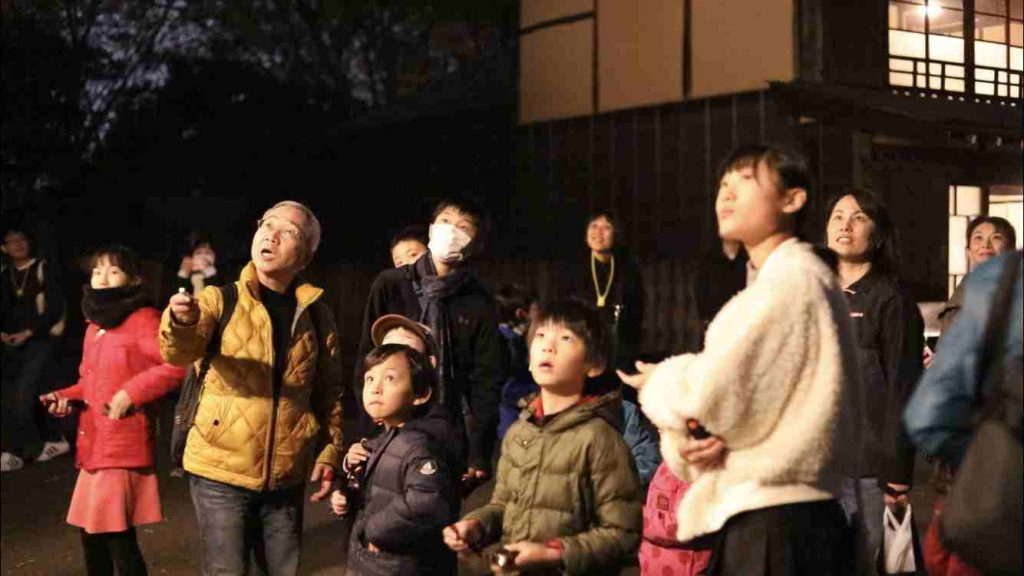 Applying the flashlight beam as instructed by chief Mende
 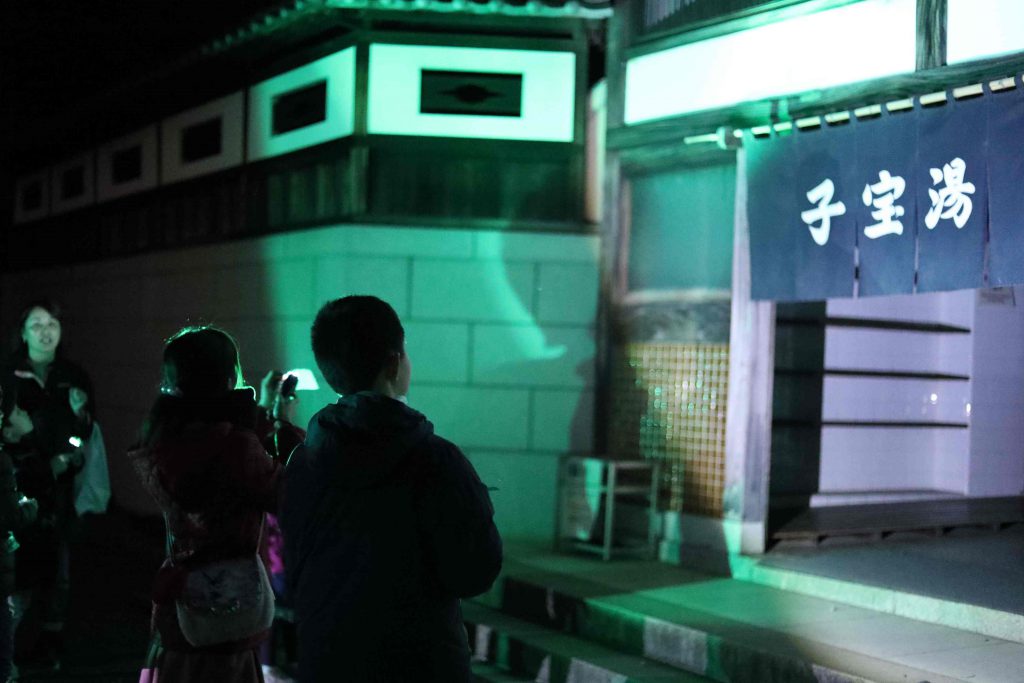 Illumination experiments using various colors
We held a children’s workshop at the Edo-Tokyo Open Air Architectural Museum on December 1st, just as the cold weather was becoming severe. This time, we conducted three activities: Light-up Ninja, Darkness Experience, and Irori (Hearth) Experience.
After the orientation, 17 elementary and junior high school students gathered in front of the Kodakara-yu (public bathhouse) in the park, carrying flashlights and color filters. Following chief Mende’s instructions, they illuminated the walls and signs of the building, changing the colors with red, blue, green, pink, and orange filters. Blue light was the most popular, and the consensus was that blue light looked best on the white plaster walls of the Kodakara-yu. When they lit up the large willow tree next to it, although we expected green to be popular, the opinion was that the white light without a filter was the best.
After the light-up, we toured the park to see the nighttime appearance of old Japanese buildings. For the children, who are accustomed to bright nights, it was like stepping back in time 400 years to old Japan. Everyone looked on with great curiosity.
Next was the Darkness Experience. Since they rarely have the opportunity to experience complete darkness, we had them walk alone through the unlit forest. The children’s reactions to the darkness were varied: some cried out of fear, some cautiously walked while being led by their older brother, and some said it was completely fine and ran through. However, the feeling that something might be lurking in the darkness seemed to be common among them.
Finally, gathered around the irori (hearth) in one of the private homes, we listened as Mr. Takahashi, the curator, explained how people spent their evenings in the past and the role of the irori. We learned just how important the irori was to old Japanese homes. In an era without electricity or heating, the irori in the center of the room was the only warm place in winter. The whole family would sit around the irori and eat their meals. In a time without mobile phones or television, that time spent around the hearth must have been lively family time, filled with conversation. The children enjoyed listening to stories of life back then, warming their hands and feet, and using the illuminance meter to measure the light around the fire.
Natural light has a mysterious way of drawing people in. Even the children, who spend their days surrounded by advanced technology, were captivated by the fire in the irori. They mumbled, “Just a little longer,” while gazing at the dying embers, but the last flame eventually went out, and the gathering concluded.
With the spread of mobile games and other technologies, scenes that were once common, like children playing outside or interacting with nature, have drastically decreased. I feel a sense of pessimism about the reality that opportunities to experience things that can’t be felt through a screen —the darkness of a forest, the warmth of natural light—are diminishing. In this context, this workshop must have been an invaluable experience for the children. (Simeng Huang)
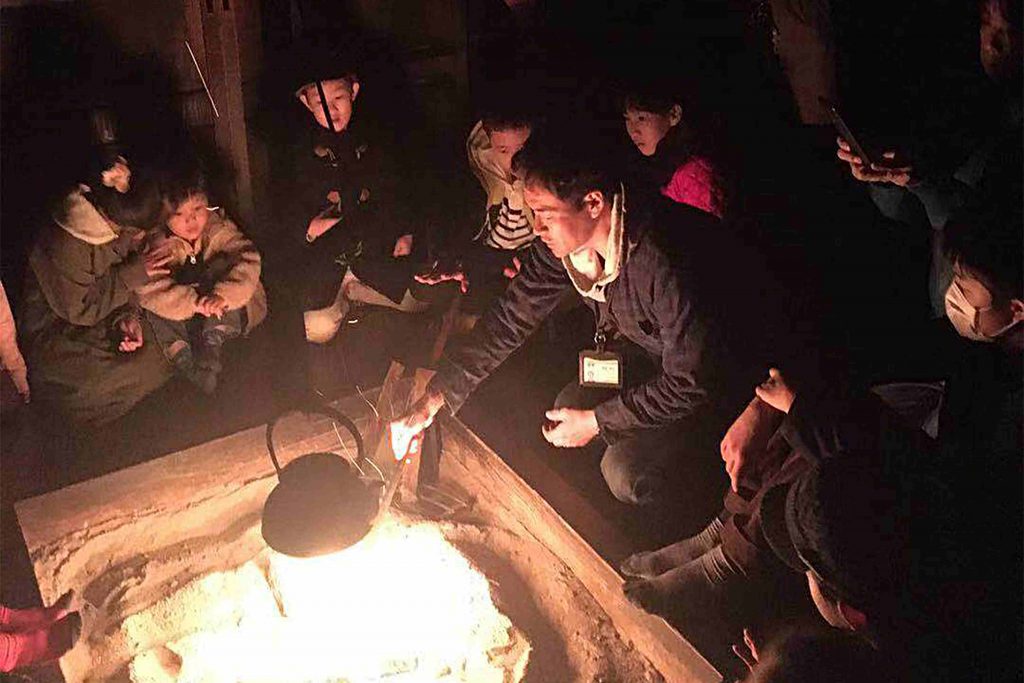 Children quietly listening to Mr. Takahashi’s stories while gathered around the irori
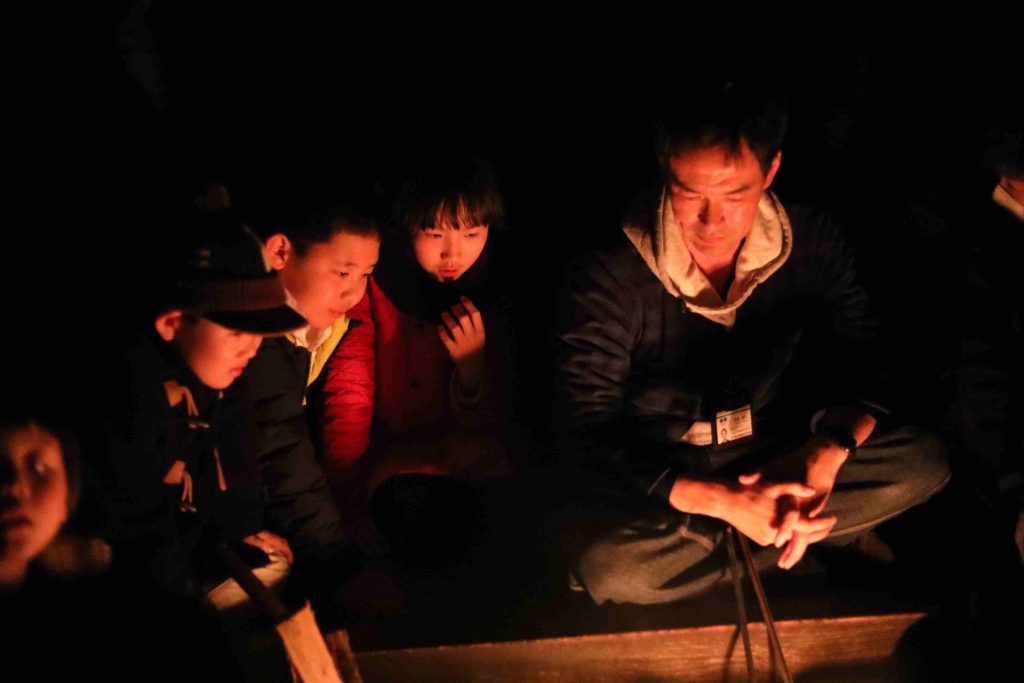 Drawn toward the irori (hearth), bodies naturally lean forward