Workshop to think about ideal way of light and future way of “Forest of Ueno”
2017/10/16,11/13-11/14 Haruka Takano + Toru Mori + Nobuyo Sato + Masara Akiyama + Koki Iwanaga

Lighting workshop at Tokyo National Museum. It was very precious experience to try out lighting plans
January and February of this year, we held a city walking workshop named “Ueno-Night-Park”. This is the second one of it. We carried out a workshop in Tokyo National Museum experimenting ideal way of light that we considered at field work last time. Illumination experiment was carried out during “The second Tokyo Suki-Festival”, and this workshop enabled not only participants but also citizens to rediscover the potential and its value of Ueno Park. (Koki Iwanaga)
■The first night: Lighting experiment and making of proposal
This time, we took 3 days to make a lighting proposal for Tokyo National Museum by bringing ideas from lighting professionals to students, house wives, and a wide range of people. Content was to set up the lighting fixture at the Japanese Gallery, Hyokeikan Building and an approach to Horyuji Treasures and illuminate and give presentation on the last day.
October 16th was the first night which was raining unfortunately. We started at 6 pm in Kuroda Memorial Hall, and moved to Tokyo National Museum and actually lit up the lighting fixture that was going to be used on performance. We confirmed each lighting fixture’s ability and characteristics by lighting from the second floor of Toyokan to Hyokeikan. After that, from 7 pm, we lit up the lighting that is usually carried out in Tokyo National Museum at night closing time and were able to observe/consider from many places.
When we finished researching at an actual place, we went back to Kuroda Memorial Hall and separated into Group A (Main building), Group B (Hyokeikan), and Group C (Horyuji Treasures・Kuromon, Black Gate) and started planning proposal of each location. The first night was scheduled very tightly with only 3 hours to research the actual sites and making proposal, but with participant’s active debate and creation of sketch, our expectation for the second night’s lighting experiment became higher. (Haruka Takano)
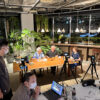
 Mr. Kinoshita from Tokyo National Museum explains the point of the event
 Scene of experiment of lighting up the roof of the main building from the second floor of Toyokan.
 Using actual fixtures and confirming its effect
 Separated into groups and made illumination proposal
■The second + third night: Lighting experiment + illumination performance
On the second night, November 13th ‘s workshop, we confirmed how the lighting plans that each group made is going to act lighting phenomenon in actual space, and conducted final adjustment to make ideal view. To prepare for the performance, we discussed ways of presentation of lighting plans for audience. November 14th was the day of the performance. We presented ideal lighting environment that each group considered. There was a group that performed with fancy arrange, and it was very spectacular for review meeting.


 Presentation of concept of illumination and its review was carried out from each group.
■Group A:Main Building
The presentation of illumination started from black wall of main building that the light was shining through a little. Then, LED beam irradiates in 7 colors for 60 seconds each on a large wall. Some colors recalled us the time flowed on this ground, such as pink and green that represents change of the season, and red for flames of war happened in the last days of Tokugawa Shogunate. Changing the color of wall and eaves of a large roof from white that was uniformed into the color we chose: material color of the stone from the main building that also goes with the color of woods that has warmer tone was a teamwork of group members covering up light source of 9 lamps with filters to lower the color temperature from 5000 Kelvins to a half of it.
With everyone’s shout, Tulipifera in front of the main building lit up, and irradiated dancing dead leaves close up on the end of the big tree that’s like guardian deity, and revival of next spring. (Toru Mori)
■Group B: Hyokeikan
Group B was responsible for Hyokeikan, Neo Baroque style architecture made by Katayama Toukuma Design in Meiji. For profound atmosphere of main building, image of lady, dome roof in melon sorbet color, dark sunken front entrance, using banner for exhibition carried out right now, wall design of wings that gives flat impression, lions that decorates the scary entrance. We decided to do experimental illumination with these items not just for problem solving. Members focused on the dark sunken front entrance. Someone suggested to highlight the center by lighting inner entrance to outer, and to form banner in RGB color with depth including columns. We tested many things like applying contrast to planar imprinted outer wall of right wing by coloring convex part in white, and concave part in orange. Other ideas were to make building’s edge stand out more, uplit trees, and light with blue or purple from image of lady.
There was an idea to use reflector to apply shades to get floating feeling on stairs leading to front entrance.
Eventually, we decided the concept to float from ground to the sky, and lighting calling for daily life to extraordinary. We emphasized the front entrance with image of rising color temperatures from low to high. The statue of lions in the entrance was lit up from diagonally below to break away from scary image. We tried to invite to presence of columns and inner part of building by emphasizing entrance by illuminating with lower color temperature from the ground in front of stairs. We changed the direction of existing lighting fixture on dome roof a little. We didn’t illuminate the trees, but it made shadows that performed well on the wall. Because of the limited time and equipment, we only could have lit the right wing on the outer wall, but if we could try again, we want to challenge on lighting circles that goes around as a series of story of each seasons of main building-Hyokeikan-Horyuji Treasures. (Nobuyo Sato)
■Group C: Passage from front entrance to Horyuji Treasures
Group C was responsible for pathway from front entrance of Tokyo National Museum to Horyuji Treasures. Besides the pathway, there are many tall trees that stand out the darkness. The glare of security light and the darkness of trees makes a contrast which increases the spookiness, and it was difficult to walk up to Treasures located at the end of the pathway. The problem is that there aren’t many visitors to Treasures. So, our concept was “lightings that guide visitors to Horyuji Treasures”.
The opinions that were made in the discussion were, making changes to visibility by illuminating buildings and monuments in the pathway, unity that doesn’t offset other building’s illumination, and how to keep the balance of favor Horyuji Treasures as a final goal. In the workshop using lighting fixture, we walked while moving fixtures initiatively, and discussed and adjusted for each points like intersections.
We eventually chose three method; 1. Illuminate the leaves of trees that grow thick like tunnel, and have the floating feeling and keep the brightness of overall space, 2. Set up the bollard lighting and make point of sight intentionally to make relieved feeling to visitors, 3. To favor the Treasures, we balanced by moderating the illumination of Black Gate to blend in overall space. The achievement of the actual illumination was that we were able to reduce the glare and make a different scenery, and guiding illumination to Horyuji Treasures. Since there are many trees in Ueno Park, many sceneries that looks like ours exist. The suggestion we made this time is something that could be reflected to future lighting planning of Ueno Park. (Masara Akimoto)
■Thoughts through these 3 days
Everyone has their opinion like “I want make it more like this”, so it is not so hard to image and draw it out. On the other hand, there are times that can’t be realized with your own power, or it requires many lucks and opportunities. This time, Shomei Tanteidan was able to reproduce and verify the proposal through workshop actually using lighting fixture in front of the eyes.
I was very interested in ideas brought up from the workshop such as plans using LED of RGB and lighting in warm color, and proposal using shadows and reflections made by illuminating trees and water surfaces. Many people’s ideas and opinions were broken down and reconstructed by professional’s knowledge and experience, which I saw source of feasible new ideas.
I am very excited to imagine that this workshop’s idea is in the scenery of Ueno which is enjoyable both in the daytime and the nighttime. I am expecting to find one scene of new night in Ueno. (Haruka Takano)