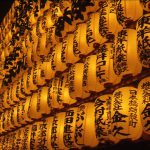
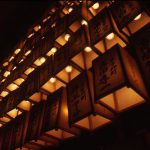
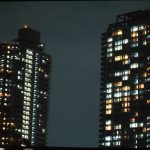
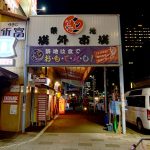
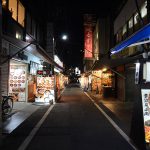
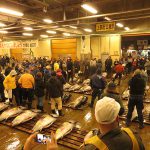
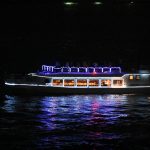
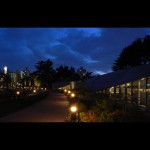
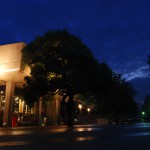
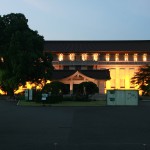
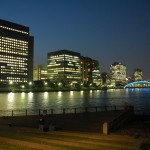
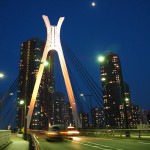
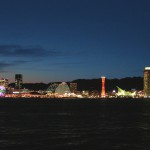
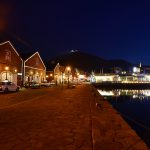
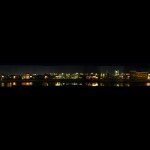
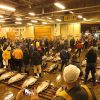
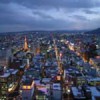
City Survey: Tsukiji, Tokyo 2017/12/14,2018/01/12 Nemoto Isao + Masafumi Yamamoto Night view from the opposite shore of Tsukiji, across the Sumida River. Tsukiji Market on the middle, Tokyo Tower and Tsukiji Bridge on the left, and Kachidoki Bridge on the right. In this Tsukiji survey, we visited the inner market, where mainly wholesale is taking place, the outer market, where visitors can shop and eat, and also the Tsukiji Honganji temple and the Kachidoki Bridge which are popular spots for tourists. ■Luminous Environment around Tukiji Fish Market From the Kachidoki area on the opposite side of the Tsukiji fish market, you can overlook the entire view of the market, buildings such as Kachidoki Bridge and Tokyo Tower across the Sumida River. While we notice white light that comes from the market and surrounded buildings, the warm-colored light of incandescent lamps emitted from the fish handling facility facing the Sumida River on the opposite shore. This view is quite impressive, and creates an emotional and beautiful view during the night.This warm light from the market brings the sense of the history of Tsukiji rooted in this area for a long time. In contrast, the white light emitted from the group of high-rise buildings in the background seems to symbolize the momentum of the rapidly evolving city. Outside the market, there are more than 400 shops, and many shops still remain open after evening.Various light sources and lighting fixtures are used in each…
2022.07.11 Hikaru Kimura + Yonglin Ke + Xueying Piao Shibuya, known as a youth hub, began redevelopment in 2012, transforming into a business district with a cluster of new office buildings and commercial facilities. While many new restaurants have emerged, traditional drinking alleys remain intact. This survey investigates the contrasting night scenes of the new and old Shibuya. ■Overlooking Nightscape of ShibuyaFrom the Shibuya Scramble Square, the rooftop of Miyashita Park stands out prominently to the east of the central railway tracks. The warm glow along the podium belongs to Shibuya Yokocho (alley). Nestled beside the pitch-black railway tracks and appearing as a dotted red line is Nonbei Yokocho. Viewed from above, Nonbei Yokocho exuded a soft, flickering light, resembling candles, in contrast to the lively and vibrant atmosphere of Shibuya Yokocho.The overall nightscape, divided by the Yamanote Line tracks, presents a striking contrast: the western side is dominated by tall buildings, densely packed with billboards and advertisements, exuding the lively energy of a traditional entertainment district. The eastern side, on the other hand, has fewer billboards and subdued signage, giving it a unified and calm appearance.I wonder if Shibuya will eventually become a more standardized urban landscape, much like its eastern side. Personally, I felt the bustling, nostalgic charm of the western side embodies the true spirit of Shibuya, and it’s something worth preserving. (Yonglin Ke) ■Shibuya YokochoRAYARD MIYASHITA PARK, a new landmark in Shibuya, features Shibuya Yokocho, a 100-meter-long…
Roppongi has many faces including, an entertainment district with a foreign twist, new offices for daily business, and is developing as a center for the Tokyo art scene. The Lighting Detectives sped around on their bikes in April to discover what kind of light exists in this multi-functional area. The presence of the entertainment district is strongly felt at Roppongi intersection. Most people recognize this intersection as the center of Roppongi, but in recent years new development has created two new areas of focus, leaving the center of Roppongi very ambiguous. Points of reference include Mori Tower, Midtown Tower, Tokyo Tower and the metropolitan expressway, that cuts through, dividing this area of Tokyo. Large-scale luminous signage and a collage of other miscellaneous lighting dominate the view. Looking toward Roppongi from Aoyama Cemetery. The 3 towers that stand pronounced over Roppongi are a product of power and force, but appear alien in this setting. The towers look close and, yet, far off, as this scene can play tricks on your eyes.
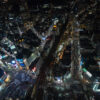
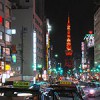
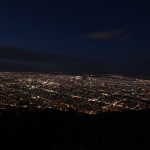
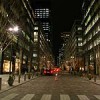
The Marunouchi district in the center of Tokyo has been transformed in recent years from a business and financial center to the latest redevelopment to intertwine commercial and office space. Our survey started in Marunouchi, as we closed in on the infamous Tokyo Tower to view the sprawling Tokyo nightscape. Marunouchi Central Street is enclosed on both sides by buildings all at the same height of 31 meters. Facade lighting and streetlights throw an even light over the street, creating a flat nightscape with no rhythm of light and shadow. Quite possibly occupying the staring role in the production of the Tokyo nightscape is the Tokyo Tower. The ironworks structure of this tower is illuminated from underneath, beautifully generating a glowing symbol for the city. At 250 meters, looking down on Tokyo from the tower is a beautiful site. Glare is blinding and there is no visible unified pattern to the lights of Tokyo, but lights twinkle all over the city and continue as far as the horizon. Things always look better from a distance and the Tokyo nightscape is one of them!
The Television Broadcasting Tower looks down on the orange sodium lamps overflowing from the grid patterned streets of Sapporo. While on assignment in December we were able to view the multi-colored White Illumination set up along Ohdori Park and Sappore Eki Mae Street. Looking towards Ohdori Promenade from the JR Tower. Sapporo is a beautiful city at twilight with orange light from the streets to set off the blue-tinted snow-topped roofs. The tree-lined street, Sapporo Ekimae Avenue is a sight to see with its unique style of looping lights over tree branches. Visitors with cameras and mobile phones converge on the decorated Ohdori Promenade. Sapporo Television Tower, similar to Tokyo Tower and Nagoya Tower, and all designed by the same architect, is also illuminated with the same type of sodium lamp.