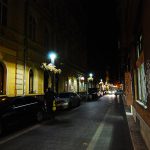
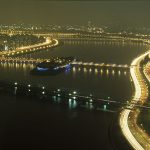
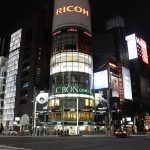
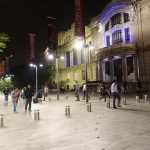
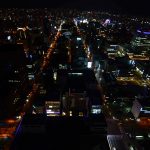
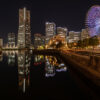
2022.06.28 Kouki Iwanaga+ Xiaoyi Dong+ Hikaru Kawata Yokohama Minato Mirai, which has seen rapid development in recent years with projects such as Japan’s first urban circulation ropeway “YOKOHAMA AIR CABIN” launched last spring, the cruise ship terminal “Yokohama Hammerhead,” and the prestigious Hawaiian luxury resort “The Kahala Hotel & Resort Yokohama.” The purpose was supposed to be to investigate whether the “nightscape of Minato Mirai,” which could be considered a tourism resource in itself, has been well preserved… but. ■Relationship Between Zoning and Street Lighting The Minato Mirai area, which was developed on reclaimed land around Yokohama Port, can be broadly divided into three zones: the “Central District,” the “Shinko District,” and the “Yokohama Station East Exit District.” Among these, our survey focused on the Central District—with its high-rise buildings such as Landmark Tower and Queen’s Square Towers—and the Shinko District, which features many commercial and cultural facilities such as the Red Brick Warehouse and Yokohama Hammerhead. When examining the street lighting in these two districts, it was found that the streets running parallel to the Rinko trunk road and the Metropolitan Expressway were lit with sodium-colored lamps, while the streets leading toward the port, such as Icho Street and Keyaki Street, were illuminated with streetlights at a color temperature of 4000–5000K. At first glance, this color temperature plan, which changes according to the direction of the streets, appears well-organized. However, according to the building color scheme guidelines for the Minato…
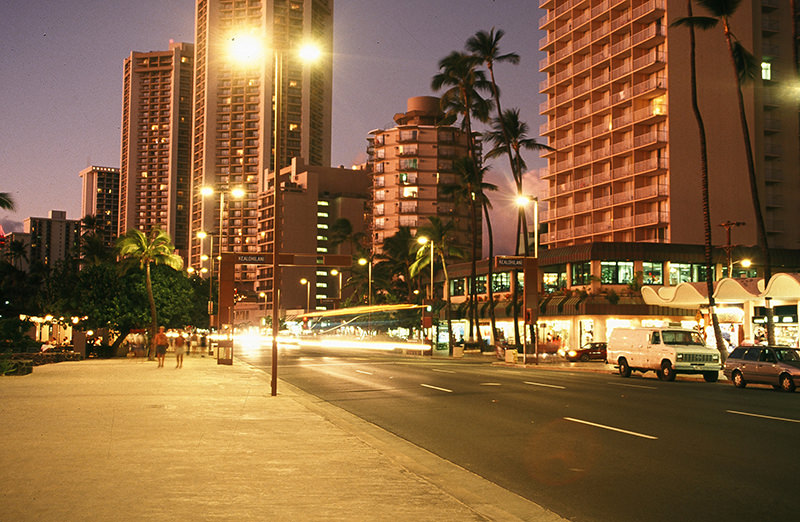
2025.09.04-09.08 Yonglin Ke + Masashi Kurobe The nights in Honolulu are a diverse blend of resort illumination, residential lights, torches, and night market glows. However, as the city develops, the starry sky is fading, raising concerns about the impact on the local ecosystem. Balancing urban growth with light pollution countermeasures remains a significant challenge. We conducted an on-site night walk survey to explore the balance between the city and nature and to evaluate the current lighting environment. ■Honolulu Honolulu, the capital of the U.S. state of Hawaii, is a prominent tourist destination in the heart of the Pacific Ocean. Simultaneously, it serves as the political and economic hub of the state. In this land where the sea, mountains, and urban areas sit in close proximity, the nightscape reveals a variety of expressions depending on the time and location—blending the glow of resort hotels, the soft lights of residences, traditional fire torches, and the vibrant lights of night markets. Furthermore, the combination of intense sunlight and a tropical climate creates a unique character within the city’s lighting environment. On the other hand, urban development and the growth of the tourism industry have negatively impacted the visibility of the starry sky and affected local ecosystems, such as migratory birds and sea turtles. While the state and city have begun implementing measures to reduce light pollution, finding a balance with the tourism industry remains a challenge. During this night walk survey, we investigated…