
Tomoya FurukawaKanagawa Still basking in the joy of how bright, unusually large, and beautiful last night’s full moon was, I headed out early in the morning to the wood deck along the beach. I went to take part in a radio calisthenics session together with elderly ladies, married couples, local runners, etc. The morning after the Cold Moon, sunrise in the Shonan area on December 6 was at 6:33 a.m., and as we exercised, we ended up watching the sun rise. I restarted radio calisthenics to add some rhythm and structure to my long days. I thought I would probably give up after about three days or so, but I have stuck with it for a month. I wonder why I have stuck with it this time? What is my motivation? The early bird catches the worm? A growing sense of urgency to maintain physical health? Because I like the post-workout chat? “Mt. Fuji is very beautiful today. So clear. You can see Ohshima Island!” “Glad to see the sun rise, again today. So peaceful.” At this time of year just before the winter solstice, the sun in the Shonan area gradually shifts to the right of Enoshima in the eastern sky and rises from behind the Miura Peninsula. As the sky turns pale and bright, about five minutes before sunrise the eastern horizon slowly deepens into shades of red. Then, for a few minutes until the very top of…
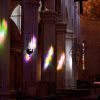
Mutsuo HonmaLighting Environmental ResearcherKyoto How has the design of light in architecture evolved throughout human history? This is the research theme I am currently pursuing, with a particular focus on religious architecture. Today, I would like to share an overview of this work with you. I very much look forward to your enthusiastic responses. Today, light is valued for concepts such as ‘coloring space’ and ‘creating atmosphere.’ In the past, however, I think the role of light was much simpler. In the Romanesque period, the use of stone masonry arches imposed clear limitations on the size of window openings. Reliance on daylight was unavoidable, therefore, windows known as embrasures, with splayed edges, were widely used. Maximizing daylight was regarded as an absolute priority. Because embrasures also increased penetration of direct sunlight, linear shafts of sunlight entering through windows into otherwise dim interiors may have been perceived as gifts from God. Presumably, this visual experience was cherished and valued. Fast forward to the Gothic period, structural innovations dramatically relaxed constraints on window openings. Although these developments might naturally lead to brighter interiors, in reality large windows were filled with low-transmittance, richly colored stained glass. Instead, deliberately preserving a dim atmosphere and bathing interior spaces with shafts of direct sunlight filtered through stained glass. Introducing the injection of colored light. While one theory holds that stained glass served as a visual display of biblical stories for followers, regardless of interpretation, this period…
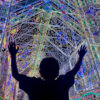
Federico FaveroLighting DesignerStockholm When asked to write a note in TNT column, I was considering to share my thoughts on how Artificial Intelligence might change lighting design. But then during the summer I experienced the “Notte delle Luci” (Light Night) festival, and I felt the urge to report it. Visitors of the festival gather at dusk in Scorrano, a small town in Salento, the heel of the Italian boot. Thousands of people walk from the outskirts of the town to the main square. The public lighting is switched off and there is life buzzing from the shops and the restaurants. White structures along the streets frame the sky and create architectures of varied scale and complexity. These structures are called “Luminarie” and host multiple light points in patterns. When the sky is completely dark, music starts and all of a sudden all the “Luminarie” are switched on. The architectural structures shine, their patterns become alive, people are lit almost as in daylight, the atmosphere recalls a sense of fascination and of lightness. The eye shifts constantly between the saturated light dots and a sense of intense diffuse white light, which creates a vibrant complexity. Most of the lights are static but there are also spectacular shows of light and sound in the square and the surrounding streets. All in all, an awe-inspiring experience. I asked Paolo Portaluri, a lighting designer based in Salento, to give some context to what I…
Christof FielstetteLighting DesignerHamburg Light and shadow are fundamental elements of our world and have always inspired the imagination of humans. Light is the source of life, it allows us to perceive the world around us and gives us orientation. Shadows, on the other hand, are the absence of light, they are created when light is blocked by an object and can sometimes be unsettling or even frightening. However, despite their contrasting nature, light and shadow also have a lot in common. They are both essential for balance in our world and offer us the opportunity to see things from different perspectives. Without light, there would be no shadows and without shadows, no light. They rely on each other and cannot exist without the other. In nature, shadows provide a welcome change from bright, sun-drenched landscapes. They can be an oasis of coolness in the heat or a refuge from rain. They are an important part of the landscape and contribute to its diversity. Shadows also have a symbolic meaning. They can be a metaphor for the dark sides of human nature or for insecurity and fear. At the same time, they can also serve as a place of rest and relaxation, a place to protect oneself from the scorching sun. Another important aspect of shadows is the beauty they can radiate. In art, shadows are often used as a means to add depth and dimension to a picture. In architecture,…
Reiko KasaiLighting Design ProducerSingapore I am now cramped in a packed economy class flight from Bangkok back to Singapore with my laptop open. I am amazed at the number of people passing through the airport. The reason this scene feels like a dream is that I am still vividly remembering my flight from Japan only a year ago, when the airport was deserted, and I was the only passenger. On the return “private” flight from Haneda to Singapore, I enjoyed strolling around the cabin, chatting and playing cards with the five amiable cabin crew members who were working for just one passenger. The anxiety of the mandatory 21-day hotel stay that awaited me after landing had disappeared. Once again, I was the sole passenger on the bus that ferried me from the empty and lonely Changi Airport, where there were more staff in protective suits than passengers. I was nervous because I was not told where we were going, but we arrived at a high-rise 5-star hotel with a balcony in the center of the city. My prior fearful and pessimistic imaginings – 21 days isolation in the locked hotel room, boredom, stagnation, ill-health, and madness – were completely misled as I spent the next 21 days in peace, comfort, leading healthy regulated time schedule, and happiness. I can say with absolute certainty that what brought me happiness was the view from the room; windows that fully opened to the…
Paulina VillalobosLighting DesignerSantiago Being part of the lighting detectives family, first as a student in Belgrade, Serbia (2008) and later as core member in Mexico 2015, has become an amazing cultural adventure of night and day light. During the workshops we use language to communicate our perception, thoughts and feelings of light in each one of our own languages. But as much as I experienced different cultures, the boundaries to express, understand and perceive “everything” expands and at the same time questions the limits of language. Language helps us to design reality.When the Greek philosophers started to define concepts far beyond what we could see, the language grew from the sound to define an object or food to describe an idea like philosophy, aesthetics, metaphysics, democracy and so on. With these new words they expand thoughts, communication and also perception of reality. In ancient Greece there were no words to describe all colours like we have now, just some few basic colours were enough to live, enjoy and talk about complex philosophy. Blue was not part of them, they did not need it. Hence, they did not see it. The evolution of language since long ago made the blue possible in all contemporary languages. Now if we speak about light we can not imagine our thoughts without the blue concept to describe our environment, but the reality or our environment had changed so fast in the last decades that we…
UNO LAILighting DesignerTaipei I imagine, when we look back twenty years from now, this period of time will appear as one long pause. Over the past 48 months, I have been in quarantine 10 times for 14 days each, adding up to 140 days — nearly 4 months of my life that have disappeared. Perhaps, though, it is not so much that those days have disappeared; rather, the pause simply occurred and can be examined positively, as a phenomenon. Life leading up to this point had been very busy — so busy that I could sometimes hardly recall what I had just done or what I was doing. The pause, as a force, has slowed the pace so that I can more clearly see what I do and what the next step is. Twenty four hours has often felt like a blink, a swiftly disappearing day… and yet in the long isolation of quarantine, twenty four hours seem like a vast expanse, an endless day during which one can watch time ebb and flow. As I add up these days, they resolve into a long stretch of quiet that has offered space to more fully appreciate where I have been, to reflect on the things that occurred and think about the people who were part of those experiences. Before the outbreak, it would have been nearly impossible for me to remain at the same balcony or by the same window…
Aleksandra StratimirovicArtistBelgrade … well, it has been both very different and almost the same. Being an artist, I am used to work alone in my studio. Just the same as under this pandemic period when you were not recommended to meet with others. Loneliness is inevitable in the process of creation. At least it is for me. I need to struggle on my own through that essential part of each concept process. Only when a true and stable idea, or vision, or goal is born, I can open my doors and face the world. Those periods I both enjoy and dislike. I have no one in those moments to brainstorm my ideas with, and that can be so frustrating. And it takes time, always… until it gets solved by me alone, of course. What I don’t like is the feeling of helplessness when my thoughts and ideas are not satisfying my inner creative “boss”. But, those moments are unavoidable and so important for my own evolution. When the right idea is born and to my delight accepted and approved by the “boss”, the next phase is opening to the world. Reflecting on this pandemic time, that changed our world so drastically; I would like to focus on the positive effects of it, although those are very few. What comes to my mind first are just those awfully huge, overwhelming big politics, big economies, big strategies … just too many hopeless…
Written by Charles StoneLighting DesignerNew York・Seattle・Tucson My favorite memories as a Lighting Detective are those hours spent around a table or in a circle of chairs with the other Core Detectives talking about light. We come from 12 countries and varying professional backgrounds. I am always thrilled by their wide ranging poetic and scientific observations about light, as artists, practitioners, educators….and lighting designers. The one unique and crucial ability of a career Lighting Design professional is our observation skill: we are and must be, Expert Observers. This means we must understand the science and application of light, and that we must be able to express, often in words alone, as Detective Gustavo would say, “..how the light feels.” During these past 18 months, in the FMS studios, our hands-on evaluation of light fittings, whether in mock ups or in the daily parade of manufacturers’ products … has gone dark. Normally, we are fiddling with lights, discussing how the beam looks on a wall, and disassembling samples (sometimes breaking them “by accident”.) The remarkable dynamic range of the human eye requires us to pay attention to high lux level experiences too. Alas, we have also been missing daylight mock ups and site visits to evaluate daylighting. These absent observation activities create a problem that must to be solved. If you wish to be (or remain) an Expert Observer, it’s not enough to look at lighting effects in the world: you must…
Written by Ulrike BrandiLighting DesignerHamburg In March 2020 I sent out our annual spring card and wrote: Dear friends, As the beginning of spring and our spring card coincide with the spread of the Coronavirus Sars-CoV-2, I cannot send our card without comment.Fortunately, it is spring.A crisis is also an opportunity for something new, something better. This is my hope and I pay attention to every little sign. Could we create an economic system that is not so mercilessly based on inequality and growth? One that is not so sensitive to taking time off, being healthy, experiencing anxiety, protecting and caring for the needy, and reflection? Instead of returning to our “regular” way-of-life, I wish us all a more compassionate, loving, respectful, and unified attitude towards humanity and nature. In August 2021 I see: The world is on fire, as we can see from the satellite images of recent weeks. Floods and storms claim human lives, blackens the earth, driving people all over the world into long term existential distress. The global extinction of species continues unabated, and COVID-19 is also a consequence of increasing ignorance. In the face of these wide-ranging changes that challenge us, we emphatically desire to make an impact in order to live in a truly sustainable way. Lighting design is a small but influential profession. Our contribution can be impactful. Light pollution: Let’s minimize and avoid light pollution in all our projects by providing our…
Written by Acharawan ChutaratLighting DesignerBangkok There is still the bright side in every dark situation, especially during the COVID-19 pandemic. At least, it has brought up opportunities for our friends of light to become closer, to share ideas, and to learn from each other by online communications. Enlighten Asia 2021* keeps us connected. Thank you Mr.Mende to think about us. Since April 2021, the situation in Bangkok has been worsened until the time I am writing this article. KMUTT has announced the temporary closure of all campuses in Bangkok from July 12, 2021, and uses online teaching/learning throughout semester 1/2021. It means no official face-to-face activities until December 2021. However, our students insisted to join the lighting workshop and expressed their passion that I can feel. Students have made good progress in their own way which I very much enjoy working with them. We adapted ourselves for learning. First, site selection, since we have limited access to sites, we discussed selecting sites they have been surveyed from previous classes that fit their interest. It strengthens their urban design class through different issues at night. Second, students had a chance to conduct observation skills for heroes and villains with my guidance before a worse situation. Real experience is still important. Third, we have learned from Tsinghua University, which is one of the schools that participate in this workshop, on data collection through different tools such as microblog, Baidu heatmap, Instagram using…
Written by Lisbeth Skindbjerg Kristensen Lighting DesignerCopenhagen Since spring last year the pandemic has drastically changed our daily lives, and I, like many people, have had to work from a home office. My desk is by a window. After working from home for some time, I realized something interesting: I rarely felt the need to turn the ceiling light on. Even on a dark winter’s day, a simple desk lamp provided ample task light and enough reflected light to take the gloom from the space around me, creating a perfect balance between the room and the objects I needed to focus on. A sense of calmness somehow filled the space. This made me think of the Mexican architect Luis Barragan’s notion of the human need for “tranquility in the half light”[1], and of the beauty of shadows described in the Japanese author Tanizaki’s book “In Praise of Shadow”. In contrast, the lighting in most of our indoor work environments is designed to be constant and stable, with very uniform and relatively high illuminance levels. And in many offices, room lighting and task lighting are provided by the same luminaires to ensure flexibility, efficiency and perfect environmental control. The architect Louis Kahn once stated: “Artificial light is only a single little moment in light (…) I can’t define a space really as a space unless I have natural light (…) because the moods which are created by the time of day and…
Written by Ignacio ValeroLighting DesignerMadrid No doubt this is the best dynamic lighting event EVER…Tunable white plus dim to warm and RGBW sources, stunningly huge backlit panels providing a truly immersive experience, controlled by the most complex random algorithm, which is performing in real time unique cues, with silky soft transitions, and driving zillions of watts. Nothing is even close to this. We try hard. But, simply, we cannot. This is the kind of bullshit a lighting designer might think in front of a sunset, while everyone else is just enjoying the wonderful colors. Actually, I do, I have to admit. But the truth is that it can be even worse. Like many other people, I have a deep relationship with sunsets. With each of them. With all of them. With this one I’m witnessing right now as well. It all began as a child. Even then, I kept suspended in front of a dusk, my mother told me. As a kid, when I kept constantly running from wherever to whoknows, I used to stop, mesmerized, for the sunset call. As a young man, I remember myself cycling as fast I could with my tripod and my first camera, every single afternoon for a long time, just to grab some pictures that looked so unique for me then. Now, at my late fifties, I still keep on hold every day. Sunset light opens some kind of intimate door and, for…
Written by Kaoru Mende It has been 31 years since the start of the Lighting Detectives in August 1990. We have also been connected to members around the world since the announcement of the Transnational Lighting Detectives 21 years ago. It seems like just yesterday, but also such a long time ago. It wasn’t our initial intention to grow membership, but the number of membership cards issued has reached 1400 with 250 members from overseas. With this many members it is hard to remember everyone’s face, so I thought we needed something to create a sense of togetherness. On the Lighting Detectives website, there are two columns I contribute to regularly, “Mende`s Lighting Detective Note” and “Coffee Break.” The Mende’s Detective Note is a collection of short essays about experiences with light and shadow from my point of view. As I reread some of these essays, good and bad writing is very obvious and I find it very interesting. Every so often, the point blank feelings and remarks in these essays are so very me. On the other hand, “Coffee Break” is written as a casual interaction over lunch between a staff member and I, the principal of the lighting design office, LPA. With a total of three offices in Tokyo, Singapore, and Hong Kong, staff has grown to about 60 members. Each individual is, of course, unique and many LPA staff members are very assertive and passionate. I really…