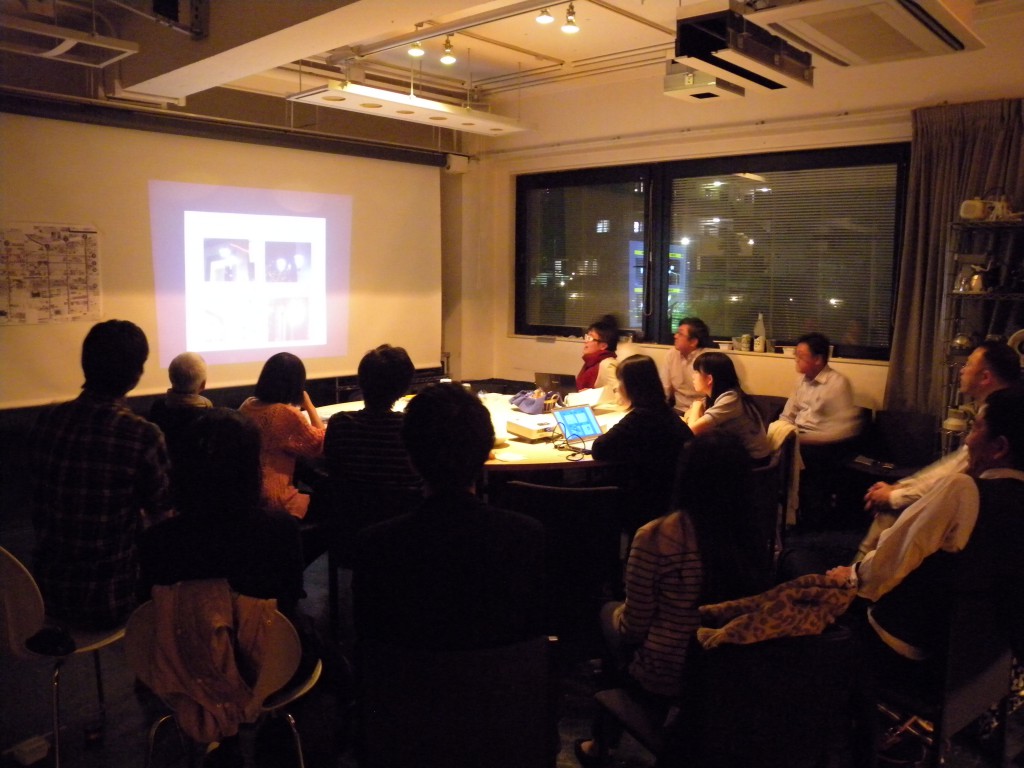
Round Table Discussion will be held on 6 SEP(WED)19:00-21:00 @ LPA .
If you would like to attend, please send mail to office@shomei-tanteidan.org
Looking forward to hearing from you.
Vol.55 Round Table Discussion Review on city walk in Tsukuba Express Area 05/29/2017 Noriko Higashi We held a review on the city walk in Tsukuba Express Area. Did we find to our answer to the key thesis, “The last developed major railway in the capital region, Tsukuba Express – The lighting for the development of railway line succeeded?” We held city walk in Tsukuba Express Area on May. 15 members joined. It was not many, but we could have deep discussion. We had four groups, which walked the following four areas. Kashiwanoha-campus Station, Yashio, Nagareyama-ōtakanomori, Kitasenju. Some members commented it was difficult to find Heroes. The railway line area and its surrounding areas are being developed since EX was opened on 2005. The access from Tokyo to Tsukuba got to be convenient. Along the railway development, new shopping malls and high-rise apartments have been developed as well. However, lighting planning has a lot of problems. We found very glare lights which were wasting energy. On the other hands, we found some areas, where there were not enough light for necessary points, were very dark. New apartment lighting looked designed well, but parks were too bright or too dark and not conformable. It seemed there were no guideline of lighting for commercial buildings, and we didn’t see unity among the buildings as one town. It was appreciated that light poles around the stations were suitable color temperature and brightness. As our answer…
This topic may not directly concern the Lighting Detectives, but here’s what is on my mind. As a lighting design office and having to compete within this growing profession, I’d like to tell you about our recent staff workshop. As the creator of this workshop and after seeing the “serious faces” of my hardworking staff, I had to try out my new toy, a digital camera, to capture the moment. LPA`s two offices, Tokyo and Singapore have grown to a staff of 30 with the average age in the late twenties. During this daylong workshop, we used previous LPA projects and noteworthy mounting detail as a platform to discuss LPA`s responsibilities, perspectives, and rights when dealing with architects, designers, and builders. However the situation in recent years has been good for business, but not for the education of our younger staff. We, veterans, have been too busy to properly rely the tricks of the trade and communicate with our younger staff so I have decided to schedule these biannual staff workshops. I don’t plan to make the workshops a huge production, like at a big firm, but, in a relaxing atmosphere, create a meaningful opportunity to discuss relevant and important topics, things on the mind of the younger staff. But, take a look at these photos. The staff are very serious and poised! For my part of the presentation, I created a flow chart outlining the design process from start…
Theme:Lighting Design Awards Interviewer: Li Jinmu Jinmu:Mende San, today let us discuss about design awards. When I was in the college, I actively joined many student design competitions. During my final year in the University, I particularly got a chance to participate an urban design competition. Mende:Why were you interested in taking part in design competitions? Jinmu:As you may know I majored in landscape architecture. Through this competition, I was able to team up with other architecture and urban design students. That was something I had never experienced before. I would like to know other people’s thoughts throughout the entire process. Mende: Really? So, the purpose for you to join the competition is to know something? You didn’t intend to get any prize? Usually, people would like to win. Jinmu:I didn’t expect too much at that time. My school invited several top universities in the world to participate, such as University of Tokyo, University of Pennsylvania, thus I learned to take a better yearning attitude. Adding to the difficulty, Kazuyo Sejima from SANNA was in the Jury. She came to Singapore, and our group had to present to her and other judges. It was a very interesting experience for us, and surprisingly, we got the third prize at the end. Mende: I see. One of the function of the design award program is to encourage young people to challenge themselves. Jinmu:Perhaps this is also to get the motivation for my design…
Interviewer: Linxi Chen Chen: Today I’d like to talk about minimalism. Minimalism started as an art movement in the realm of western art after the end of World War II. This movement dramatically affected later generations.When you hear the word “minimalism”, what do you think of? Mende: Minimalism is also used in the world of music. Well, I picture minimalists who prefer things simple or straightforward. Are you a minimalist? Chen: Technically speaking, I am not a minimalist right now, but I would like to become a minimalist.The term “minimalist,” refers to someone who practices minimalism—a lifestyle centered on living with the bare essentials. In Japanese, it’s also expressed as “最小限主義者” (saishougen shugi sha), which translates directly to “minimalist.” This concept involves simplifying one’s life by reducing material possessions. My understanding of a minimalist is “someone who simplifies complex things, seeking a better way of being while maintaining a comfortable state both materially and mentally, and continues this lifestyle keeping themselves simple.”In the real world, the ideal scenario would be being light enough to carry all your essentials in just one suitcase and a bag, with the freedom to always be ready to do whatever you want. I think the reason this kind of thinking emerged is the result of experiences throughout my life. When I was a child, I was often told at home and school that ‘frugality is a virtue.’ Growing up, we lived in a large house…
Once every two years「Light & Building」, the world’s largest lighting trade fair, opens in Frankfurt and I always make a point of attending. This year was no different, as my fourth time to attend, along with five colligates from LPA; we took up residence in Frankfurt for three days. The Frankfurt trade fair started just eight years ago, but its predecessor was the Hanover trade fair. I used to attend that fair as well and it just seemed like a fun time. All trade fair event halls are the same crowd of people poking around the booths until they are bushed, but the Frankfurt trade fair has a different feel. Like Europe in the springtime when fresh white asparagus should begin showing up on the menu, I just can’t not go! I said we were at the exhibition for three days, but really its only two and you can’t do much in two days. I leave the combing of the huge event hall to the younger staff and I seem to network more than I look at the fixtures. I am thrilled to see old friends from the lighting profession again. Just prowling around the exhibition hall and I’m bound to be tapped on the shoulder or suddenly hugged or hear my name called from afar, endless boisterous encounters. There are also those encounters that I don’t try to initiate or avoid altogether, but sometimes there is no other choice….
This website uses cookies to improve your experience. We'll assume you're ok with this, but you can opt-out if you wish. Cookie settingsACCEPT
Privacy & Cookies Policy
Privacy Overview
This website uses cookies to improve your experience while you navigate through the website. Out of these cookies, the cookies that are categorized as necessary are stored on your browser as they are essential for the working of basic functionalities of the website. We also use third-party cookies that help us analyze and understand how you use this website. These cookies will be stored in your browser only with your consent. You also have the option to opt-out of these cookies. But opting out of some of these cookies may have an effect on your browsing experience.
Necessary cookies are absolutely essential for the website to function properly. This category only includes cookies that ensures basic functionalities and security features of the website. These cookies do not store any personal information.