2025.09.04-09.08 Yonglin Ke + Masashi Kurobe The nights in Honolulu are a diverse blend of resort illumination, residential lights, torches, and night market glows. However, as the city develops, the starry sky is fading, raising concerns about the impact on the local ecosystem. Balancing urban growth with light pollution countermeasures remains a significant challenge. We conducted an on-site night walk survey to explore the balance between the city and nature and to evaluate the current lighting environment. ■Honolulu Honolulu, the capital of the U.S. state of Hawaii, is a prominent tourist destination in the heart of the Pacific Ocean. Simultaneously, it serves as the political and economic hub of the state. In this land where the sea, mountains, and urban areas sit in close proximity, the nightscape reveals a variety of expressions depending on the time and location—blending the glow of resort hotels, the soft lights of residences, traditional fire torches, and the vibrant lights of night markets. Furthermore, the combination of intense sunlight and a tropical climate creates a unique character within the city’s lighting environment. On the other hand, urban development and the growth of the tourism industry have negatively impacted the visibility of the starry sky and affected local ecosystems, such as migratory birds and sea turtles. While the state and city have begun implementing measures to reduce light pollution, finding a balance with the tourism industry remains a challenge. During this night walk survey, we investigated…
2024.02.06-02.12 Masafumi Yamamoto + Yuki Ito We visited Alaska at the beginning of February. The purpose was to investigate the light environment in the Arctic under the theme of ‘Mother Nature’, focusing on urban areas, living environments, Eskimo life, and the wilderness. In this study, we stayed in Anchorage, the largest city in Alaska, and Fairbanks, a citysurrounded by nature. In Fairbanks, we stayed at a lodge in the mountains and observed the northern lights. ■Arctic City After noon in Fairbanks, a city as close to the Arctic Circle as you can reach. The weather is clear. The sun has risen close to the horizon and is about to set. Houses and trees cast long shadows on the ground. It is a beautiful scene, as if I had dipped the tip of my paintbrush in dark blue watercolor paint and carefully traced a stroke on a white canvas covered with snow. The temperature here is minus 20°C (68°F). Still, I can feel the warmth of the sun on my skin. The temperature can reach minus 40°C (-40°F) during the harshest season, while the four seasons are rich in variety. The temperature drops even further when the wind blows. This is the kind of Alaska I wanted to visit. The flora and fauna live in such a harsh natural environment. Human life right next to them. We would like to investigate the lighting culture while unraveling the reasons for this. ■Closing…
2018/10/13-23 Mikine Yamamoto + Kouki Iwanaga This was our first South American survey in about 15 years. We tracked the light expression of Rio de Janeiro, a port city marked by both entertainment and poverty, which hosted the FIFA World Cup in 2014 and the Olympics in 2016 and has become increasingly international. While possessing famous coasts like Copacabana and Ipanema and being counted as one of the world’s three most beautiful harbors, it also has the “favela” slums covering its hillsides. Surrounded by magnificent nature, Santiago, Chile’s largest city, has annual rainfall of only about 360mm, meaning it is sunny for most of the year. We investigated the lighting situation of this city blessed with natural light. The nightscape from Pão de Açúcar: A beautiful contrast created by the rich topography Viewing Copacabana Beach from Pão de Açúcar Favelas built on the mountain slopes ■Rio de Janeiro / Brazil Rio de Janeiro is an international tourist city that hosted the Carnival and the Olympics in 2016. It is said to be a microcosm of the country, where light and darkness coexist: scenic areas with beautiful topography blending nature and culture are situated next to slums. We surveyed the light expressions of this city, which has various faces, including the glamorous light of tourist and resort areas, and the strangely glowing light of the favelas (slums) where poor communities gather, reflecting the lives of the people.The suburbs leading from the…
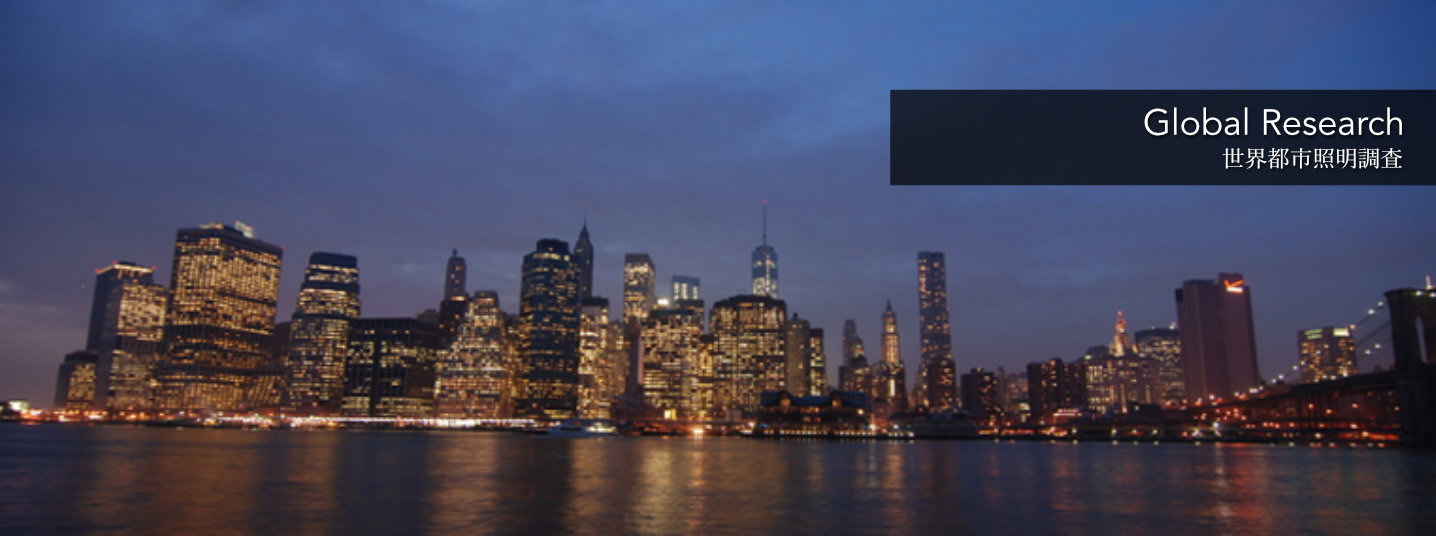
New York is a modern city to beat all modern cities. Streets are lined with skyscrapers and the lighting adds to the excitement of the city. On the other hand, in neighborhoods like Chelsea, the lighting is minimal, creating a quiet and comfortable residential area. However, city street lighting has not advanced to support LED fixtures, along with businesses and public facilities which still use older lighting methods. New York is a city sensitive to crazes and fads, but the city doesn`t seem to have any interest in lighting trends. Office lighting is usually a cooler, whitish tone, but office lighting in NYC seems to hover around 3000k, adding a touch of warmth to this concrete and steel jungle. Colored LED lighting is used periodically throughout the city, but full-on flood lighting seems to be on the way out, creating a very refined NYC nightscape. A view of Manhattan from across the river. No lighting displays really stand out and there is no real facade lighting, either. Interior light escaping from windows is the main element of this famous nightscape. At dusk most windows are bright with light and help to outline each building, but as the interior lighting fades, the nightscape changes for a very dynamic view of the city. Memories of 911 are still fresh in NYC. The victims` names and a cascade of water are dimly lit at the memorial, still blanketed in a solemn atmosphere. Depending…
Chicago is the birthplace of the skyscraper and a city with a refined style of its own. However, the nightscape is basically assembled for crime-prevention with streets over powered by high-pressure sodium lamps and wrapped in an orange haze. We can only hope to see a more stylish Chicago nightscape in the near future. High-pressure sodium lamps create yellow lines of light across the Chicago landscape as viewed from the 103 floor of the Wills Tower. The lines of light extend as far as the eye can see, but it is not all that beautiful of a landscape, but more of a reflection of the fear and concern of criminal activity that might lie in the shadows. The view along N Michigan Ave. Trendy, retro street lamps line the avenue, but the light is diffused and not directed for a flat, blanket of light everywhere. Some of the more classic architecture has flood lighting along the ground level, but when combined with this method of street lighting it is not very effective. The lux level directly below a street lamp in 105lux, halfway between is 56lux and in the middle of an intersection we recorded 80lux. These numbers are too high, but maybe give residents and sense of security. Crown Fountain at night. In the park, artwork is lit up at night creating a vibrant area in the city.
It is an island of light floating in the desert. Lighting technology in Las Vegas is not sedentary, but reinventing itself daily. How can we seize the inviting eyes of visitors? What is attractive lighting? In this place, day is night and night is day. Everybody’s internal clock has goes haywire. From the top of the Stratosphere Tower, the lights of The Strip appear out of the black desert, like the lights of a spacestation. Exterior lighting of the Venetian Resort Hotel. Tourists sit in front of casino slot machines 24 hours a day with no perception of time, since even during the day the interior is keep fairly dark.
Buenos Aires, aiming to become the Paris of South America, entertains a long siesta in the afternoon leading to a remarkable late nightlife. The atmosphere of these bright, flourishing streets could easily be mistaken for the middle of the afternoon. Where the air of excitement and chaos meet, this is uniquely South American. Diffused, shaded light gives the night scene along Alem Street a pleasant rhythm. The eaves extend out over the sidewalks creating an arcade that acts as a connector from the inside to the outside of buildings. Even at night, the arcades are brightly lit. Bold neon lights attract people to the game center.
Dallas, the stage for the assassination of President Kennedy and Fort Worth, a city of culture that attracts architects and designers from around the world. However, both cities have to compete under the hot Texas sun, with most buildings fitted with walls of heat reflective glass. This building style leaves only the edge of buildings for accent lighting, which often reflects onto nearby buildings. From Reunion Tower, looking towards the glass skyscrapers in the west end of downtown Dallas. Strong accent light for other buildings is seen reflected in the facade. The interior of Louise Kahn’s Kimbell Art Museum, where his words “Light is the Theme” still echo. Natural light filters in through a slit opened at the top of the vault and reflects off of reflectors fitted into the architecture. The reflected light turns the vaulted ceilings brilliant silver. The Modern Art Museum of Fort Worth designed by Tadao Ando and completed in 2002. The main walls seen from the outside are lightly wall washed without intruding on the art pieces and exhibition space. The outer perimeter of the building reflects clear design intent in the careful composition of high-quality light. In the evening, reflections on the surface of the surrounding pond present another angle to this building.
Manhattan is a sleepless city of luminous spectacles, a city everyone dreamed of in the 20th century could have imagined. The energy of the people is transformed into the bright lights of the nightscape, as lights dot the skyscrapers all day and night. The beauty nightscape at New York City is best seen in its skyline from across the river. Looking down on Manhattan from the Empire State Building at dusk. The Streets and Avenues present a rock-solid, ridged foundation. The RCA Building glows a bright white, Fifth Avenue is a yellowish-gold, and the point of the Chrysler building can be seen. Walls of light surround Times Square with the latest technology incorporated into the different interactive lights. The Empire State Building, a well-established icon in the Manhattan skyline with a 360°view from the top.
Orange lights brighten the plains and continue on towards the horizon, creating the Chicago nightscape. Notorious for cold winds, the Chicago nightscape was unified early on with high-pressure sodium streetlights. For crime prevention, the amount of light slowly increased with each passing decade, but outdoor lighting technology in Chicago is considered very progressive. Orange axes of light extend toward the horizon. High pressure sodium streetlamps are used beautifully throughout the citystreets of Chicago. The highmast lighting pole at the base of the John Hancock building is functional and glareless. Highly efficient streetlights illuminate State Street, creating a unified environment.