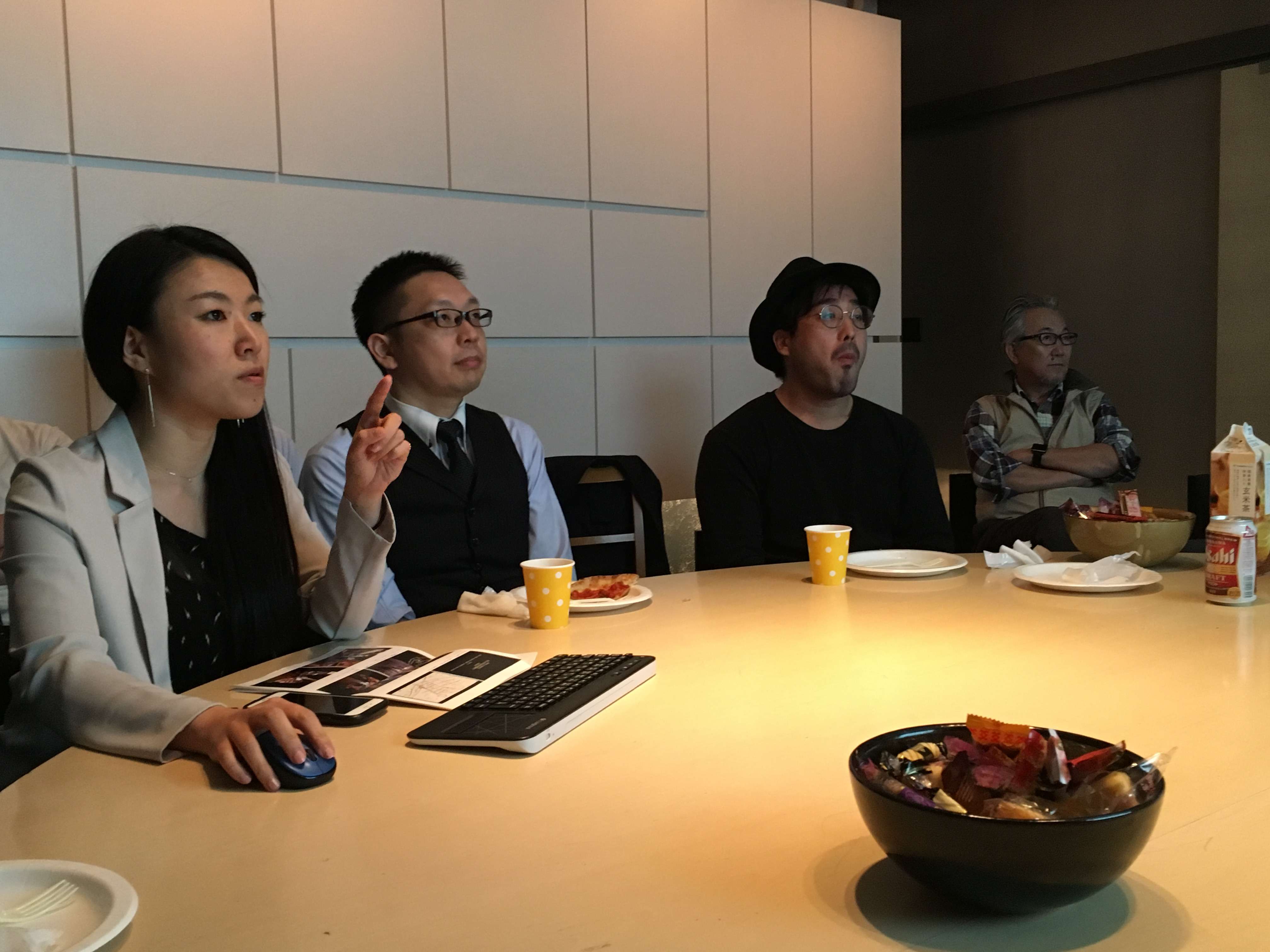
we will have a roundtable discussion to review the night walk in Shibuyagawa area.
-Date: 29 Nov. (THU)19:00~21:00.
-Venue: LPA2F 5-28-10 Jingumae Shibuyaku
-Fee: Free
Send E-mail to office@shomei-tanteidan.org by 19th Nov. to save your seat.
The east end of Taipei is really growing and developing with many modern structures like the Taipei 101, the world’s tallest building, looming over the area. But off the main streets and in the back alleys, life is as usual as old buildings line the side streets of these unique little neighborhoods. The streets are alive with daily activity and residents come and go; a some what nostalgic picture. Looking west from the top of Taipei 101, the world’s tallest building, as the last of the day’s orange light breaks through the space between the buildings. From this view point you can really see how the old part of the city spreads out in the west as the streets get narrower and twist and turn. Jungshan North Road, one of the main thoroughfares of Taipei. Mounted on the streetlights lining the sidewalks are fixtures to illuminate the trees and small LED nodes programmed with different scenes of color lighting. Although the trees are big and imposing, the lighting has helped to create a pleasant pedestrian area. Every night is like a festival at the Shilin Night Market in Taipei. Many of unique smells、wares, and activity to go along with the jimble-jamble of lighting.
In the middle of Tokyo is the Imperial Palace, a haven for runners and tourists, alike. The lighting in the palace outer garden and nearby Wadakura Fountain Park has been renewed and replaced with environmentally conscious LED fixtures. We surveyed the unique pocket of darkness that surrounds the Imperial Palace along with lighting environment of nearby parks and roads. Imperial Palace Outer Garden. The fancy pole lights in the outer garden are originally gas lamps, but the light source has been changed to high-pressure sodium lamps and now upgraded to LEDs. The average lux level is only 1-2lux along the paths lined with these LED fixtures, but inside the fixtures are 6, 26watt LED modules all pointed in different directions. This application helps to spread the light around without making a too bright, but comfortably dim atmosphere. Daikancho Street Daikancho Street runs along the north side of the palace grounds, is a much narrower street and pedestrian sidewalk compared with the rest of the facilities surrounding the palace. Along the tidy, hedged sidewalk, streetlights are placed at 3-meter intervals. Mostly for crime prevention, the lights are very bright and glaring. Ohtemachi Entrance The Ohtemachi Entrance area leads to an inner palace garden and is surrounded by a main arterial road on the outside, for a very open and accessible area. Most lighting is road lighting, mounted on 10-meter tall poles arranged down the middle of the street, but plenty bright…
Jiyugaoka Night Walk Review2018/04/16 Mikine Yamamoto + Noriko Higashi Jiyugaoka is a popular town, even in Tokyo. It was totally worth the hype. It was bustling with many people during our Night Walk Survey. This time, with “style” as our theme, did each team manage to discover a stylish street? 24 people met on the second floor of LPA for a Night Walk Survey review We reviewed the Jiyugaoka Night Walk Survey that was held on April 6. The theme of the survey was “Find the Stylish Street.” Was Jiyugaoka’s night scene as stylish as we had imagined? We announced the best stylish street chosen by each team, from A to D, who were separated for the Night Walk. Highlights from a Presentation A presentation of the compiled impressions and opinions from the Night Walk Survey by each team The presentation materials show great ingenuity It was a pleasant gathering while having light meals The cobblestone and brick-style streets, which are often seen in Jiyugaoka, look stylish and create a fashionable atmosphere without any extra effort compared to streets paved with asphalt. We heard comments that the streetlights on these streets used shades that directed light only downwards, which was likely done to prevent glare and light pollution, showing consideration for pedestrians.In general, Jiyugaoka’s streetlights have a high color temperature, while the light spilling from the shops is often low in color temperature. Although there was a difference in color temperature,…
Nightscape in Jingmai Mountain2023.12.08 – 12.13 Kyoko Takubo + Hongna Chen Located on the southwest border of China, Jingmai Mountain is the birthplace of Pu’er tea, where the indigenous people have created an ancient tea forest cultural landscape, which was registered as a UNESCO World Heritage Site in September 2023.While working on the project, we became interested in the local culture. So we decided to survey the villages at night and to observe and report the impact of tourism development on the local nightscape. ■Introduction Visiting Jingmai Mountain isn’t easy. First, spend the night in Kunming, then leave early morning for the destination by plane or train.We had planned to fly from Langcang Jingmai airport, but our flight was suddenly cancelled. So we had to travel to Pu’er by train and grab a cab to Jingmai Mountain.During our stay, we were based in Huimin Town where our project TEA CELLAR is located. We visited Nuogang Village, Wengji Village, and Jingmai Village to observe the people’s daily life and the nightscape there. ■ Nuogang Village Nuogang Village is a historic village of the Dai tribe, where the villagers have maintained their traditional lifestyle. The first floor of the house, with its distinctive gabled roof, is used for tea production and for the teahouse. The second floor with a tiled roof is a living space.The owner of the teahouse told us that the first floor is open to guests and the family…
2022.10.01-10.03 Shunichi Ikeda + Genki Watanabe Koyasan (Wakayama Prefecture), a sacred site of Japanese Buddhism with a history of 1,200 years, was inscribed on the UNESCO World Heritage List in 2004 and again in 2016, and is one of the world’s most renowned religious cities. It is also a popular tourist destination, attracting many international visitors prior to the COVID-19 pandemic. Through the distinctive light environment created by the numerous temples and shrines, as well as through the experience of staying at temple lodgings (shukubō), we conducted an investigation into this extraordinary lighting culture from the perspective of the Lighting Detectives. Koyasan is a town situated in a mountain basin at an altitude of 800 meters, surrounded by peaks of around 1,000 meters in northern Wakayama Prefecture. It was founded about 1,200 years ago, in the early Heian period, by the Buddhist monk Kōbō Daishi (Kūkai) as a sacred site of Japanese Buddhism, with Danjō Garan serving as the central temple complex of this religious city.Originally, the entire area of Koyasan was considered part of the grounds of Kongōbu-ji Temple.For us, this was the first time to focus on a religious city in an urban lighting survey. We wanted to examine what the nightscape of this temple town looks like and how the lighting culture of Japan and Buddhism manifests itself in various aspects. ■Okunoin, Kongōbu-ji, Head Temple of Koyasan Shingon Buddhism Okunoin is an expansive cemetery stretching about 2…
This website uses cookies to improve your experience. We'll assume you're ok with this, but you can opt-out if you wish. Cookie settingsACCEPT
Privacy & Cookies Policy
Privacy Overview
This website uses cookies to improve your experience while you navigate through the website. Out of these cookies, the cookies that are categorized as necessary are stored on your browser as they are essential for the working of basic functionalities of the website. We also use third-party cookies that help us analyze and understand how you use this website. These cookies will be stored in your browser only with your consent. You also have the option to opt-out of these cookies. But opting out of some of these cookies may have an effect on your browsing experience.
Necessary cookies are absolutely essential for the website to function properly. This category only includes cookies that ensures basic functionalities and security features of the website. These cookies do not store any personal information.