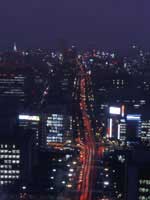
Along Osaka`s main street, Midosuji, taillights create a river of red light.
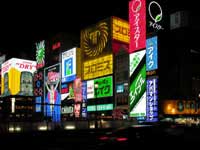
Osaka’s symbolic shopping district, Dotomobori, is full of Osaka style flare.
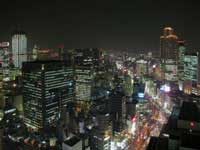
Redevelopment in Nakanoshima West District continues.

Along Osaka`s main street, Midosuji, taillights create a river of red light.

Osaka’s symbolic shopping district, Dotomobori, is full of Osaka style flare.

Redevelopment in Nakanoshima West District continues.
Interviewer: Kunzhi Jiang Jiang: Today I’d like to talk about “Cinema Lighting.” I think cinema lighting is very important. For example, I recently watched “The Godfather,” and felt that light and shadow in cinema can really reveal various conditions of human psychology. Especially senses with intense contrast, light and shadow help create a very tense situation. Mende: Yes, there are many dark scenes in this film. It is an impressive example of using light to symbolize human emotion. Jiang: Yes. I was really impressed with how light is focused on the left side of the screen and the right side gradually becomes dark. I felt this represents the two-sided nature and internal turmoil of the characters. What kind of movies do you like? Mende: I like films of various genres, but I was really moved by the French movie “Diva.” The use of natural light is beautiful. The softness and warmth of natural light really dictates the atmosphere of this film. Jiang: This sounds like a film with many great scenes. I am curious about the balance of light and shadow. By the way, films by the Taiwanese director, Edward Yang, are also very impressive. Lighting melts into the quiet everyday scenes of his films in a way that is very easy. Mende: Taiwanese films certainly have a unique charm. Particularly, natural light is skillfully used to create detailed scenes and atmospheres, unable to be reproduced with artificial lighting. Jiang: “A Brighter Summer…
28 July, 2005 At this session there were only a few topics on the table, which gave members an opportunity to discuss, in-depth, new products and ideas from the New York City Lighting Fair, the direction of and trends in Ginza lighting, and the festive events that unfolded at the most recent Candle Night Performance. This session was a welcomed breather from previous salons of fast-paced slideshows and long agendas. Members could freely exchange ideas and talk about lighting culture without a pressing schedule. Reported News, Surveys, and Events NYC Light Fair and Survey…..Akiko Okunaka City Walk: Ginza…..Ueda Natsuko Candle Night Summer Solstice 2005…..Saiko Tanuma
Theme: Into the Water Interviewer:Yusuke Hattori Hattori:Your first diving experience was five years ago near Malaysia`s Tioman Island, is that right. Was it really your first time? Mende:Yes really. I wanted to go diving and so I went. I got my diving licence with a really strict Japanese instructor. I was 64 years old at the time and now I go diving every year. I am still a beginner, but I have done about 30 dives. How many dives have you done? Hattori: I have about 100 dives and an advanced diving license. The first time I went diving, I was so moved by the lighting experience underwater, I wanted to capture it in photographs. So I just went out and bought an underwater camera. Underwater photography is so interesting. Mende:Are there any differences between photographing underwater or on land? Hattori:Underwater you are floating, so shooting the camera is very difficult. Also you can`t use a tripod so it is hard to use auto focus when your body is floating and moving. I can really understand the distinction between a regular photographer and underwater photographer. Their diving skills need to be very advanced. Mende:Divers are all interested in different targets underwater. Some divers are interested in only sea slugs or really big fish or such. Hattori: I like underwater terrain. The dynamic landforms get me really excited! The fish are pretty, some look good to eat, but that is the…
Date of Issue:December 29, 2021・Activity 1 / City Night Survey : Akasaka, Tokyo(2021.10.27)・Activity 2 / City Night Walk Vol. 68 : Small-group Night Walk (2021.11)・Activity 3 / Round Table Discussion Vol. 67 @ ZOOM (2021.12.02) City Night Survey : Akasaka, Tokyo 2021.10.27 Shunichi Ikeda + Erina Hosono + Namiko Watanabe About three weeks after the state of emergency in Tokyo was lifted, we conducted our first urban night walk survey since the COVID-19 outbreak, heading to Akasaka. The area between Akasaka and Akasaka-mitsuke features both traditional establishments such as atmospheric ryotei (Japanesestyle restaurants) and neon-lit entertainment districts reminiscent of Kabukicho. At the same time, Akasaka has gained recognition as a tourist destination due to redevelopment centered around Akasaka Sacas. We surveyed the nighttime environment of this area where tradition, business, and nightlife coexist. ■Aerial Nightscape of AkasakaThe central area of Akasaka lies roughly in the middle of the cluster of high-rise buildings. At first glance, the nightscape viewed from above gives a rather subdued impression, due to the lack of prominent building illuminations or large advertising towers. However, upon closer inspection, one can see clusters of commercial lights peeking through the gaps between buildings. While the limited presence of dramatic lighting or decorative illuminations may make it less visually striking, the overall effect is a calm and environmentally friendly nightscape. ■Akasaka Sacas AreaAkasaka Sacas, a multi-use complex directly connected to Akasaka Station, is usually frequented by businesspeople and shoppers. However, likely due…
In the middle of Tokyo is the Imperial Palace, a haven for runners and tourists, alike. The lighting in the palace outer garden and nearby Wadakura Fountain Park has been renewed and replaced with environmentally conscious LED fixtures. We surveyed the unique pocket of darkness that surrounds the Imperial Palace along with lighting environment of nearby parks and roads. Imperial Palace Outer Garden. The fancy pole lights in the outer garden are originally gas lamps, but the light source has been changed to high-pressure sodium lamps and now upgraded to LEDs. The average lux level is only 1-2lux along the paths lined with these LED fixtures, but inside the fixtures are 6, 26watt LED modules all pointed in different directions. This application helps to spread the light around without making a too bright, but comfortably dim atmosphere. Daikancho Street Daikancho Street runs along the north side of the palace grounds, is a much narrower street and pedestrian sidewalk compared with the rest of the facilities surrounding the palace. Along the tidy, hedged sidewalk, streetlights are placed at 3-meter intervals. Mostly for crime prevention, the lights are very bright and glaring. Ohtemachi Entrance The Ohtemachi Entrance area leads to an inner palace garden and is surrounded by a main arterial road on the outside, for a very open and accessible area. Most lighting is road lighting, mounted on 10-meter tall poles arranged down the middle of the street, but plenty bright…