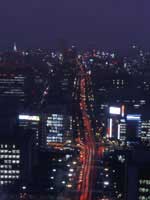
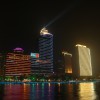
Along Osaka`s main street, Midosuji, taillights create a river of red light.

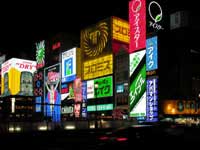
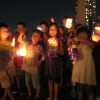
Osaka’s symbolic shopping district, Dotomobori, is full of Osaka style flare.

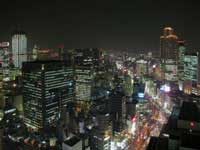
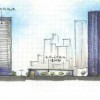
Redevelopment in Nakanoshima West District continues.

Along Osaka`s main street, Midosuji, taillights create a river of red light.

Osaka’s symbolic shopping district, Dotomobori, is full of Osaka style flare.

Redevelopment in Nakanoshima West District continues.
2022.07.11 Hikaru Kimura + Yonglin Ke + Xueying Piao Shibuya, known as a youth hub, began redevelopment in 2012, transforming into a business district with a cluster of new office buildings and commercial facilities. While many new restaurants have emerged, traditional drinking alleys remain intact. This survey investigates the contrasting night scenes of the new and old Shibuya. ■Overlooking Nightscape of ShibuyaFrom the Shibuya Scramble Square, the rooftop of Miyashita Park stands out prominently to the east of the central railway tracks. The warm glow along the podium belongs to Shibuya Yokocho (alley). Nestled beside the pitch-black railway tracks and appearing as a dotted red line is Nonbei Yokocho. Viewed from above, Nonbei Yokocho exuded a soft, flickering light, resembling candles, in contrast to the lively and vibrant atmosphere of Shibuya Yokocho.The overall nightscape, divided by the Yamanote Line tracks, presents a striking contrast: the western side is dominated by tall buildings, densely packed with billboards and advertisements, exuding the lively energy of a traditional entertainment district. The eastern side, on the other hand, has fewer billboards and subdued signage, giving it a unified and calm appearance.I wonder if Shibuya will eventually become a more standardized urban landscape, much like its eastern side. Personally, I felt the bustling, nostalgic charm of the western side embodies the true spirit of Shibuya, and it’s something worth preserving. (Yonglin Ke) ■Shibuya YokochoRAYARD MIYASHITA PARK, a new landmark in Shibuya, features Shibuya Yokocho, a 100-meter-long…
Date of Issue: 16 January, 2024 -Activity 1 /Lighting Survey: Nepal(2023.11.12-11.14) -Activity 2 / Children Workshop Experiencing Old Traditional Japanese house in Chiba (2023.11.25-11.26) Lighting Detecdtives Newsletter Vol.127 Download PDF Lighting Survey: Nepal 2023.11.12 – 2023.11.14 Mayumi Banno Xianyu Liu (Flower) Kathmandu Valley, a World Heritage Site encompassing Kathmandu, Patan, and Bhaktapur; how is the city faring now after the devastating earthquake of 2015? During Tihar, Nepal’s festival of lights, we visited the capital city of Kathmandu and the adjacent ancient city of Bhaktapur. ■IntroductionHow are Nepal’s cities faring after the 2015 earthquake? During Tihar, Nepal’s festival of lights, we visited the capital city of Kathmandu and the adjacent ancient city of Bhaktapur to explore the reconstruction and the lighting environment during the festival. From the plane overlooking the whole of Nepal, shocked by the twinkling lights of the stars. Nepal is a country with a high national happiness index, but it is also very poor. But when I saw this from the plane, I was surprised, I thought Nepal would have no lights, or very little lights. Later, I heard local people say that because it is the New Year, every family will prepare the colored lights, decoration, and create a lively atmosphere. (Flower) ■KathmanduKathmandu is located at an altitude of about 1,400 meters. In mid-November, when we visited, the days were hot and sunny, but the nights were cooler than 10 degrees Celsius. The city was filled with the…
Once every two years「Light & Building」, the world’s largest lighting trade fair, opens in Frankfurt and I always make a point of attending. This year was no different, as my fourth time to attend, along with five colligates from LPA; we took up residence in Frankfurt for three days. The Frankfurt trade fair started just eight years ago, but its predecessor was the Hanover trade fair. I used to attend that fair as well and it just seemed like a fun time. All trade fair event halls are the same crowd of people poking around the booths until they are bushed, but the Frankfurt trade fair has a different feel. Like Europe in the springtime when fresh white asparagus should begin showing up on the menu, I just can’t not go! I said we were at the exhibition for three days, but really its only two and you can’t do much in two days. I leave the combing of the huge event hall to the younger staff and I seem to network more than I look at the fixtures. I am thrilled to see old friends from the lighting profession again. Just prowling around the exhibition hall and I’m bound to be tapped on the shoulder or suddenly hugged or hear my name called from afar, endless boisterous encounters. There are also those encounters that I don’t try to initiate or avoid altogether, but sometimes there is no other choice….
Interviewer: Xiaoyi Dong Dong: Today I’d like to talk about feminism. I recently read the book “ Japanese Misogyny: I hate Women” written by the popular writer, Chizuko Ueno. Even though I was born and raised in China, I can sympathize with many ideas in this book. Have you had the chance to read this book? Mende: No, not yet. Was it good? Will you please explain misogyny? Dong: It means to look down on women or a strong hatred towards women. Not only men hating women, but also women hating women. For men it is called misogyny. For women it is self-hate. Ms. Ueno gave a speech at the University of Tokyo that is very popular in China about no matter how hard women work it is unanswered or thankless. Mende: Why is that? Dong: In Japan, even if one graduates from a well-known university, gets a good job, and performs well for that company, this kind of strong, independent women is not viewed as adorable or loveable compared to the type of women who needs to be protected by a man, who is even weaker than the independent women in question. This line of thought is not exactly the same in China, but similar. For example, women who have graduated from famous universities such as Beijing University or Tsinghua University are less approachable compared to women who have graduated from other universities. Mende: Is that right? I don`t think…
2025.11.09-11.14 Jiang Kunzhi + Lin Huangyi This survey aims to explore the interaction between Soviet culture and Islamic culture within the urban space of western Tashkent, with a particular focus on whether this cultural layering has given rise to region-specific lighting approaches and expressions of the luminous environment. Therefore, a systematic field survey and documentation were carried out across the urban areas of Tashkent. As the capital of Uzbekistan, Tashkent reflects both Soviet modernism and Islamic architectural traditions. The city features large Soviet-era public buildings alongside religious architecture that blends tradition and modernity. In addition to above-ground buildings, this survey also examined the Tashkent Metro, Central Asia’s first metro system opened in 1977, where refined lighting and rich materials create museum-like underground spaces. (Jiang Kunzhi) ■Aerial night view of Tashkent Viewed from the TV Tower, Tashkent’s nightscape appears as a network of “lines” and “points” rather than a continuous illuminated façade. The road system forms the clearest visual structure: main roads and ring roads read as linear light bands, while bridges and major intersections appear as brighter nodes, creating a legible traffic framework over the city’s flat skyline. These linear elements strongly define the city’s sense of direction and scale. In contrast, most buildings remain dark at night, with their presence defined only by entrance lighting, limited window glow, and reflected ambient light. As a result, the overall background luminance stays low, allowing a few landmarks—such as tall structures or media…