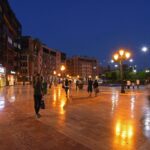
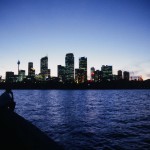
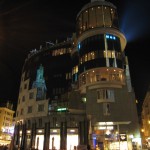
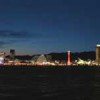
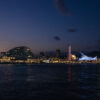
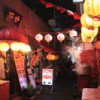
Kobe, very similar to the port town of Yokohama, is full of great spaces for pedestrians, including, the main strip, Flower Road, many arcades, underground passages, and the Kobe Meriken Park. While most of the lights in this area are white mercury lamps, Kobe Port Tower glows a brilliant orange. Looking from Port Island across the bay towards the Kobe waterfront, Meriken Park and Harbor Park, both places of escape for Kobe residents, are clearly visible. Another great way to enjoy this view is to hop on one of the many night cruises for a tour of Kobe Bay. The stage for the Hanshin Tiger’s victory parade, Sannomiya Station and Flower Road in downtown Kobe, a very a pedestrian friendly area with wide sidewalks for pleasant strolling. From the Rokko Mt. observation deck, one cannot only view the lights of Kobe, but also its neighbor, Osaka, and on a really clear day, the Akashi Strait. Maya Mt. observation deck on the next ridge over, is a local spot, but also an incredible view of the Kobe nightscape.
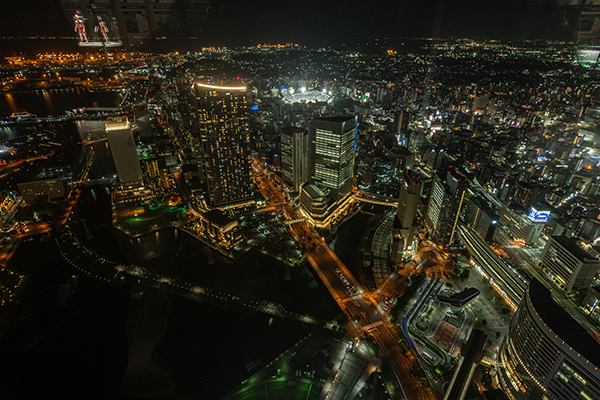
2022.06.28 Kouki Iwanaga+ Xiaoyi Dong+ Hikaru Kawata Yokohama Minato Mirai, which has seen rapid development in recent years with projects such as Japan’s first urban circulation ropeway “YOKOHAMA AIR CABIN” launched last spring, the cruise ship terminal “Yokohama Hammerhead,” and the prestigious Hawaiian luxury resort “The Kahala Hotel & Resort Yokohama.” The purpose was supposed to be to investigate whether the “nightscape of Minato Mirai,” which could be considered a tourism resource in itself, has been well preserved… but. ■Relationship Between Zoning and Street Lighting The Minato Mirai area, which was developed on reclaimed land around Yokohama Port, can be broadly divided into three zones: the “Central District,” the “Shinko District,” and the “Yokohama Station East Exit District.” Among these, our survey focused on the Central District—with its high-rise buildings such as Landmark Tower and Queen’s Square Towers—and the Shinko District, which features many commercial and cultural facilities such as the Red Brick Warehouse and Yokohama Hammerhead. When examining the street lighting in these two districts, it was found that the streets running parallel to the Rinko trunk road and the Metropolitan Expressway were lit with sodium-colored lamps, while the streets leading toward the port, such as Icho Street and Keyaki Street, were illuminated with streetlights at a color temperature of 4000–5000K. At first glance, this color temperature plan, which changes according to the direction of the streets, appears well-organized. However, according to the building color scheme guidelines for the Minato…
The largest Chinatown in Japan has become an established feature of the Yokohama downtown area, but still an area with its own culture and identity. We surveyed Yokohama to discover the Chinese style of lighting environment alive within Japan. At night, there are many hanging lanterns with soft glowing light. This “Light with a Shape” or, through colorful shades, “Light with Color” is a staple of Chinatown and helps to create excitement and a sense of elation. Along the main street there is no specific street lighting, but shop lighting and luminous signage create a natural ambiance along the street. Most structures have columns painted red and use warm tone lighting, but the facade design and signage is all different. This unification of the streetscape through color temperature creates a balance and lasting impression of Chinatown.
2023.01.18-01.20 Yumi Honda + Misuzu Nakamura Kobe is famous for the night view from Mt. Rokko as the “10 Million Dollar Nightscape” and for its waterside nightscape as a port city. Nightscape guidelines have been established in 2012, and efforts are being actively made to improve the lighting in the city. We walked around the city, which continues to be updated, and explored the components of a nightscape that is uniquely Kobe. ■“Instagrammable” NightscapePort Tower, Maritime Museum, Oriental Hotel, Hotel Okura, Ferris wheel, sightseeing boats, and the “BE KOBE” monument…. When people think of the city of Kobe, they probably think of Meriken Park. Meriken Park is the face of Kobe, and even at night many people were visiting the park to take commemorative photos. Many of the park’s symbolic monuments were lit up and color lighting was used extensively, but the colors and color schemes were mainly neutral, not primary colors, so it was nice to enjoy the colorful light without getting an overpowering impression. To complement the color lighting, the ground lights of the pole lights, handrail lights, and bollard lights were uniformly lit with light bulbs, creating a subdued brightness. Both decorative lighting and functional lighting emitted little excessive glare, allowing us to concentrate on the illuminated objects. It seemed like seeing the nightscape and taking pictures of it could be the purpose of a visit to this place. In this age of breathlessly uploaded photos and videos…
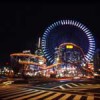
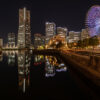
Compared to many cities, Yokohama is a relatively open city. Even with large high-raise buildings close-by you don’t feel enclosed and the added factor of a waterfront can help make anyone feel refreshed. The continually changing point of view from the Cosmos World Ferris wheel is a great way to observe the city. The Landmark Tower is often thought of as the symbol of Yokohama, but the Cosmos World Ferris Wheel could be the runner-up. In the dark night sky the Ferris wheel draws a perfectly beautiful circle of transparent layers of light, adding a deep appeal to the Yokohama nightscape. Looking south from the top of the Yokohama Cosmos World Ferris wheel. The illuminated Red Brick Warehouse expresses its self beautifully as it blends with the surroundings area and the blue twilight settling in on the Yokohama Bay. Ohsanbashi Pier and Yamashita Wharf complete the background. Looking from the vicinity of Yokohama Customs towards the Landmark Tower. In this newly developed area space is comparatively open. With only a few high-raise buildings, and reflection on the water the city seems bigger than it really is.