9
YOU MIGHT ALSO LIKE
Vol.022 – Teaching about light
Teaching about light Interviewer: Sachiko Segawa It is important to be sensitive to and sense light in one`s immediate presence. A class experience on the three primary colors of light. Segawa:Today I would like to talk about “Teaching about Light.” Mende:If I`m not mistaken, you are one of my former students. Do you have an interest in education? Segawa: Yes, I do, but the number one reason I chose this topic is because I am a mother. My mother was a teacher, so when I was younger an “educator” was always an immediate presence. At home, she was always our mother, but to other children, she was the “teacher.” She always wore those two hats. I didn`t progress into the field of education, but at work, I have had to train new and part-time staff. I have come to realize that teaching somebody about light is a difficult task. You taught at Musashino Art University for 10 years. Did you find it challenging at times? Mende:I never really thought of it as challenging. My studio class was titled “Lighting Seminar,” but not everyone was motived to become a lighting designer. Maybe two or three students out of 10 wanted to be a lighting designer. The other students had different interests and motivations and I would struggle with whether it was best to teach them from a technical point of view of or sensory point of view. Segawa: I would think that…
BUENOS AIRES
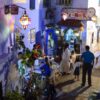
Buenos Aires, aiming to become the Paris of South America, entertains a long siesta in the afternoon leading to a remarkable late nightlife. The atmosphere of these bright, flourishing streets could easily be mistaken for the middle of the afternoon. Where the air of excitement and chaos meet, this is uniquely South American. Diffused, shaded light gives the night scene along Alem Street a pleasant rhythm. The eaves extend out over the sidewalks creating an arcade that acts as a connector from the inside to the outside of buildings. Even at night, the arcades are brightly lit. Bold neon lights attract people to the game center.
Lantern Making Workshop ~Build town of light~
2013.11.22-23 @Edo Tokyo Open-Air Architectural Museum As the 3rd children`s workshop to be held at the Edo Tokyo Open-Air Architectural Museum in Tokyo, the children crafted lanterns in the shapes of buildings and trees to create a miniature city of light after a parade through the park. Build town of light As a part of Autumn event “Light up Autumn Foliage at Edo Tokyo Open-Air Architectural Museum, we were invited to do children workshop. Theme of this time was to experience the dark and candle light, to make house shape lantern and to create a town. Lantern with shape of tree and house In two days, about 50 children and 63 parents joined this workshop. College student volunteers were responsible for preparing for the workshop and explanation on the day. Children chose from three shapes of tracing paper for lanterns. The most popular shape was tree lantern!!A lot of branches extending from a round base transformed into a fantastic forest。 A lots of founding during lantern making Children who participated were wide in age, even if template of lanterns were the same, each one of the completed works was different. The base of lantern was colored paper and tracing paper. Drawing a picture as they like on the base, using six color cellophane, using scissors to drill a hole, or changing to an entirely new form, children were able to think freely to create their original lantern. With the limited materials,…
City Night Survey : Seoul, Korea
Songdo newcity, Inchon and Seoul city2025.10.22- 2025.10.25 Karen Huang + Xueying Piao + Xianyu Liu The purpose of this Seoul lighting survey is to explore how lighting shapes the city’s identity and cultural expression of the urban landscape in the multiple layers of Seoul.With this purpose in mind, we went to Songdo, Incheon and Seoul for the servey. ■ Songdo InchonOn the first day of our site survey, we visited Songdo International Business District in Incheon. As a flagship planned development in Yeonsu-gu, this new town represents a remarkable urban planning achievement, constructed entirely on reclaimed land – essentially a future-city built from the ground up. The district demonstrates excellent connectivity, with the core area accessible within approximately 90 minutes via bus from Incheon International Airport. By around 8:00 PM, few people are on the street. Our survey focused on the central park area of Songdo. At street level, building facades demonstrated minimal use of decorative flood lighting, relying primarily on internal illumination to create a subdued atmosphere, while the commercial districts utilized abundant illuminated signage to inject vibrancy into the urban landscape. The most critical insight emerged from the view at G Tower: the urban planning framework is distinctly articulated through strategic color temperature zoning, with residential areas at 2700K transitioning to over 5000K for landmark structures, constituting a macro-level “light planning” methodology. Simultaneously, the concentrated application of architectural lighting to tower crowns effectively reinforces skyline identity while minimizing…
City Night Survey: Yokkaichi, Mie
2024.11.21-11.22 Shunichi Ikeda + Yuta Shibata Yokkaichi has developed as an industrial city. The striking contrast between its dazzling factory nightscape and the increasingly organized city center stands out. We conducted a survey of the urban lighting where industry and daily life coexist. ■About Yokkaichi Yokkaichi has a long history, having developed as a port town facing Ise Bay. During the Edo period, it prospered as a post station along the Tokaido route. The city’s name originates from the markets that were held on days ending in “4.”After World War II, Yokkaichi grew as an industrial city with the construction of a petrochemical complex during Japan’s period of rapid economic growth. However, air pollutants emitted from the complex caused a serious pollution-related illness known as Yokkaichi asthma.Today, the city has regained a comfortable living environment. Residential areas, shopping streets, and everyday life now extend right alongside the industrial zones. ■3D Factory Nightscape Yokkaichi, with its history of industrial development, began drawing attention during the early 2000s factory nightscape boom. The expansive factory nightscape of the Yokkaichi petrochemical complex, which stretches about 10 kilometers north to south, is counted among Japan’s five greatest factory nightscapes. What makes it especially unique is that the nightscape can be viewed from the sky, land, and sea—earning it the nickname “3D Nightscape.” Particularly photogenic views of the factory nightscape have gained significant popularity. From the perspective of the Lighting Detectives, we conducted a survey of…