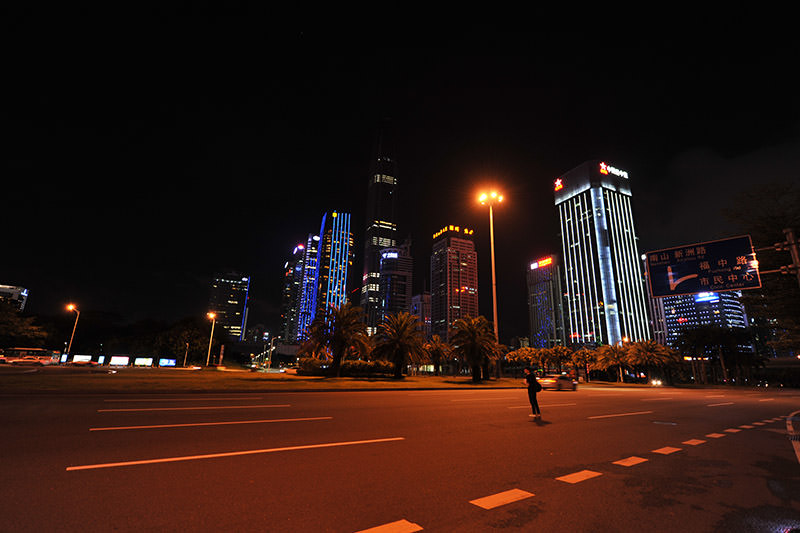
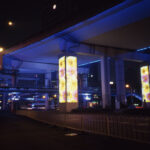
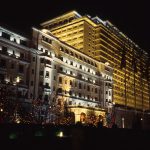
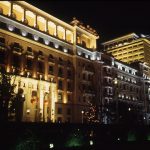
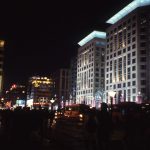
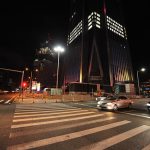
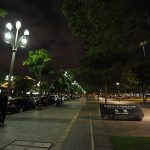
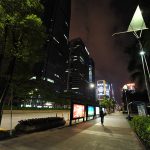
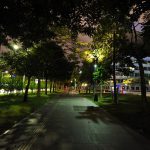
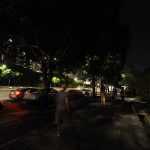
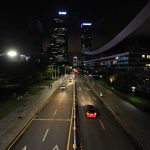
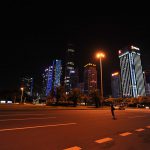
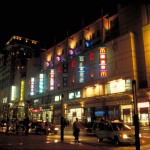
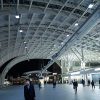
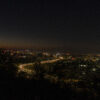
City Night Survey : Saitama-Shintoshin 2019.04.11 Lin Hu + Hikaru Kimura Saitama Shintoshin is a district established around the year 2000. Centered on JR Saitama-Shintoshin Station, it is an intensively structured urban area featuring a variety of functions, including large-scale commercial facilities, a major multi-purpose arena, government office complexes, and hospitals. This survey examined how this planned city has evolved from the perspective of lighting. Nightscape over the heliport from the Saitama Government Office Complex Light Linking Spaces A pedestrian walkway system is installed around Saitama-Shintoshin Station, utilizing an active pedestrian-vehicle separation plan that allows for smooth circulation from the second-floor station gates to various facilities. While the ground level is brightly illuminated by roadway pole lights, the pedestrian walkways feature lower-level lighting such as uplights and footlights—excluding some decorative pole lights in park areas—creating distinct expressions of light for each zone.Saitama-Shintoshin Station is connected to Kita-Yono Station by a walkway spanning approximately 600m. A continuous cantilevered glass canopy allows pedestrians to walk without getting wet in the rain or being stopped by traffic signals. Along this route, there is a straight path of about 100m running parallel to the railway tracks. Here, despite the cantilevered canopy structures being identical—likely due to differing construction phases—the lighting techniques varied across three distinct types. Although the architectural design is similar, the change in lighting methods results in varying levels of brightness depending on the location. While achieving uniformity may seem important, using different…
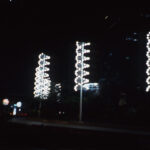
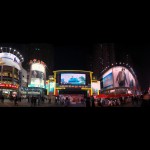
Lighting Survey: Nepal 2023.11.12 – 2023.11.14Mayumi Banno Xianyu Liu (Flower) Kathmandu Valley, a World Heritage Site encompassing Kathmandu, Patan, and Bhaktapur; how is the city faring now after the devastating earthquake of 2015? During Tihar, Nepal’s festival of lights, we visited the capital city of Kathmandu and the adjacent ancient city of Bhaktapur. ■IntroductionHow are Nepal’s cities faring after the 2015 earthquake? During Tihar, Nepal’s festival of lights, we visited the capital city of Kathmandu and the adjacent ancient city of Bhaktapur to explore the reconstruction and the lighting environment during the festival. From the plane overlooking the whole of Nepal, shocked by the twinkling lights of the stars. Nepal is a country with a high national happiness index, but it is also very poor. But when I saw this from the plane, I was surprised, I thought Nepal would have no lights, or very little lights. Later, I heard local people say that because it is the New Year, every family will prepare the colored lights, decoration, and create a lively atmosphere. (Flower) ■KathmanduKathmandu is located at an altitude of about 1,400 meters. In mid-November, when we visited, the days were hot and sunny, but the nights were cooler than 10 degrees Celsius. The city was filled with the hustle and bustle of the Hindu festival of Lakshmi, the goddess of wealth and happiness, to pray for wealth and health, and the New Year who live in this region….
2023.09.22 – 2023.09.26 Ke Yonglin + Chuanyi Liu
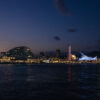
2023.01.18-01.20 Yumi Honda + Misuzu Nakamura Kobe is famous for the night view from Mt. Rokko as the “10 Million Dollar Nightscape” and for its waterside nightscape as a port city. Nightscape guidelines have been established in 2012, and efforts are being actively made to improve the lighting in the city. We walked around the city, which continues to be updated, and explored the components of a nightscape that is uniquely Kobe. ■“Instagrammable” NightscapePort Tower, Maritime Museum, Oriental Hotel, Hotel Okura, Ferris wheel, sightseeing boats, and the “BE KOBE” monument…. When people think of the city of Kobe, they probably think of Meriken Park. Meriken Park is the face of Kobe, and even at night many people were visiting the park to take commemorative photos. Many of the park’s symbolic monuments were lit up and color lighting was used extensively, but the colors and color schemes were mainly neutral, not primary colors, so it was nice to enjoy the colorful light without getting an overpowering impression. To complement the color lighting, the ground lights of the pole lights, handrail lights, and bollard lights were uniformly lit with light bulbs, creating a subdued brightness. Both decorative lighting and functional lighting emitted little excessive glare, allowing us to concentrate on the illuminated objects. It seemed like seeing the nightscape and taking pictures of it could be the purpose of a visit to this place. In this age of breathlessly uploaded photos and videos…
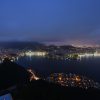
2018/10/13-23 Mikine Yamamoto + Kouki Iwanaga This was our first South American survey in about 15 years. We tracked the light expression of Rio de Janeiro, a port city marked by both entertainment and poverty, which hosted the FIFA World Cup in 2014 and the Olympics in 2016 and has become increasingly international. While possessing famous coasts like Copacabana and Ipanema and being counted as one of the world’s three most beautiful harbors, it also has the “favela” slums covering its hillsides. Surrounded by magnificent nature, Santiago, Chile’s largest city, has annual rainfall of only about 360mm, meaning it is sunny for most of the year. We investigated the lighting situation of this city blessed with natural light. The nightscape from Pão de Açúcar: A beautiful contrast created by the rich topography Viewing Copacabana Beach from Pão de Açúcar Favelas built on the mountain slopes ■Rio de Janeiro / Brazil Rio de Janeiro is an international tourist city that hosted the Carnival and the Olympics in 2016. It is said to be a microcosm of the country, where light and darkness coexist: scenic areas with beautiful topography blending nature and culture are situated next to slums. We surveyed the light expressions of this city, which has various faces, including the glamorous light of tourist and resort areas, and the strangely glowing light of the favelas (slums) where poor communities gather, reflecting the lives of the people.The suburbs leading from the…