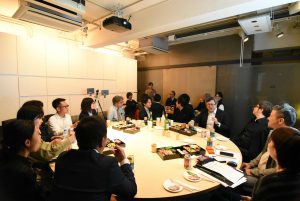
we will have a round table discussion to review the night walk at Meguro-gawa area.
-Date: Apr.17 (WED)19:00~21:00.
-Venue: LPA2F 5-28-10 Jingumae Shibuyaku
-Fee: Free
Send E-mail to office@shomei-tanteidan.org by Apr.08 to save your seat.
Theme:Playback! Interviewer: Bryan Yan This “coffee break” column is a bit different from all the previous ones. The change of style in this column is also corresponding to our interview topic – “Playback”! Since I have read the PAST issues, I decide to make some changes. Actually, the original topic is “Look back!”. After a discussion with Mr. Mende, “Playback” is more interesting. Playback – It’s straightforward. We are going to talk about the PAST. Everyone has their PAST. Some people are very afraid to look back and remember some bad memories. Bryan:Hello Mende-san! I’m long waiting to have a coffee break section with you today. People like you with a lot of achievements and experiences should have many things in the PAST that you would like to remember and look back. Taking this opportunity, I would like to listen to you because I love stories. Would you tell me which project you like the most in LPA’s thousand projects? Mende:Well, since I always try to enjoy and concentrate now and think about little bit near future, I am not good at remembering. However, if you ask me to choose, I would like to say it should be “Tokyo International Forum”. The reason is that it’s the first big scale project after LPA office was established. On the third day of establishment, we received a call from New York to invite LPA to be the lighting designer for this project. From…
Muslim District within New Development Context2025.11.06-11.09 Quratuaini Jamil + Xu Sunny The survey aims to examine the Muslim Quarter District with a focus on its religious, cultural, and urban context, while assessing how it integrates with the emerging modern development within Xi’an. ■ Brief Summary of Lighting SurveyWith a vast metropolitan population of 12.9 million—of which 4.45% reside in the urban center—Xi’an is a renowned historical and cultural hub in China that pursues an urban planning strategy blending tradition with modernity. The city integrates its rich heritage with the demands of contemporary development while carefully safeguarding key cultural areas. A prime example is the Muslim Quarter, which plays a crucial role in preserving living heritage, ethnic diversity, and the traditional urban fabric. Xi’an’s planning approach emphasizes “development within preservation and preservation within development,” reflected in the harmonious coexistence of new growth and historic architecture. Accordingly, this research focuses on how the old and new parts of the city—particularly distinct areas like the Muslim Quarter—are effectively integrated. ■Xi’An Muslim QuarterOn the first day, we observed the Friday congregational prayer at the Great Mosque of Xi’an. This visit provided a valuable opportunity to study the mosque’s internal spatial organization and architectural characteristics. The Great Mosque of Xi’an is distinctive for its unique synthesis of traditional Chinese architectural language and Islamic religious functions. It differs markedly from the Middle Eastern style—characterized by prominent domes and tall minarets—commonly seen in places like Singapore. Instead,…
~Let’s Go Search for Darkness~2023.09.26 Shinichi Sakaguchi + Tomoya Furukawa+Ryuji Hatta + Ryuma Shiota+Noriko Higashi This time, our night walk survey was themed “Exploring the Darkness of the City,” taking us through the green paths of Setagaya in Tokyo and visiting shrines in Kyoto where darkness lingers. Typically, our walks focus on the lights of the city, but this time we decided to take a different approach with the theme “Let’s Search for the Darkness of Tokyo”. While parks, shrines, and cemeteries are places with inherent darkness, we thought there wasn’t much room for discussion. Instead, we focused on Setagaya’s green paths, which are commonly used at night for commuting, school, and jogging. Although these paths are very pleasant during the day and popular for strolls, we wanted to see what the nighttime environment is like, so we divided into three groups to explore. (Noriko Higashi) ■ Group 1: Ikejiri-Ohashi to Sangenjaya The first group walked along the Meguro River Greenway and the Karasuyama River Greenway from Ikejiri-Ohashi to Sangenjaya, which are connected by a single greenway, and we were able to feel the various expressions of the greenways from different places. The atmosphere, brightness, and sense of safety when walking at night seem to vary greatly depending on the surrounding environment. The atmosphere of the tall streetlights and security lights was greatly influenced by the surrounding trees. I got the impression that places with thick trees and narrow greenways were…
11 July The Lighting Detectives hosted the first of three salons focusing on residential lighting Friday, July 11th at the New Maru Building Ecozzeria. The hall was packed with over 100 guest who listened intently to the speakers who presented; “Residential Lighting: Past, Present, Future ? Rediscovering Residential Lighting from the Past to Modern Day.” by: saiko tanuma During the fiscal year of 2008 ? 2009 the Lighting Detectives will be hosting a series of 3 salons, all focusing on the influences of residential lighting. In discussing the culture of lighting, residential lighting seems like the best and most important starting point, as we delve into and analyze the why`s, what`s, and how`s. Our first salon outlined the history of residential lighting, with an emphasis on the ideal form of lighting from past to present in Japan. Kaoru Mende, and members of the Lighting Detectives, also heard contributions from guest speaker, Kazuya Ura, architect and interior designer. First on the program, a report from a survey of the Yoshihara residence in Kyoto by Lighting Detective members, who relayed their findings about Japanese light and the lighting environment of an old, Japanese-style house. What kind of effects do the daily changes in natural light contribute to the lighting environment? What can be done in the light of a single lantern? These are just some of the thought provoking questions raised and discussed during their presentation. Mr. Ura presented examples of his…
Yokohama Kitayamata Elem. School 2010.11.16 Chief Mende x Class of 3rd Graders It was a perfect sunny day. So perfect that Lighting Detective`s Chief Mende gathered with Kitayamata Elementry School 3rd graders in a perfectly darkened, blacked-out music room to give a lesson on “Light and Dark.” Chief Mende, who regularly lectures at a local university, seemed slightly intimidated by the smaller-in-size students. However, the difference ended there. Inquisitive and curious, the children were very eager to learn, first about light and different sources of light, and then experience complete darkness, laser beams, and candlelight. Lastly, using a 500ml plastic bottle and LED, the children made their own lanterns from recycled materials. Chief Mende began by showing the children a drawing of a campfire and firelight, the origin of light used thousands of years ago by the first humans. The talk continued with several questions and answers about what kind of light the children like, don`t like, and why. Chief Mende presented the children with different lamps such as an incandescent bulb, various sized halogen lamps, a compact fluorescent lamp, and a color-changing LED panel so they could compare different types of everyday light sources. Then the lights went out! Instantly, the room was completely dark. First, there were a few yells and screams, but even in complete darkness the children`s eyes began to adjust to see vague outlines. After a few minutes in complete silence and darkness, Chief Mende…
This website uses cookies to improve your experience. We'll assume you're ok with this, but you can opt-out if you wish. Cookie settingsACCEPT
Privacy & Cookies Policy
Privacy Overview
This website uses cookies to improve your experience while you navigate through the website. Out of these cookies, the cookies that are categorized as necessary are stored on your browser as they are essential for the working of basic functionalities of the website. We also use third-party cookies that help us analyze and understand how you use this website. These cookies will be stored in your browser only with your consent. You also have the option to opt-out of these cookies. But opting out of some of these cookies may have an effect on your browsing experience.
Necessary cookies are absolutely essential for the website to function properly. This category only includes cookies that ensures basic functionalities and security features of the website. These cookies do not store any personal information.