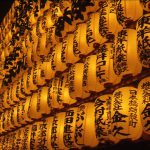
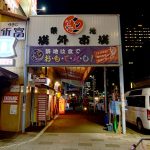
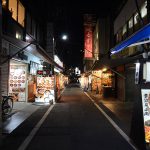
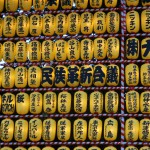
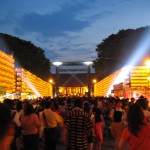
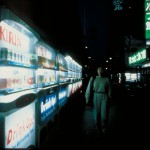
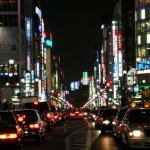
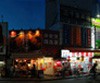
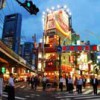
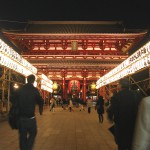
In front of the main gate to Senso-ji Shrine lies the neighborhood of Asakusa. One of Tokyo’s most popular entertainment districts, Asakusa flourished with kabuki, opera, and comic storytelling from the Meiji Era to the end of WWII. The Lighting Detectives discovered a variety of decorative streetlights and a lighting atmosphere fitting for this lively cultural destination. Upon entering the famous Kaminarimon, the Nakamise approach proceeds towards the shrine with bright-white, fluorescent-tube illuminated signage lining both sides. After navigating this corridor, walls of softly glowing lanterns come into view. The lanterns once lit with fire were replaced with incandescent bulbs and now fluorescent lamps. In popular neighborhoods like Shibuya or Roppongi, architectural facade lighting or neon signage fills the vertical space and “street lighting” is virtually non-existent. However, a variety of decorative streetlights festively illuminate the streets of Asakusa for a very fitting lighting environment. Pub signage and lanterns dispersed along the dark streets of Asakusa create an uncanny charm in this neighborhood. Roadway lux levels are a fairly dim 10-16 lx, but the red lanterns hanging from the eaves of establishments dig up affection for this old town.
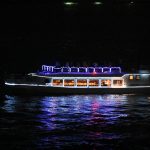
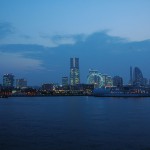
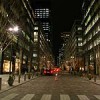
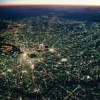
From up above Tokyo looks like an overturn jewelry box, the night streets glitter with lights and it a fairly beautiful sight. Once back on ground, the glitter has turned harsh. It is an economically advanced nightscape, an efficient nightscape with needless light and light pollution. An aerial view of Tokyo at night. The dark area in the center of Tokyo, the Emperor`s Palace, is surrounded by clusters of lights that resemble precious stones. From this view it is unclear where Tokyo begins or ends. The Tokyo nightscape is illuminated in bright white light. Mercury lamps and florescent lights in the background of Tokyo Tower control the nightscape of this city. Old-fashioned houseboats gather in the foreground of the Odaiba District and the Rainbow Bridge.
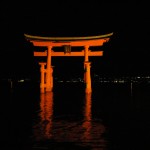
2023.01.26-01.29 Masafumi Yamamoto + Yuki Ito Okinawa is a place where diverse cultures and histories are intertwined. In Okinawa, each region has its own unique streetscape, and this is due to the fact that each region has a completely different historical background. The following is a simplified explanation of the historical background of each area. The Naha area was severely damaged in the war and was rebuilt; the Koza area was influenced by the U.S. military base and retains a strong American culture; and the Bise and Imadomari areas retain the traditional streets of the Ryukyu Islands. By comparing the light environment of each area, this survey sought to determine what kind of lifestyle culture and light features each area has, and what kind of light is unique to Okinawa. ■Sakae-machi MarketSakae-machi Market, located in Naha City, is a shopping street that was established during the postwar reconstruction period and has remained almost unchanged since then. Today, the market is a lively place where locals gather during the daytime, but at night it transforms into a more local haunt, drinking district that is quite different from the impression it gives during the daytime. The only light at night is from the taverns and the faint fluorescent lights in the upper part of the shopping street. (Floor illumination: approx. 20 lx) The illuminance alone gives the impression of dimness, but the actual atmosphere was not as dark as the impression given by…
Kichijoji is an area of Tokyo where a variety of elements are compressed together to create this unique neighborhood. However, even though it seems to be a mixture of “stuff” the area is well planned and organized. Public and private organizations have aggressively worked together in city planning and we surveyed the area to discover what kind of lighting environment or rules they have advised. Starting on the north side of the station, a commercial area, we then moved to the south side of the station and Inogashira Park and the alleyways that connect the park and station. North Side of the Station The lighting along the covered arcade shopping streets, Sun Road and Diamond Street, are LEDs, creating a modern atmosphere, but down some of the narrower alleyways, like Harmonic Alley, the lighting is retro for an exciting nightly stroll. Park Street The main street from the station to Inogashira Park is a narrow 3-meter wide street lined with small cafes, bars, and recycled clothing and nick-nack shops. Restaurant and shop lighting is a warm 3000k for a comfortable atmosphere, but most street lighting spills out from the entrance to these restaurants and shops. Once they are closed for the night the street is very dark. Inogashira Park Equip with solor panels, tall metal halide streetlights record 331lx inside the park. However, the average lux level inside the park is about 30lx. The streetlights are too bright, and ruin…
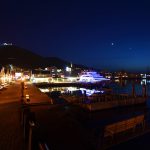
Zurich ⇒ Bern ⇒ Basel2018/04/12-04/17 Yumi Honda + Kyoko Takubo We visited Switzerland in search of places with light where people gather. Celebrating the longawaited arrival of spring, we found that more people than we expected were relaxing outdoors from morning until night. During the day, they enjoyed the abundant nature and beautiful cityscapes, soaking up the natural light. At night, people were chatting and laughing in a soft, gentle light. We climbed a dark hill for an elevated nightscape shot, but even there, it wasn’t tourists but locals who were gazing at the nightscape. We were able to find a city light in Switzerland that makes you want to spend a long, leisurely time there. People enjoying the sunset on the shores of Lake Zurich People Gathering on the Riverside in Basel, with Beers in Hand ■Waterside at DuskOn a warm spring evening, people gather on the shores of Lake Zurich. In open areas with a view, everyone enjoys the passing of time in their own way—a unique luxury. After the sun sets and the sky turns indigo, historical buildings from the Middle Ages are softly lit and reflected on the water’s surface. The reason this atmosphere can be enjoyed comes from a combination of historical background and urban planning.First, the number of cars is overwhelmingly small compared to other cities. The city is not obstructed by wide roads or traffic jams, so you can feel close to the river,…