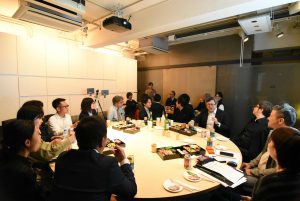
we will have a round table discussion to review the night walk at Meguro-gawa area.
-Date: Apr.17 (WED)19:00~21:00.
-Venue: LPA2F 5-28-10 Jingumae Shibuyaku
-Fee: Free
Send E-mail to office@shomei-tanteidan.org by Apr.08 to save your seat.
9 November 2005 Akihabara, home of the latest and greatest in electronic technology, is not just a place for the “otaku” any more. While the “super-nerds” scour the electronic stores for the newest gadget, urban redevelopment is re-shaping this area, trying to combine the old Akihabara with a fashionable new version. The Lighting Detectives setout this time to discover the possible direction of Akihabara`s future. Akihabara Redevelopment The detectives gathered at the entrance to the infamous Electric Town to start off on their Akihabara Adventure. Redevelopment to make Akihabara a worldwide center for the IT community is part of the concept behind Akihabara Crossroads, a new development officially awaiting its grand opening in the spring of 2006. However, one of two high-rise structures in this redevelopment, Akihabara Daibiru Building, a combination office, IT academic research, and convention center, opened its doors in the spring of 2005. From the inside wall washers gently illuminate the Daibiru Building facade and blue LED accent lighting, embedded in the entrance pavement, creates a lighting environment that is a far cry from the typical Akihabara experience up until now. Along with this new lighting environment, the opening of the Tsukuba Express and a temporary museum D-Akihabara, we caught a faint glimpse of the new Akihabara. The Yamanote Train Line platform is almost level with the second floor of the Daibiru Building, just in front of the train station. As the trains pass in and out…
Theme:Lighting Design Awards Interviewer: Li Jinmu Jinmu:Mende San, today let us discuss about design awards. When I was in the college, I actively joined many student design competitions. During my final year in the University, I particularly got a chance to participate an urban design competition. Mende:Why were you interested in taking part in design competitions? Jinmu:As you may know I majored in landscape architecture. Through this competition, I was able to team up with other architecture and urban design students. That was something I had never experienced before. I would like to know other people’s thoughts throughout the entire process. Mende: Really? So, the purpose for you to join the competition is to know something? You didn’t intend to get any prize? Usually, people would like to win. Jinmu:I didn’t expect too much at that time. My school invited several top universities in the world to participate, such as University of Tokyo, University of Pennsylvania, thus I learned to take a better yearning attitude. Adding to the difficulty, Kazuyo Sejima from SANNA was in the Jury. She came to Singapore, and our group had to present to her and other judges. It was a very interesting experience for us, and surprisingly, we got the third prize at the end. Mende: I see. One of the function of the design award program is to encourage young people to challenge themselves. Jinmu:Perhaps this is also to get the motivation for my design…
17 November, 2005 This month the Lighting Detectives rallied at the new Endo Lighting Corp. Aoyama Showroom for a bigger and better version of the regular salon session. The showroom accommodated 60+ detectives, a 3-screen slide show, and energy and enthusiasm to keep the discussion going for more than 2 hours. It was a more “formal” setting than our usual meetings and guests needing coaxing to sit in the front row, but all eyes and hears were on the presenters and their slides once the lights were dimmed. The agenda for the night gave the detectives a rare opportunity to compare and contrast the Japan bay cities of Nagasaki and Yokohama, watch footage from the Bali Kite Festival, and view in detail two monsters in the architecture world: Louis Kahn’s Kimbell Art Museum and Tadao Ando’s Modern Art Museum of Fort Worth. To top the night off, the detectives were able to seek a peak at Endo Lighting products on display. The detective’s did not go home unsatisfied tonight! Reported News, Surveys, and Events Nagasaki City Lighting Survey…..Rachel Nakayama Yokohama City Lighting Survey…..Tsutomu Nagatsu Dallas / Fort Worth Lighting Survey…..Yosuke Hiraiwa City Walk: Akihabara…..Momoko Muraoka Light Up Ninja@Bali…..Ken Okamoto & Natsuko Ueda 2005 Transtantional TN Form in NYC…..Saiko Tanuma
Hikaru Kimura Due to the impact of the COVID-19, the Lighting Detectives have voluntarily suspended in-person activities since 2020. While we haven’t been able to conduct our usual activities, we’ve been exploring new methods, such as individual Night Walk Surveys and connecting our salons via the web. Now that we’ve grown accustomed to online communication due to the pandemic, we have launched three new live-streamed online activities on YouTube and Instagram as new content. ■Lounge Talk with Chief Mende and Friends The first is a live-streamed lounge talk on YouTube Live. This is a special project where chief Mende invites his friends to have a casual and candid conversation over drinks. For the first episode, we invited Mr. Naomitsu Tokieda from Toki Corporation as our guest, who has a personal relationship with chief Mende and has participated in the Lighting Detectives World Forum. It was a fun first episode with a relaxed, private atmosphere unique to YouTube, which included anecdotes from Mr. Tokieda’s younger days.The second episode, titled “The Dawn of the Lighting Detectives: A Look Back at 1990-2000,” featured guests Mr. Yu Inaba and Ms. Reiko Kasai. They shared their founding beliefs and the struggles from the group’s early days. A must-see part of this episode is the rare, never-before-seen footage from a 1998 exhibition, where 100 prominent figures from various fields predicted the “Tokyo nightscape in 2050.” ■Take a Walk with Chief Mende The second activity is a…
City Night Survey – Taipei & Taichung, Taiwan 2023.10.30 – 11.04 Genki Watanabe+Hikaru Kimura Office of the Governor-General Taiwan is geographically close to Japan and has deep historical ties. It is famous for its skyscrapers such as Taipei 101 and, more recently, for buildings designed by Japanese architects. Renovations of old buildings are also being actively undertaken. We investigated how the mixture of old and new influences the light and human activity in the cities of Taipei and Taichung. Taipei and Taichung The capital of Taiwan, “Taipei” is characterized by world-class skyscrapers such as Taipei 101 and streetscapes that retain historical architecture. In addition to new buildings, there are also many renovations of existing buildings, creating a city with a mixture of old and new architecture. Taichung has become the second largest city in Taiwan in terms of population in 2017 as a result of government-led urban development efforts in recent years to disperse the over concentration of the metropolis in Taipei.We investigated how Taichung, planned as a compact city, affects the city’s light and human activity, and how it differs from Taipei’s light. The nightscape of Old City (west side) from Taipei 101 Taipei’s Urban Area Taipei’s urban area can be roughly divided into two areas. The west side of the city is the Old City, where historical buildings still remain. Many important political centers are still located on the west side, and historical buildings are still used as administrative…
This website uses cookies to improve your experience. We'll assume you're ok with this, but you can opt-out if you wish. Cookie settingsACCEPT
Privacy & Cookies Policy
Privacy Overview
This website uses cookies to improve your experience while you navigate through the website. Out of these cookies, the cookies that are categorized as necessary are stored on your browser as they are essential for the working of basic functionalities of the website. We also use third-party cookies that help us analyze and understand how you use this website. These cookies will be stored in your browser only with your consent. You also have the option to opt-out of these cookies. But opting out of some of these cookies may have an effect on your browsing experience.
Necessary cookies are absolutely essential for the website to function properly. This category only includes cookies that ensures basic functionalities and security features of the website. These cookies do not store any personal information.