


Tokyo Sky Bus Tour
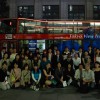
26 September 2008 The Lighting Detectives are always up to something unusual and for this city walk we rented a double-decker, open-air bus to cruise the streets of Tokyo. A specially planned route took us from Marunouchi→around the Imperial Palace→past the Diet Building→through the middle of Ginza→across the Rainbow Bridge→around Odaiba→back through Toyosu→across Kachidoki Bridge→up Haruumi Avenue→back to Marunouchi. It was a neck-kinking, eye-popping, wind-in-your-hair tour! Sore Neck after a Magical Tour of Ginza Group photo in Marunouchi before the start of the tour. An air of excitement and anticipation as members boarded the bus for the 2-hour night tour of Tokyo. Driving through the heart of Ginza was the highlight for many on the tour. New and old methods for street and facade lighting were on parade, an excellent opportunity for comparing and contrasting lighting eras. Office tower lighting and residential condominium lighting dominated the scene on the drive back from Odaiba to Marunouchi. While white fluorescent lighting was the predominate color some condominiums glowed a soft orange. Members all had stiff necks after 2-hours of continuous looking up, but nobody seemed to mind. Chatter even died down as the bus started along the route, as members seemed to take this opportunity very seriously. On this bus tour I accomplished something that I am too embarrassed to do any other day; Crank my head back and look up as we drove through the streets! As anybody knows, Tokyo is…
SAINT-PETERSBURG, Russia
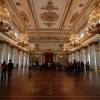
Saint Petersburg is a city of deep imperial and artistic culture. As the city was once the capital of the Russian Empire, many impressive palaces and cathedrals convey this great history. Although, there are not many newly constructed buildings in the city and it doesn’t seem that the economic growth of recent years has improved the lighting environment of the city. Once a secret hide-a-way of the empress this building is now the State Hermitage Museum. As a former private art museum to royalty and aristocracy, the luxuriousness of the interior is a little overwhelming, but the lighting environment is absolutely beautiful. Pleasure boats run tours on the Neva Heba River at night to view the river nightscape cutting though the middle of the city. The shimmer of lights on the water’s surface is awe-inspiring. The fancily decorated palaces and cathedrals are symbols of this once imperial culture. At night most are light up to emphasis their beauty. However, the city also has many waterways and the nightscape along these canals is a lonelier story.
MOSCOW 2008, Russia
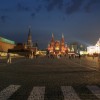
During the day short sleeves are fine, but even the Russian summer nights are cool with a little bit of white breathe after the sun goes down. Many main roads run through the middle of Moscow with classic Stalin style architecture lining the sides of the streets. The detailed, but dynamic lighting is very becoming for this architecture. On the other hand, lighting for roadways and plazas is rougher and not as artistically finished. The Red Square has been the stage for numerous historical events. The entire plaza is beautiful paved in stone, but at night huge floodlights shine huge amounts of light on the plaza and the glare is unbelievable. This beautiful, palace-like subway station platform is not uncommon in Moscow. We didn’t see one naked fluorescent light, very common in Japan, but each platform space was softly lit with indirect lighting. In the suburbs of Moscow along the river is the new “Moscow City,” a large multi-complex project still under construction. The developed area is a whopping 10,000 sqkm! What kind of lighting will this new town have? We’ll have to wait until its finished in 2020.
MOSCOW, Russia
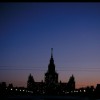
The streets of Moscow are mostly buried in shadows except for a few groups of lucent buildings, maybe an expression of authority. During the intense commercial time bawdy lights are lost, along with street activity, and stillness returns to the city. Now, towering lights dot the cold winter landscape. Looking towards Moskva University at dusk. The Bolshoi Theatre rebuilt in 1856. The upper lights set off the detail of this Greek-style Architecture. Christmas illumination at Tsum Department Store next to Bolshoi Theatre.
Residential Lighting: Past, Present, and Future “Rediscovering Residential Lighting from the Past to Modern Day.”
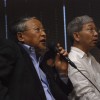
11 July The Lighting Detectives hosted the first of three salons focusing on residential lighting Friday, July 11th at the New Maru Building Ecozzeria. The hall was packed with over 100 guest who listened intently to the speakers who presented; “Residential Lighting: Past, Present, Future ? Rediscovering Residential Lighting from the Past to Modern Day.” by: saiko tanuma During the fiscal year of 2008 ? 2009 the Lighting Detectives will be hosting a series of 3 salons, all focusing on the influences of residential lighting. In discussing the culture of lighting, residential lighting seems like the best and most important starting point, as we delve into and analyze the why`s, what`s, and how`s. Our first salon outlined the history of residential lighting, with an emphasis on the ideal form of lighting from past to present in Japan. Kaoru Mende, and members of the Lighting Detectives, also heard contributions from guest speaker, Kazuya Ura, architect and interior designer. First on the program, a report from a survey of the Yoshihara residence in Kyoto by Lighting Detective members, who relayed their findings about Japanese light and the lighting environment of an old, Japanese-style house. What kind of effects do the daily changes in natural light contribute to the lighting environment? What can be done in the light of a single lantern? These are just some of the thought provoking questions raised and discussed during their presentation. Mr. Ura presented examples of his…
Candle Night Summer Solstice 2008 @ Omotesando – Eco Avenue
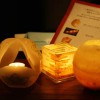
June 21, 2008 Sumer Solstice This was the 5th Annual Candlenight along Omotesando since the event was moved from nearby Cat Street. “Turn off the lights and take it slow” is the catch phrase for this familiar candle event. Two Japanese environmental NGO first proposed Candlenight as an opportunity to take another look at our modern lifestyles. Every year on the summer solstice from 8pm to 10pm this event reminds us to turn off the lights and reflect on our lives by enjoying the night in candlelight. Nationwide there are 938 individual candle events as part of this promotion. The theme for this years Lighting Detectives Candlenight @ Omotesando-Eco Avenue was “Dialogue: Dialogue with the Shadows, Dialogue with the Light.” As every year, local art university students and others gratuitously volunteered to help with the event, including the Omotesando Candle Cafe Network, candle installations along Omotesando, and original lantern making. We started with a kick-off meeting in February and used the next five months to prepare for this one-night event in June. Producers for the Omotesando event included Lighting Detectives Chief, Kaoru Mende, cultural anthropologist, Shinichi Takemura, and, as a special guest, graphic designer, Taku Satoh, all of who participated in each meeting. Each team presented their candle installation ideas, receiving advice and critics from the gallery. As the event neared and projects took shape, the weather report was not as cooperative, forecasting rain. But, after so many hours of…
Tama Art University Library and Hachioji Campus
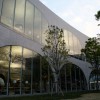
23 April 2008 On this cool, spring evening we took our city walk to the Hachioji Campus of the Tama Art University to investigate the new library, completed in the spring of 2007. Professor Satoshi Tabuchi, who has been coordinating the architecture and general campus planning for the Hachioji Campus, was kind enough to give the lighting detectives a personal tour of the library and campus. by: misa fujii / hiroyuki miyake Library during the Daytime Reading is the focus and concentration of a fixed line of vision over a long period of time and sharp shadowing can disturb this concentration. During the daytime, daylight creates soft shadows and a slightly changing atmosphere through out the library. Natural light penetrates thin, white curtains helps to soften the lighting along the seating near the windows. The silhouette of the Zelkova trees and curtain pattern fall onto the desktop with spots of sunbeams that stream through the tree leaves to create a relaxing reading atmosphere. The indirect fluorescent lighting overhead reflects off the concert ceiling to recreate the impression of a cloudy day. Each space seems very personal, like one would want to curl up by oneself with a book on a rainy day. These two types of light meet in a perfectly, soft gradation of light and shadow to create a very comfortable reading a studying environment. Tray of Light The sloping 1st floor and spiraling staircase to the 2nd floor…
TOKYO : ROPPONGI
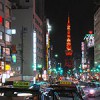
Roppongi has many faces including, an entertainment district with a foreign twist, new offices for daily business, and is developing as a center for the Tokyo art scene. The Lighting Detectives sped around on their bikes in April to discover what kind of light exists in this multi-functional area. The presence of the entertainment district is strongly felt at Roppongi intersection. Most people recognize this intersection as the center of Roppongi, but in recent years new development has created two new areas of focus, leaving the center of Roppongi very ambiguous. Points of reference include Mori Tower, Midtown Tower, Tokyo Tower and the metropolitan expressway, that cuts through, dividing this area of Tokyo. Large-scale luminous signage and a collage of other miscellaneous lighting dominate the view. Looking toward Roppongi from Aoyama Cemetery. The 3 towers that stand pronounced over Roppongi are a product of power and force, but appear alien in this setting. The towers look close and, yet, far off, as this scene can play tricks on your eyes.
6th Annual TN Forum: 2007 / Copenhagen PARKS, PLAZAS, and PROMENADES
Date: December 4th, 2007 Program: City Tour, Exhibition, Symposium Venue: Royal Acadamy of Fine Arts, School of Architecture in Copenhagen Transnational Tanteidan Forum 2007 in Copenhagen What started in Tokyo in 2002 is now in its 6th year, the Transnational Tanteidan Forum. Just as Christmas illuminations were springing up around the city, Copenhagen played host to the 2007 TNT Forum. Over the course of the three-day event, we held the main forum along with core member meetings, city walks, and excursions out of the city. The theme for this forum was “The Lighting of Public Spaces: PARKS, PLAZAS, and PROMENADES.” Up until now, we have disused many issues related to public lighting and as the final chapter is this series we tackled parks, plazas, and promenades. Seven cities presented along with Chief Mende from Tokyo, including: New York (Eleni Savvidou), Hamburg (Christof Fielstette, Christoph Geissmar-Brandi), Singapore (Reiko Kasai), Stockholm (Jan Ejhed), Belgrade (Aleksandra Stratimirovic), and our latest member from Brussels (Jean-Luc Capron). Dec. 4th 2 p.m. Waiting outside the auditorium, sunrays low over the horizon created long shadows from the building that fell at my feet. This is northern Europe in midwinter. Inside, guests from Copenhagen and the surrounding European countries gathered. Looks like another great turnout for this year’s forum; attendance totaling 200 guests. While starting to put together the Tokyo presentation, we had to ask ourselves, “Is there a park with a night view worth telling people about?”…
AMSTERDAM, The Netherlands
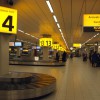
Five main canals fan out from the central station to form the city of Amsterdam. In contrast to the nostalgic streetscape along the canals, newly redeveloped areas include modern Dutch architecture with a touch of humor. Because these buildings stand in the same city the lighting environment is rich in variety. The signage at Schiphol Airport is easy to read and designed so anybody can understand with very effective use of color and light. For the residence of Amsterdam the waterfront is their backyard. Just watching the way they live, water is a part of their normal lives. Even the ordinary streets seem wistful as the canals wind through the city. I was completely surprised by the shear amount and variety of flowers and bulbs at this flower shop. A floodlight was mounted to the ceiling and illuminated the entire lot of flowers.
A Roppongi Christmas: Comparison of Tokyo Midtown and Roppongi Hills Christmas Illuminations
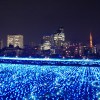
10 December 2007 Winter Blues Winter is a cold and quiet time where people gather indoors, drink hot cocoa or coffee, and maybe reflect on the year before and ahead. But Christmas in the city always gives us something to get out and about and see?Christmas illuminations. The Lighting Detectives gathered in Roppongi to shake off some of those winter blues and experience the new trends in Christmas illuminations. We tackled the big two: Roppongi Hills and Tokyo Midtown. Tokyo Midtown The theme for Tokyo Midtown was “Someone is always Santa Clause for someone else;” a lovely theme, but not very decipherable from the illuminations. A quick overview includes a sparkling rendition of the aurora borealis in the Plaza, a colorful display of stained glass in the Galleria, and a brilliant blue Milky Way in the Garden. In the image of the northern lights a dangly curtain of waves and motion was hung in the plaza. The installation seemed more crystal-like as the lights where mostly white colored. In the Galleria the Kiriko tree of cut stained glass continually changed colors and seemed to gather the most attention. At 8m tall it was quite impressive and visible from the far end of the garden. The ocean of little blue lights that covered most of the grassy area in the garden was actually the Milky Way with swirling stardust and shooting stars, all accompanied by music. Now this might have been…
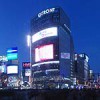
TOKYO : SHIBUYA
A city for the young and young at heart, Shibuya. The area is composed of a mess of streets all with a different atmosphere, including a few main streets connected by narrower alleyways. Each street has developed its own personality and role, including lighting conditions to create the Shibuya night. From the scramble intersection in front of Shibuya Station, 3 distinctive roads, Dogenzaka, Center Gai, and Koen Dori radiate. After dusk, the lights come on and the personality of each street is even more clearly defined. As the title implies, Center Gai is the center of Shibuya geographically and caters to the young as the center for shopping and entertainment. This street is full of light. Each shop seems to be competing for the brightest facade with infinite amounts of luminous signage and advertising, creating a 3-dimensional playground. Dogenzaka is a festive street with a steady flow of pedestrians, but turn down one of the narrow side streets and the atmosphere changes immensely. The facades of many love hotels packed into the area are saturated with color creating a seedy blend of light and young couples prowling the Maruyama-cho area.
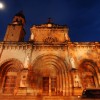
MANILA, Philippines
Because of previous colonial rule and occupation by Spain, USA, and Japan, many different cultures are accepted in the Philippines. As with architecture or cuisine, the uniquely arranged culture is also visible in the lighting environment. But behind the bright lights and in the shadows, we also saw a gap in the standard of living. For many people the church is a stronghold in their lives. The walls of this church were brightly lit with fluorescent lights and for relief from the heat several fans are also mounted on the walls, a nightscape very familiar in Asia. The floodlights bath the facade in featureless, flat light. In the area of town where Spanish architecture is still preserved hang sodium lamps, giving everything, walls, ground, and buildings an orangish glow. The dark green vegetation by the day is lost, but the historical atmosphere of the street seems like a scene out of a period movie. In the poorer areas of the city burned out streetlights are everywhere, but in the wealthier areas high-rise apartments and office buildings stand tall and just like in any other big city, there is a lack of individualism in this nightscape. Compared to the intensity of light in adjacent neighborhoods, the economical gap is prominent.
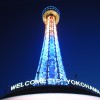
Bay City Lights of Yokohama
28 Septmber 2007 Night Gazing in Yokohama …by: natsuko ueda It has been a long time since the Lighting Detectives have been walked Yokohama. This autumn evening 24 members participated in the walk, along with member of the Yokohama City & Urban Design Group. Our first stop on the tour was the Yokohama Marine Tower, not usually open to the public, but with special arrangements our group climbed to the top to view the night scene. The industrial area along the bay had an orangish glow from low-pressure sodium lamps, in contrast with the residential area, which had a whiteish glow from mercury lamps. The lighting surrounding Minato Mirai is a large part of the whole lightscape with signature lightmarks like the Landmark Tower, the colorful lights of the ferris wheel, and flood lights from the baseball stadium. Every direction in our 360-degree view presented a different story for the city. After climbing the tower and jumping aboard a boat to see the best of Yokohama nightscape from the water, our last stop was the newly opened commercial complex, Yokohama Bay Quarter, followed up by the all-important post-walk dinner and discussion. The Lighting Detectives were able to hear straight from Yokohama City & Urban Design Group about invaluable topics concerning the city and how the nightscape can become even more dramatic and dynamic. My impression was not just of a typical waterfront city with dots of light everywhere across the…
Tokyo Midtown City Walk
01 August 2007 Searching for Heroes and Villains of Light The Roppongi One-Mile. In a one-mile radius (1.6 km), there are over 40 embassies, 9 international schools, and National Art Center, Mori Art Museum, and Suntory Museum of Art completing a triangle of art. In the center of where world cultures and arts clash, Roppongi, Tokyo Midtown is trying to become a base for transmitting Japanese Design to the rest of the world. In this new landmark of Tokyo, Lighting Detective members went in search of Heroes and Villains of Light. See what they found in this new urban environment. Heroes and Villains …by: yuji sato My overall impression is of a typical commercial facility catering to adults with a well-balanced lighting plan. Prime example of a lighting hero is the unified appearance of the Galleria interior. Inside, simple translucent signage with black lettering gives the interior a clean-cut feeling. A single warm-colored fluorescent lamp in the bottom of the sign creates a beautiful gradation. The signs are also mounted at the perfect high, not blocked by people’s heads and all visible with one glance down the corridor. The shopping area has the feeling of a European high fashion street with most shops also using halogen lamps or similar low color temperature lamps to create a posh and unified space. The second lighting hero I`d like to recognize is the small gallery space along the large columns in the atrium….
Candle Night Summer Solstice 2007 @ Omotesando – Eco Avenue
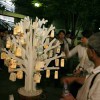
June 22, 2007 Sumer Solstice “Turn off the lights and take it slow.” Candle Night, a environmental and energy conservation event that also focuses on habits of the modern lifestyle and finding ones inner sense of time, is the brainchild of a environmental NGO. During the one night event, main building facilities are “lit down” and in different areas of the country candlelight events are held, and keep growing each year. According to the official Candle Night web site, this year over a three-day period from June 22 to June 24, 897 candlelight events were recorded. The Lighting Detectives have been involved with this event since our first candle event along Harajuku Cat Street in 2003. In 2005, we moved our event to Omotesando to attract a larger crowd. Participants originally heard of the event by word of mouth from Chief Kaoru Mende, but have grown to involve students from area art universities, other business professionals and members of the Lighting Detectives. Including volunteers for the day of the event, staff has grown to over 300 persons. The “Candle Night @ Omotesando – Eco Avenue” event includes a schedule of three activities for the night. First the event is off to an energetic start with the candle parade down Omotesando by the children of the Jingu-mae Elementary School located behind Omotesando Hills. As the marching continues, a spectacle of candle installations is lit along the main street, as some storefronts…
WIEN, Austria
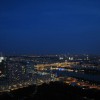
Wien is a city of artistic culture built upon the glory of the Habsburg Family Rein. Floodlights illuminate the heavy, stone architecture along the old streets, but just across the way is newer architecture with systems of LED`s that illuminate shear glass facades. The clash between the old empire and new culture is clearly visible in this city. viView of the City of Wien from Donauturm Observatory. The city, clustered around the Danubian River as it winds through the urban landscape, is beautiful at dusk. Nineteenth-century buildings used to store gasoline, Gasometer, have been transformed in to apartment buildings, shopping malls, and other facilities in 2001. Lights from the new living quarters spill out over the redeveloped area. Stephans Plaza at night. All the shops are closed, but store windows are aglow with soft light. Neon lights and other illuminated signage are also more visible along this street.
LJUBLJANA, Slovenia
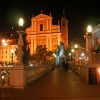
Ljubljana, the self-contained capital of Slovenia has a charming old cityscape made up of buildings topped with red tiled roofs. At dusk, people flock to the Ljubljana River to rest after a busy day and watch the lights come on over the city. Many historical buildings are lit up in this compact downtown, with other lights here and there creating a comfortable rhythm of lighting and darkness. The Tomostovje Bridge designed by Jose Plecnik connects the old city with the new city. Of all the bridges over the Ljubljana River, this is the one most central and with the most foot traffic. The orange lit facade of the Franciskanska Church next to the Presernov Plaza is visible from the bridge.。 Leaving the Presernov Plaza behind, the smaller streets are cloaked in darkness. Shop windows are dimly lit and a few neon signs are aglow down the street. View of the city from Ljubljanski Grad. From the darkness, activity along the river and the illumination of some main buildings creates axis of light across the city.
GRAZ, Austria
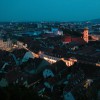
Graz is the second largest city in Austria. The Mor River runs through the center, with old cityscape and warm-colored street lighting giving the city a cozy feel. On the other hand, Kunst Haus and other newer architecture have added an element of the arts with a system of reflection streetlights also creating a new face for this city of culture. From the top of castle hill, with its large clock tower, Uhrturm, the City of Graz is in full view. Photo to the right, city hall offices in the city center. The building facades along Herrengasse Street are also up lit for a festive atmosphere as the sun goes down. The Kunst Haus, built along the Mor River and in the middle of the old cityscape, resembles a spaceship just blasting off. Fluorescent lights are mounted on the main facade and at night a program controls the fixtures, sometimes turning it blazing white. Reflection streetlights in the plaza before city hall. These streetlights are visible in many places throughout the city.
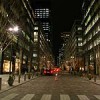
TOKYO : MARNOUCHI & TOKYO TOWER
The Marunouchi district in the center of Tokyo has been transformed in recent years from a business and financial center to the latest redevelopment to intertwine commercial and office space. Our survey started in Marunouchi, as we closed in on the infamous Tokyo Tower to view the sprawling Tokyo nightscape. Marunouchi Central Street is enclosed on both sides by buildings all at the same height of 31 meters. Facade lighting and streetlights throw an even light over the street, creating a flat nightscape with no rhythm of light and shadow. Quite possibly occupying the staring role in the production of the Tokyo nightscape is the Tokyo Tower. The ironworks structure of this tower is illuminated from underneath, beautifully generating a glowing symbol for the city. At 250 meters, looking down on Tokyo from the tower is a beautiful site. Glare is blinding and there is no visible unified pattern to the lights of Tokyo, but lights twinkle all over the city and continue as far as the horizon. Things always look better from a distance and the Tokyo nightscape is one of them!