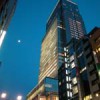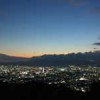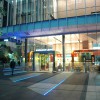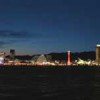
29 July 2004 It was a hot July evening when the 22 Lighting Detectives gathered at Hinode Pier to board the waterbus for a 50-minute tour down the Sumida River to Asakusa. It was early in the evening, just after dusk, and the lights from Odaiba, the Rainbow Bridge, the evening sky, and the bright moon helped us all forget the humid heat of Tokyo. As the boat headed down the river, like school children, the detectives moved from left to right and from the front to the back of the boat, taking in all the lights along the riverbank. One highlight of the trip towards Asakusa, are the 12 bridges that the boat will pass under, all individually designed and illuminated. The first bridge, Kachidoki Bridge, was dyed blue at the base and had a green arch against the dark sky. The next bridge, Central Bridge, was a combination of white ceramic metal halide light illuminating the top and orange high-pressure sodium light from the bottom, creating a simple gradation pattern up and down the bridge. Next on the river, the arch of Eitai Bridge was illuminated an impressive blue, well matched with the dark backdrop. Not often found in Tokyo, but darkness along the river helped to emphasize the bridge illuminations and Tokyo nightscape. The many highway ramps and bridges running across the river formed a complex 3-D network of static and interactive light. Also, in the Tokyo…
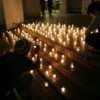
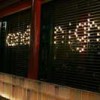
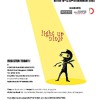
20 June 2004 What is Candle Night? This is the second season for the Lighting Detectives to participate in the Bi-annual Candle Night Performance. Many people are probably wondering, “What is Candle Night?” Well, started by an environmental NGO, this nation-wide event is a slow, relaxing time to reflect on human nature and rethink our positions on the environment, energy conservation, and the modern lifestyle. This event uses the earth’s natural “clock” the longest day of the year, the summer solstice, and the shortest day of the year, the winter solstice, to help bring awareness of the natural flow of time. The event slogan “Turn off the lights and take it slow,” means just that: turn out the lights and enjoy a time of reflection with friends or family. More then 6,000 venues all over the country participate in this “lighting down” event with over 200 of those venues also displaying candle installations. With each biannual celebration the circle of light continues to grow, but it is also a simple “event” that anyone is encouraged to participate in in the privacy of their own homes. Candle Night @ Cat Street As part of this nationwide event, the Lighting Detectives are active in the Candle Night @ Cat Street Performance. Cat Street is a narrow alleyway, lined with trendy little shops, that connects Tokyo’s Harajuku and Shibuya. The street was a small canal that ran through this district, but was filled…
31 May 2004 Back around the round table of the Lighting Detective Headquarters, club members gathered for another night of discussion, slideshows, and of course refreshments! This discussion included a whopping 3 overseas lighting survey reports, city walking tour pictures, and a report from club member, Musashino Art University student, Teruhiko Kubota on his recent trip to Italia. This was my first Salon, and I was surprised to see so many members with diverse backgrounds, students, lighting professionals, and others, who came together because a shared interesting in lighting to discuss, laugh, and be inspired. Reported News, Surveys, and Events Sydney, Australia Lighting Survey…Saiko Tanuma Las Vegas Light Fair Report and Survey…Ken Okamoto Messe Frankfurt Light Fair Report…Kaoru Mende Paris Lighting Survey…Kaoru Mende City Walk: Minato Mirai Subway Line…Chika Tanaka Travels: Roma, Italia Report…Teruhiko Kubota
12 May 2004 The Minato Mirai Subway Line connects Yokohama Station to Yokohama China Town five stops away. Four different architects were commissioned to individually design four of the stations on this new subway line. Although all of the stations have the same structural features, the purpose of our survey was to see how each architect, from the same starting point, reacted to design a unique station in terms of materials, color, and light. Minato Mirai St. / Kunihiko Hayakawa All the stations along the line are designed with the platform on floor B3 and the ticket wicket on B2, from there you climb to ground level, but at the Minato Mirai Station the shopping center, Queen’s Square, is on the ground floor. Using this to an advantage, the main feature of this station is strategically placed atriums, making it possible to view the shopping center 3 floors up from the platform and vice versa. The openness and air circulation from the high ceilings help to create a comfortable station atmosphere. The main colors and materials of this station are red, yellow, matte silver, and blue aluminum. The colors and materials were used to form horizontal axes throughout the station, emphasizing the speed and efficiency of the subway line. The entire station is basically illuminated in white light, but a more sunlight-beach influenced color might be more appropriate for this hot date spot, popular with the younger crowd. Bashamachi St….
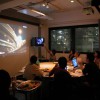
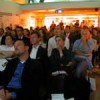
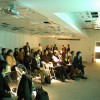
28 January 2004 The Lighting Detectives have left the building, and moved this month’s Salon to the Color Kinetics Japan Showroom. Recently, most of the Lighting Detective round-table discussions have been held at the headquarters in Shibuya, but with the help of Color Kinetics, we were able to bring a group of about 30 club members to the showroom for discussion, slideshows, and CK product review. As LED lighting is becoming more and more visible, this was an excellent opportunity to see CK products in action and inspect them with our own eyes. We also had the pleasure of special guests, Satoshi Uchihara and Mayumi Watanuki, both lighting designers who designed the recently opened Tokyo Dome City LaQua. Chief Mende and other members had a lively discussion about LaQua, as this was the venue for the most recent city walk tour. Reported News, Surveys, and Events City Walk: LaQua…..Kaoru Mende Discussion: LaQua…..Kaoru Mende with Special Guests: Lighting Designers Satoshi Uchihara & Mayumi Watanuki Bunkyo Ward Shopping Center 330°View Obervation Deck Nightscape Survey…..Ken Okamoto Oita Pref. Takigi Noh Drama Performance:…..Junko Inomoto Candle Night Winter 2003 Performance…..Saiko Tanuma Italia Lighting Survey…..Yaeko Hashimoto Color Kinetics Product Demostration
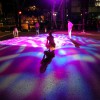
20 January 2004 Tokyo Dome City’s new multi-functional complex, LaQua, was the first stop on our city walk list this year. The new complex, with spa facilities, restaurants, shops, and amusement attractions, opened in May of 2003. The theme was to build an oasis in the middle of Tokyo, somewhere to relax, refresh, and have fun. And the first impression of LaQua reflects just that, as the spectacular color from the amusement park catch your eye. Trees lining the paths are bathed in a gold light, show their bare winter limbs, and small shrubs and bushes are also covered in twinkle lights. It seems everywhere you look light is incorporated into something, creating a vibrant light environment. The lux level reading from our illuminance meter doesn’t even begin to reflect the effect the lighting has on the feeling of brightness in the park. Another feature of the park is the world’s first ever center-less ferris wheel, Big O. A roller coaster, also, jets through the middle, unceremoniously illuminated, it only adds to the powerful impression of the gigantic “ring.” The colorful and kinetic lighting on the outer portion of the ring consist of many LED units. Each unit is further broken down into 4 parts to be programmed for a more detailed assortment of lighting display. The ring, the coaster, and the Water Symphony, a water, light, and sound show, in the plaza, turns the nightscape into an, alive, 3-dimensional…
Date: August 29th, 2003 Program: Symposium Venue: Haninge Centrum The Transnational Tanteidan Forum 2003 was held in Stockholm on August 29th, 2003 at the Kulturhuset Haninge, approximately 30 minutes by train from the city center. The forum was a great success. To our delight, the number of attendees exceeded our expectations and a change of site was necessary in the preceding days. Almost 200 people attended and enjoyed the afternoon forum. The forum’s theme was “Residential Neighborhood Lighting.” Core members from Tokyo, Hamburg, Copenhagen, Singapore, Washington and Stockholm reported results of their research into Residential Lighting. The difference between the international cities is very interesting and offers a unique window on the life of each nation. Most spend daily life without any notice of the lighting around us. But think one minute to change your life with lighting at your home. It might be very interesting to investigate lighting around you once again in order to create something special.
2003年12月22日 冬至 電気を消してスローな夜を 冬至の夜8時から10時の2時間だけ電気を消してスローな夜を過ごそう・・ということをテーマに面出団長の他、ライフスタイルプロデューサーの浜野安宏氏やキャンドルナイト呼びかけ人代表でもある竹村真一氏が監修したイベントが原宿キャットストリートで行われました。 これは、環境や省エネ、現代社会のライフスタイルについて考え直すとともに、人間的な時間のありかたを見つめるきっかけとして、昨年の夏至に行われたイベントの冬至版。夏至には、環境NGOが中心となって発案した”100万人のキャンドルナイト”にさまざまな分野のアーティスト、環境省や企業、自治体、各地の公共施設が賛同して、大きなうねりに発展し、全国で500万人(環境省推定)が参加して東京タワーや全国のランドマークの照明も消える、一大イベントとなりました。 原宿キャットストリートにキャンドルアートが出現 開催場所は、原宿キャットストリートが表参道と直行する旧渋谷川約700メートルほどの暗渠の遊歩道。この遊歩道に照明探偵団、武蔵野美大、多摩美大のチームが中心となって沿道にある店舗前6箇所でキャンドルアートを作成し、イベントの拠点となりました。波打つように成形したアルミパネル前にキャンドルを並べて鏡に映っているように見せたもの、異なる種類のスクリーンを透かしてあかりの表情を見せるもの、公園のジャングルジムを赤いトレーシングペーパーで囲い、中にキャンドルを入れた行灯・・などなど工夫を凝らしたキャンドルアートの数々が通りを彩りました。 街路灯を消灯したい… たった2時間のイベントでしたが、公共空間での火を使うイベントと言うことで行政や商店街との調整が難航を極めました。今回は準備期間も少なく見送りましたが、今後の大きな課題としてふたつ。『街路灯の消灯』と『縁石へのキャンドルの配置』です。当日やはり残念だったのが遊歩道沿いに白々と点灯したままだった街路灯。キャンドルのあたたかなあかりとの何ともミスマッチな光景でした。やはりキャンドルの繊細なあかりを見せるにはまずベースとなる闇をつくる必要があるでしょう。そして、今は暗渠となった川の流れを通りに配置した光で可視化する。または、通行人が携帯したキャンドルで光の川を再現する。 キャンドルでなくては伝えられないメッセージを込めたイベントを2004年の夏至にも行う予定です。乞うご期待下さい。 (田沼彩子)
DateDecember: 6th, 2002 Program: Symposium Venue: Tokyo Design Center Theme of Transnational Tanteidan Forum 2002 in TOKYO was “Regional Lighting Environment.” Various regions around the world have nurtured characteristic cultures of light. The globalization of information and industries, however, has been standardizing lighting technologies, which has caused the loss of unique lighting cultures created through individual ethnic culture, climate, history, religion, and social conditions. It is interesting to comparatively study people’s living environments with the focus on “regional light.” Through discussing similarities and differences in cultures, we may contribute to the preservation of characteristics in regional lighting cultures and create new cultures of light. Lighting Detectives always researches and studies the current lighting environment of a place. Light is “collected,” categorizing lights into four groups: urban lighting, architectural lighting, residential lighting, and lighting of special events and celebrations. The current situations are researched and reported. We seek significance in lighting through comparing and analyzing the lighting environments.
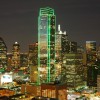
Orange lights brighten the plains and continue on towards the horizon, creating the Chicago nightscape. Notorious for cold winds, the Chicago nightscape was unified early on with high-pressure sodium streetlights. For crime prevention, the amount of light slowly increased with each passing decade, but outdoor lighting technology in Chicago is considered very progressive. Orange axes of light extend toward the horizon. High pressure sodium streetlamps are used beautifully throughout the citystreets of Chicago. The highmast lighting pole at the base of the John Hancock building is functional and glareless. Highly efficient streetlights illuminate State Street, creating a unified environment.