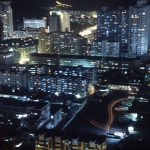
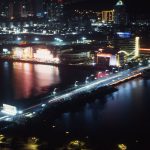
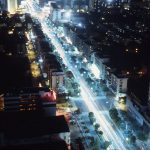
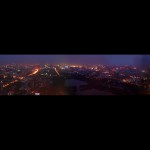
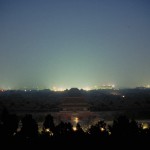
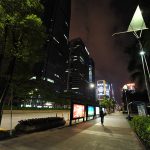
City Night Survey : Saitama-Shintoshin 2019.04.11 Lin Hu + Hikaru Kimura Saitama Shintoshin is a district established around the year 2000. Centered on JR Saitama-Shintoshin Station, it is an intensively structured urban area featuring a variety of functions, including large-scale commercial facilities, a major multi-purpose arena, government office complexes, and hospitals. This survey examined how this planned city has evolved from the perspective of lighting. Nightscape over the heliport from the Saitama Government Office Complex Light Linking Spaces A pedestrian walkway system is installed around Saitama-Shintoshin Station, utilizing an active pedestrian-vehicle separation plan that allows for smooth circulation from the second-floor station gates to various facilities. While the ground level is brightly illuminated by roadway pole lights, the pedestrian walkways feature lower-level lighting such as uplights and footlights—excluding some decorative pole lights in park areas—creating distinct expressions of light for each zone.Saitama-Shintoshin Station is connected to Kita-Yono Station by a walkway spanning approximately 600m. A continuous cantilevered glass canopy allows pedestrians to walk without getting wet in the rain or being stopped by traffic signals. Along this route, there is a straight path of about 100m running parallel to the railway tracks. Here, despite the cantilevered canopy structures being identical—likely due to differing construction phases—the lighting techniques varied across three distinct types. Although the architectural design is similar, the change in lighting methods results in varying levels of brightness depending on the location. While achieving uniformity may seem important, using different…
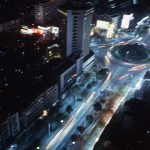
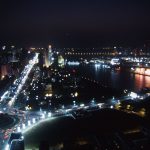
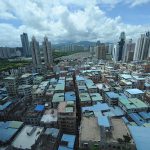
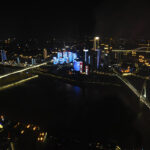
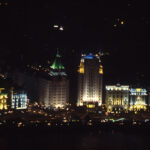
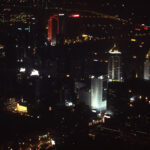
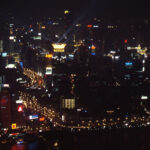
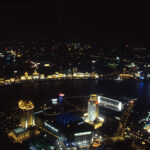
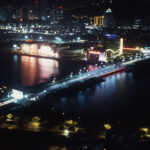
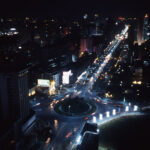
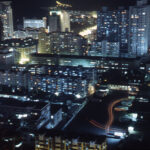
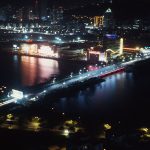
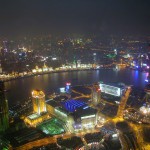
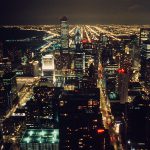
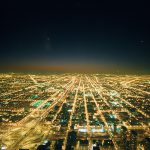
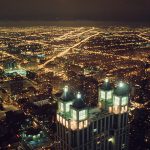
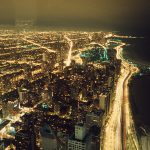
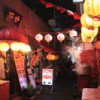
Guangzhou on the north shore of the Pearl River Delta As the saying goes “Eating in Guangzhou,” Cantonese cuisine is prepared in a wide variety of ways using almost anything under the sun. Residents carry that energy into the lighting environment that is equally diverse and full of activity, maybe a symbol of the recent economic development in China. Guangzhou Pearl River In the city limits of Guangzhou the Pearl River runs from west to east. The streets and buildings along the river face the water with people enjoying the night view from various places by cruising, strolling, and dinning. Guangzhou Xia Jiu Lu The pedestrian shopping street Xia Jiu Lu is famous for old shop houses and as a redeveloped entertainment district. Along with Chinese type red lanterns that line this street are an infinite amount of neon and other luminous signage that create a chaotic and exciting atmosphere. Shenzhen from Saige Plaza Tower After being labeled a special economic zone in the 1980`s, the population escalated and transformed the Shenzhen area into a gigantic urban beat. The city grew overnight like an illusion from a virtual world, but the population and high-rise condominium boom keep growing; which makes for an interesting nightscape.
2023.01.18-01.20 Yumi Honda + Misuzu Nakamura Kobe is famous for the night view from Mt. Rokko as the “10 Million Dollar Nightscape” and for its waterside nightscape as a port city. Nightscape guidelines have been established in 2012, and efforts are being actively made to improve the lighting in the city. We walked around the city, which continues to be updated, and explored the components of a nightscape that is uniquely Kobe. ■“Instagrammable” NightscapePort Tower, Maritime Museum, Oriental Hotel, Hotel Okura, Ferris wheel, sightseeing boats, and the “BE KOBE” monument…. When people think of the city of Kobe, they probably think of Meriken Park. Meriken Park is the face of Kobe, and even at night many people were visiting the park to take commemorative photos. Many of the park’s symbolic monuments were lit up and color lighting was used extensively, but the colors and color schemes were mainly neutral, not primary colors, so it was nice to enjoy the colorful light without getting an overpowering impression. To complement the color lighting, the ground lights of the pole lights, handrail lights, and bollard lights were uniformly lit with light bulbs, creating a subdued brightness. Both decorative lighting and functional lighting emitted little excessive glare, allowing us to concentrate on the illuminated objects. It seemed like seeing the nightscape and taking pictures of it could be the purpose of a visit to this place. In this age of breathlessly uploaded photos and videos…
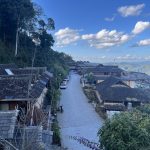
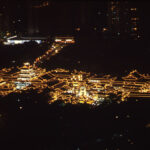
Chong Qing Lighting Survey 重庆史光: Re-Celebrating History of Light 2019.07.04 – 2019.07.05 Clement Lee + Iwata Masahiro Located in the upstream of Yang Tze Basin, Chong Qing serves as one of the manufacturing, transportation and commercial hub of China. Caught within rapid infrastructure changes, this survey seeks to uncover the methods for Architectural and Lighting preservation efforts to reflect the ancient Clement Lee + Iwata Masahiro traditions from the dynasties. Ci Qi Kou Old Town highlighted with linear architecture facade lighting contrasting the light blue canvas sky of the evening Old town of Ci Qi Kou (磁器口): Cultural Hub of Chong Qing Chongqing is a technologically advanced city situated in the mountains of southwest China. With a rich history of being a major economic hub, Chong Qing was propelled to earn a place in the top 13 megalopolises of China. With the theme of understanding and exploring the cultural traditions of Chong Qing, we set out to discover its customs and efforts to preserve the rich traditions which create the unique character that separates this Sze Chuan-influenced province from the other major cities of China. We began at the heart of the city: the old district of Ci Qi Kou. This old town is currently filled with shops sells goods and traditional food of the old Chongqing. A modernized trading hub that reflects the bustling old port to trade porcelain along the Yangtze River. It was a commercial hub for pioneers back in the…
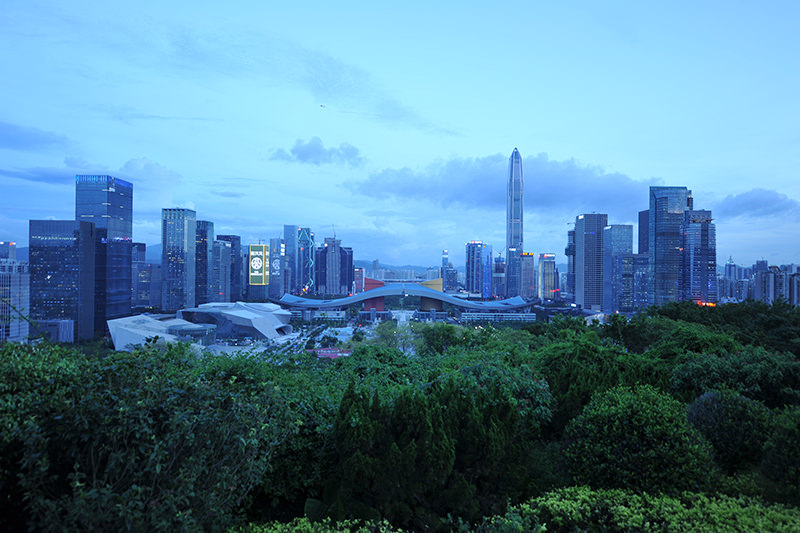
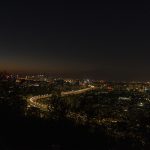
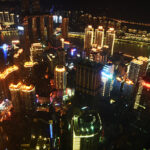
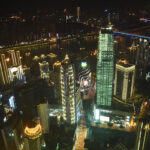
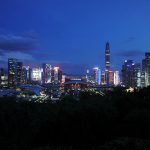
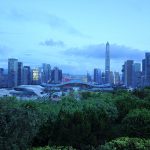
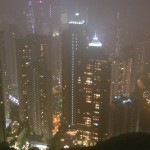
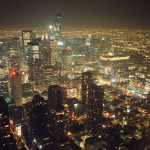
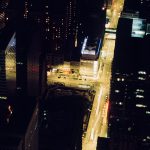
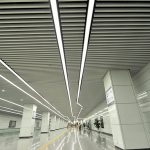
2025.09.12 & 09.18 Lin Hu + Jiang Kunzhi + Lin Huangyi Shenzhen evolved from a fringe town into a high-tech metropolis in about 45 years, and its bold, sustainable urban lighting planning stands out nationally. A two-day field study examined nightscape patterns in its three CBDs, media façades in Futian, and the functional lighting design of the new Gangxia North Metro Station. Unlike older, historically rich Chinese cities, Shenzhen started as a peripheral town and in just about 45 years has become a high-tech modern metropolis. Thanks to its local legislative autonomy, Shenzhen’s urban planning is highly experimental and often serves as a model for other Chinese and even international cities. In urban lighting planning, Shenzhen is a national frontrunner: its nightscape design is bold and innovative, yet the city has also enacted special regulations for ecological protection and light pollution control, showing a clear commitment to sustainability. However, some lighting projects still spark social debate over energy consumption, light pollution, and the use of public resources. To understand more of Shenzhen’s current nightscape, the Shenzhen office team conducted a two-day field study with Mende-san and Kasai-san, focusing on three themes: 1. Nightscape of the three main CBDsWe visited the observation deck at 540 m on the Ping An Finance Center in Futian to take in the scale and layout of the city at night. Looking east toward Luohu, the skyline shows a mix of old and new high-rises, reflecting Shenzhen’s…