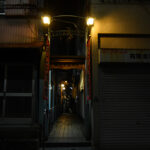
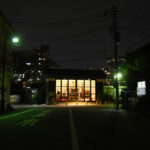
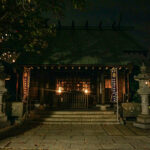
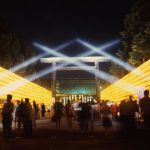
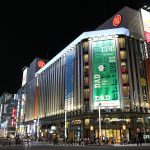
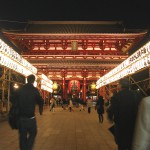
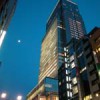
In front of the main gate to Senso-ji Shrine lies the neighborhood of Asakusa. One of Tokyo’s most popular entertainment districts, Asakusa flourished with kabuki, opera, and comic storytelling from the Meiji Era to the end of WWII. The Lighting Detectives discovered a variety of decorative streetlights and a lighting atmosphere fitting for this lively cultural destination. Upon entering the famous Kaminarimon, the Nakamise approach proceeds towards the shrine with bright-white, fluorescent-tube illuminated signage lining both sides. After navigating this corridor, walls of softly glowing lanterns come into view. The lanterns once lit with fire were replaced with incandescent bulbs and now fluorescent lamps. In popular neighborhoods like Shibuya or Roppongi, architectural facade lighting or neon signage fills the vertical space and “street lighting” is virtually non-existent. However, a variety of decorative streetlights festively illuminate the streets of Asakusa for a very fitting lighting environment. Pub signage and lanterns dispersed along the dark streets of Asakusa create an uncanny charm in this neighborhood. Roadway lux levels are a fairly dim 10-16 lx, but the red lanterns hanging from the eaves of establishments dig up affection for this old town.
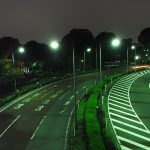
2022.11.4-5 Sachiko Segawa Surprisingly, this survey of the Sawara district marks the first time the Lighting Detectives have conducted an investigation within Chiba Prefecture. The team focused on an area designated both as an Important Preservation District for Groups of Traditional Buildings and as a Landscape Formation District. Here, the townscape of merchant houses, which flourished from the Edo period thanks to river transport on the Tone River, still remains. Located about 70 km from Tokyo Station and slightly inland from the Tone River, the Sawara district of Katori City once thrived as a merchant town, to the point it was said to rival Edo itself. However, the town declined during Japan’s period of rapid economic growth. Following a townscape survey in 1974, the value of its historic scenery was reappraised. Today, leveraging its convenient location—just two hours from Tokyo and one hour by train from Narita Airport—the area is being redeveloped as a tourist destination. For this survey, the team limited their scope to the townscape along the Ono River and conducted a nightscape survey. ■Uniquely Designed Lighting Fixtures From JR Narita Line Sawara Station, as we walked toward the Ono River, we were greeted by a bollard topped with a monkey. “Why a monkey…?” we wondered, but as we continued upstream along the river, we encountered bollards adorned with all sorts of figures: rabbits, carp, children, frogs, Ebisu, and more—each one different, with no two alike. These uniquely…
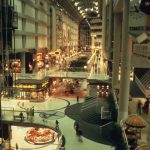
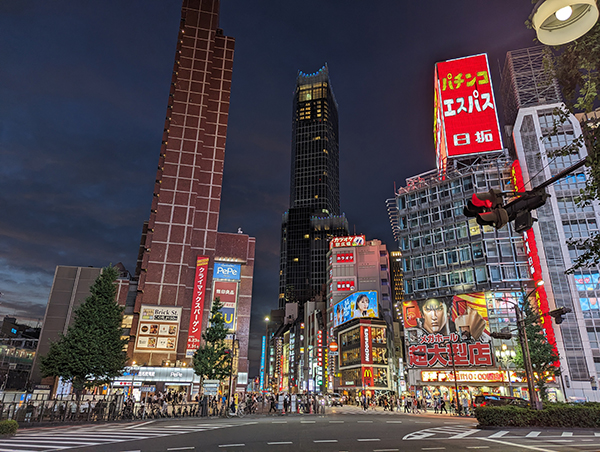
A city for the young and young at heart, Shibuya. The area is composed of a mess of streets all with a different atmosphere, including a few main streets connected by narrower alleyways. Each street has developed its own personality and role, including lighting conditions to create the Shibuya night. From the scramble intersection in front of Shibuya Station, 3 distinctive roads, Dogenzaka, Center Gai, and Koen Dori radiate. After dusk, the lights come on and the personality of each street is even more clearly defined. As the title implies, Center Gai is the center of Shibuya geographically and caters to the young as the center for shopping and entertainment. This street is full of light. Each shop seems to be competing for the brightest facade with infinite amounts of luminous signage and advertising, creating a 3-dimensional playground. Dogenzaka is a festive street with a steady flow of pedestrians, but turn down one of the narrow side streets and the atmosphere changes immensely. The facades of many love hotels packed into the area are saturated with color creating a seedy blend of light and young couples prowling the Maruyama-cho area.
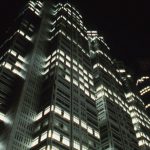
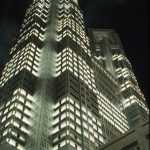
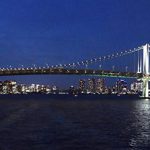
In the heart of Tokyo, Nihonbashi River lies hidden under a system of highway overpasses and the Sumida River is wide and commanding and it cuts through the city. With a variety of bridges, both rivers assert their own unique presence in the Tokyo cityscape. On our own river tour, we encountered the particular water and lightscapes surrounding the bridges and shores of each river. The newly built Nihonbashi Mitsui Tower next to the famous Nihonbashi Bridge. This is the first skyscraper in the Nihonbashi area and as the sun sets, the facade detail is elegantly illuminated. At the historical Nihonbashi District, a variety of lighting methods are on parade, but the highway overpasses keep most of the river hidden from view. Rumors of reconstructing the highway system underground would help revive the scenery along the Nihonbashi River. The main structure of the Chuo-Ohbashi Bridge is beautifully illuminated. The many bridges along the Sumida River compete with each other for top beauty marks, as each is illuminated in a multitude of colors.
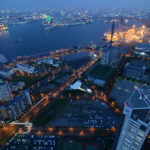
Tokyo Survey: Tsukuda / Tsukishima 2019.11.18 Kyoko Takubo+Yuichi Anzai+Namiko Watanabe An overview of Tsukishima. In contrast to the bright large city buildings, the small alleys and storefronts don’t leak much light Tsukuda is an fisherman island made in Edo-period. Tsukishima was landfilled in Meiji era and now there are still many row houses and small alleys. While the port area of Tokyo is going through mass redevelopment, we investigated the lighting environment of this area filled with intermingling old town houses and large city buildings. Tsukuda Tsukuda 1Chome Mainstreet. Children playing outside the old candy store Tsukuda 1 Chome Mainstreet is mainly lit with mercury lamps Tsukuda Machikado Museum. Its lit with LED3000K with about 134lx. Our investigation started by taking an overview photo from a tall building from the other side of the river. With the hustle and bustle bright lights from the Central area’s cityscape, there was one part that was dark- that is our target of this investigation, Tsukuda・Tsukishima. The dark patch from this area is even more pronounced as it is surrounded by the bright city lights all around. As we get back on the ground, we headed towards Tsukuda 1 chome (Old Tsukuda Island) Mainstreet. On our way we saw the mercury lamp streetlights (4500K) emitting some green tinted white light. The average brightness was around 11lx. In the day you could still see a nostalgic scene with children playing outside the old candy store…