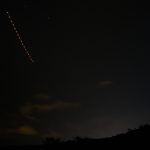
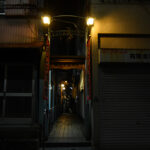
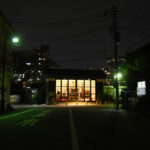
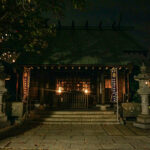
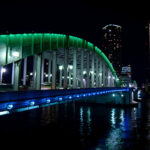
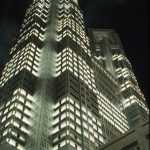
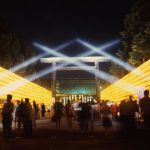
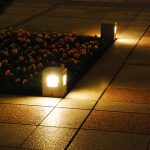
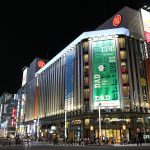
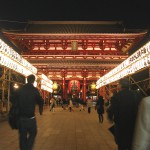
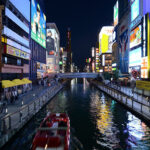
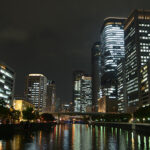
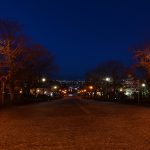
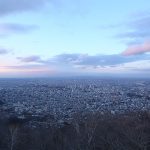
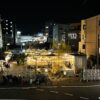
Modern Kagurazaka still conveys the atmosphere of its once flourishing Edo Era streets. Old Japanese restaurants and bars line the narrow alleyways and with softly glowing lantern light and welcome signs to complete the scene, one forgets that this is Shinjuku Ward in the middle of Tokyo. In this historical neighborhood warm lantern light is all but a natural presence. Compared to the white lights of Ikebukuro and Shinjuku glowing brightly in the distance, Kagurazaka is submerged in darkness. Buildings in Kagurazaka are lower and lower color-temperature light also peaks out from the many alleyways. Kagurazaka Street, running down the center of this neighborhood, is the only really bright spot, except for the lights reflecting off the canal along Sotobori Street. A prized neighborhood for shopping and entertainment during the Edo period, the historical Kagurazaka Shopping Street is a 700 meter long living time slip. New and old shops are jumbled together along the street with specially designed, lantern-like street lights placed at intervals along the edge of the sidewalk. From Kaguraza`s main street several narrow alleyways lead to the interior of the neighborhood where the scale of lighting is downsized to human proportions. Outside restaurants on Hyogo Yokocyo, one of the more famous back streets, softly glowing lanterns light the entrance and also reflect of the cobbled street and traditional-style fence for a very old Japanese atmosphere.
2018/09/30-10/08 Shosaku Takahashi + Masafumi Yamamoto Morocco is located on the African continent but retains a strong influence from European countries such as neighboring Spain and France. It can be said that the cities have been formed under the influence of various cultures. This survey started in the major city of Marrakech, crossed the Atlas Mountains to visit the vast Sahara Desert inland, and then continued for ten hours and another 600 kilometers across the continent to reach the blue city of Chefchaouen. We experienced the climate, culture, and lifestyle of this country, which shines on the shores of the Mediterranean Sea while benefiting from the sun, and investigated the relationship between lighting and people’s lives. Djemaa el-Fna Square Many of the Old Town’s paths are covered with sunscreens The souk is bustling with people at night People watching street performers ■Arrival in MarrakechAfter driving four hours from Casablanca Airport, we saw the reddish-clay streetscape of the major city of Marrakech pop up in the middle of the wilderness. The moment we got out of the car in the old town, swarms of flies started hitting our bodies. The smell of rotting fruit and raw fish stung our noses. Crowds of people moved through the narrow alleyways, as motorcycles sped past, honking their horns. The air was thick with dust and exhaust fumes. Flies immediately swarmed the tuna sandwich we bought from a nearby stand for a late lunch. ■Old…
City Night Survey- Chiang Mai Lantern Festival 2023.11.25 – 11.29 Angkana Kongchatri (Tan)+Momoko Muraoka Chiang Mai is the second largest city in Thailand which has special atmosphere tracing from Lannar kingdom period. Tan from Bangkok and Momoko from Tokyo traveled to the city for a survey. ■Back ground of the survey The lantern festival in Chiang Mai has been getting very high attention from international tourists since a couple of decades ago. Due to its visual appeal, the festival has become an explosively hot tourist spot and activity. As number of tourists raise up, the negative side of the festival also becoming a serious issue, such as the risks of fire and abandoned trashes which cause suffering to local people. In this SNS era, the speed and frequency of exchanging information has become extremely heavy than ever. When very local culture gets intensive attention from unidentified crowds, then the one to retain the culture need to face and respond the troubles to come with the anonymous attention which is also happening on the lantern festival in Chiang Mai. Festivals with lights are attractive. However, overlooking the wastes happening materially and culturally cannot be accepted anymore. Through this survey, we aim to observe not only the bright side but also the problems and struggles behind which could relate with many other traditional lighting festivals. We believe that the approach could bring another layer of depth for the lighting detective activity with…
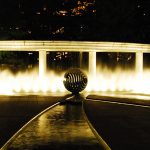
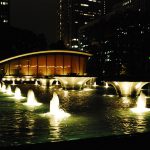
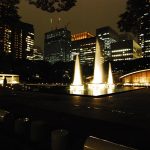
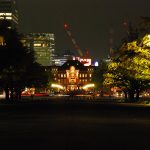
In the middle of Tokyo is the Imperial Palace, a haven for runners and tourists, alike. The lighting in the palace outer garden and nearby Wadakura Fountain Park has been renewed and replaced with environmentally conscious LED fixtures. We surveyed the unique pocket of darkness that surrounds the Imperial Palace along with lighting environment of nearby parks and roads. Imperial Palace Outer Garden. The fancy pole lights in the outer garden are originally gas lamps, but the light source has been changed to high-pressure sodium lamps and now upgraded to LEDs. The average lux level is only 1-2lux along the paths lined with these LED fixtures, but inside the fixtures are 6, 26watt LED modules all pointed in different directions. This application helps to spread the light around without making a too bright, but comfortably dim atmosphere. Daikancho Street Daikancho Street runs along the north side of the palace grounds, is a much narrower street and pedestrian sidewalk compared with the rest of the facilities surrounding the palace. Along the tidy, hedged sidewalk, streetlights are placed at 3-meter intervals. Mostly for crime prevention, the lights are very bright and glaring. Ohtemachi Entrance The Ohtemachi Entrance area leads to an inner palace garden and is surrounded by a main arterial road on the outside, for a very open and accessible area. Most lighting is road lighting, mounted on 10-meter tall poles arranged down the middle of the street, but plenty bright…


2022.10.27 Genki Watanabe+ Chuanyi Liu+ Yuki Ito This Tokyo night walk survey took place in Shimokitazawa, a neighborhood especially popular among young people. Known as one of Tokyo’s most culturally rich districts, the area is filled with vintage clothing shops, eateries, theaters, niche cinemas, and art galleries.The Lighting Detectives previously conducted a survey here in 2009. This time, we examined how the area has changed since the Odakyu Line was relocated underground. We also focused on the newly developed Shimokita Senrogai area, which opened on May 28, 2022, assessing its lighting design and comparing it with the older shopping streets to explore the contrast between new and traditional urban atmospheres. ■Map around Shimokitazawa Station With the Odakyu Line moved underground, a new neighborhood called Shimokita Senrogai was developed between Higashi-Kitazawa Station and Setagaya-Daita Station. Driven by the desire to support the community, redevelopment progressed step-by-step while listening to local residents’ voices. The entire area officially opened on May 28, 2022.Alongside the railway line, new facilities such as daycare centers, a hot spring inn, commercial spaces, student dormitories, and event venues were established. ■Development of Shimokita Senrogai The Shimokita Senrogai area we surveyed is a newly developed space created by moving the Odakyu Line underground. It was designed with the intention of reconnecting the northern and southern parts of the neighborhood that had previously been divided by the railway tracks, resulting in developments that encourage smooth pedestrian circulation throughout. The development features…