Zurich ⇒ Bern ⇒ Basel
2018/04/12-04/17 Yumi Honda + Kyoko Takubo
We visited Switzerland in search of places with light where people gather. Celebrating the longawaited arrival of spring, we found that more people than we expected were relaxing outdoors from morning until night. During the day, they enjoyed the abundant nature and beautiful cityscapes, soaking up the natural light. At night, people were chatting and laughing in a soft, gentle light. We climbed a dark hill for an elevated nightscape shot, but even there, it wasn’t tourists but locals who were gazing at the nightscape. We were able to find a city light in Switzerland that makes you want to spend a long, leisurely time there.
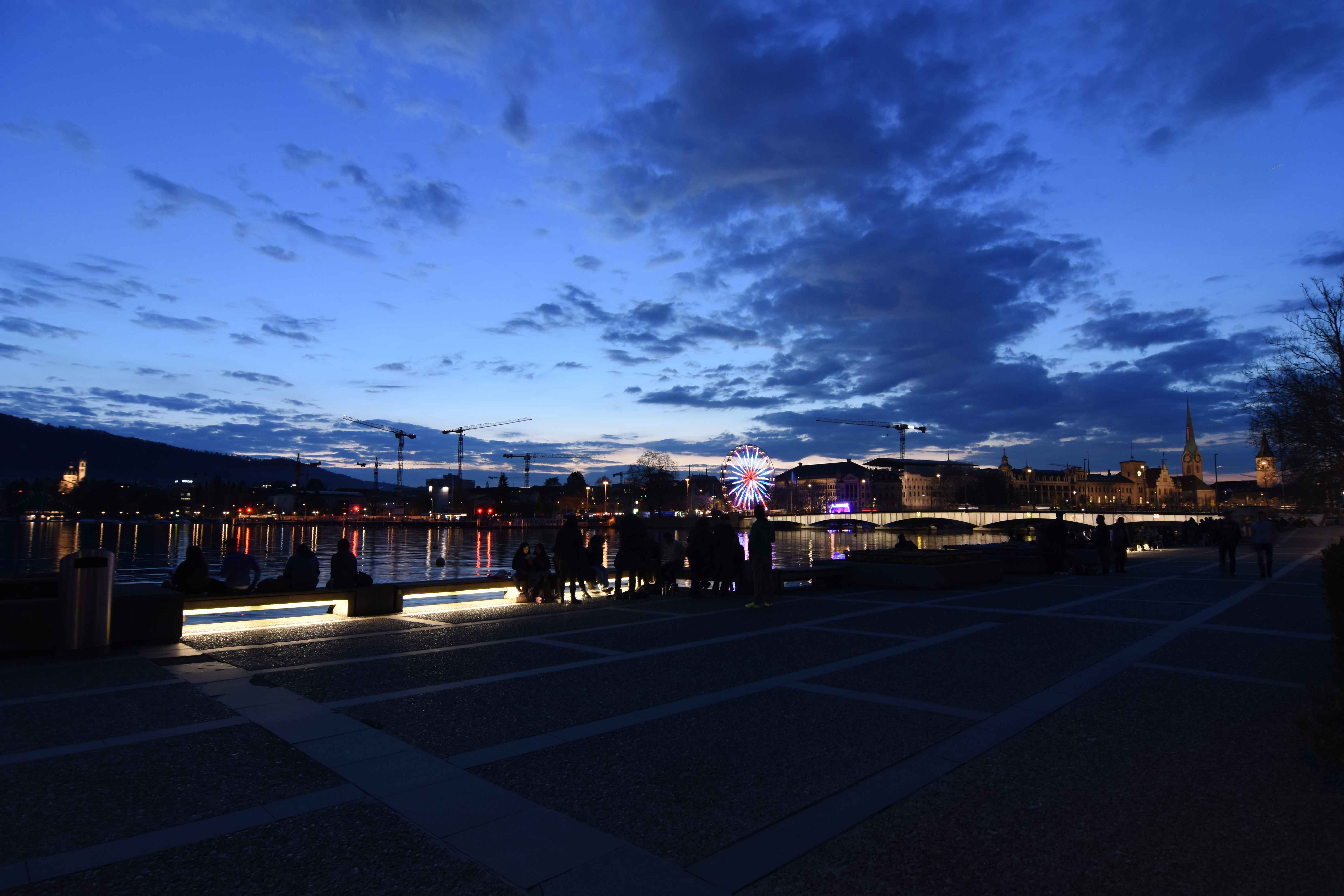
People enjoying the sunset on the shores of Lake Zurich
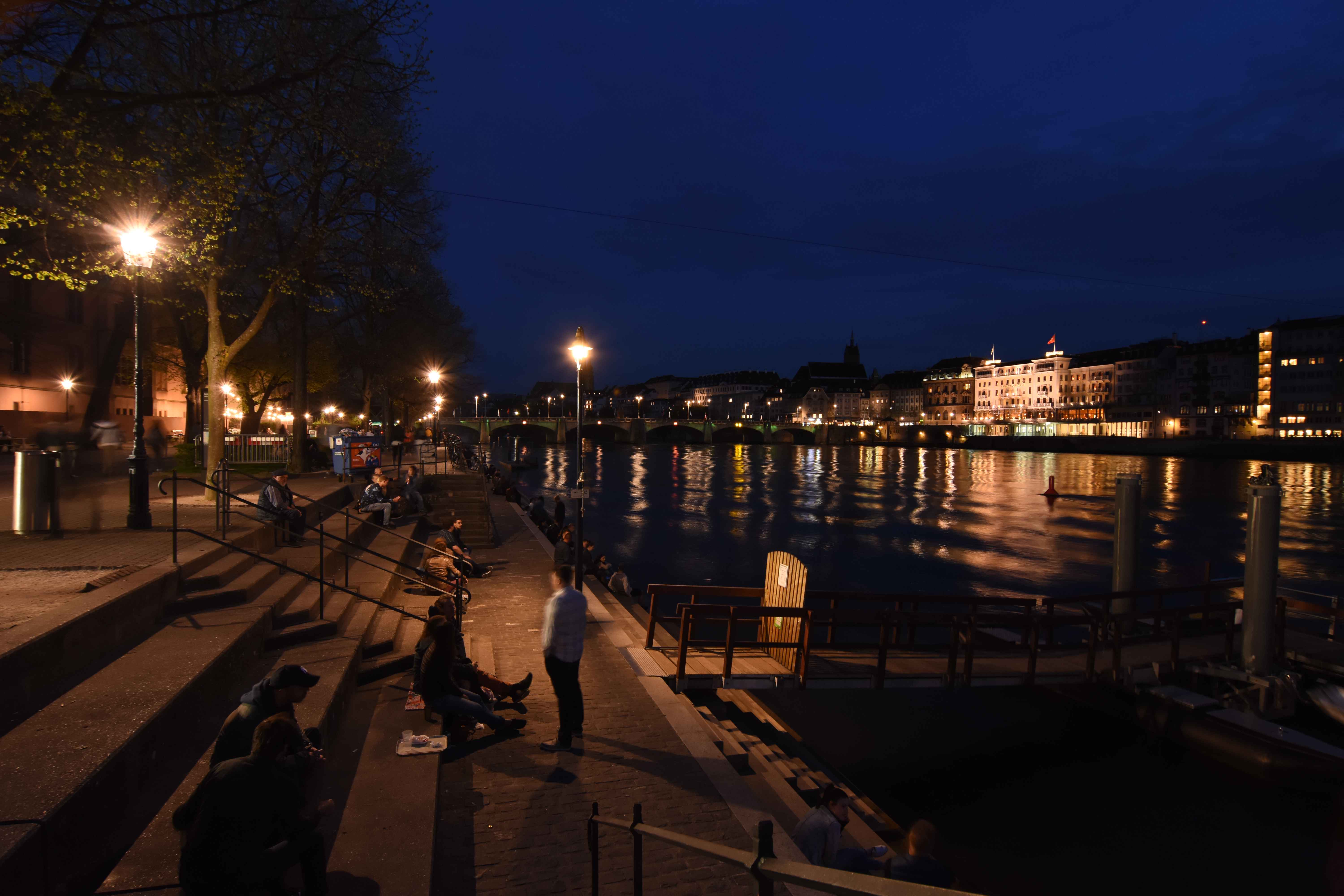
People Gathering on the Riverside in Basel, with Beers in Hand
■Waterside at Dusk
On a warm spring evening, people gather on the shores of Lake Zurich. In open areas with a view, everyone enjoys the passing of time in their own way—a unique luxury. After the sun sets and the sky turns indigo, historical buildings from the Middle Ages are softly lit and reflected on the water’s surface. The reason this atmosphere can be enjoyed comes from a combination of historical background and urban planning.
First, the number of cars is overwhelmingly small compared to other cities. The city is not obstructed by wide roads or traffic jams, so you can feel close to the river, the bridges, and the historical buildings on the opposite bank. In the old town areas scattered throughout the city, cobblestone alleys remain. Strolling through the old town with its old-world charm is elegant and pleasant, both day and night. Regarding lighting, there are few tall, towering road lights. Instead, streetlights that fit the environment illuminate the atmospheric alleys. Once it gets warm, the familiar city doesn’t make people feel uneasy, even as the night deepens. While it’s partly due to the warm season, there is also a blessed urban environment where people can gather safely, even at night.
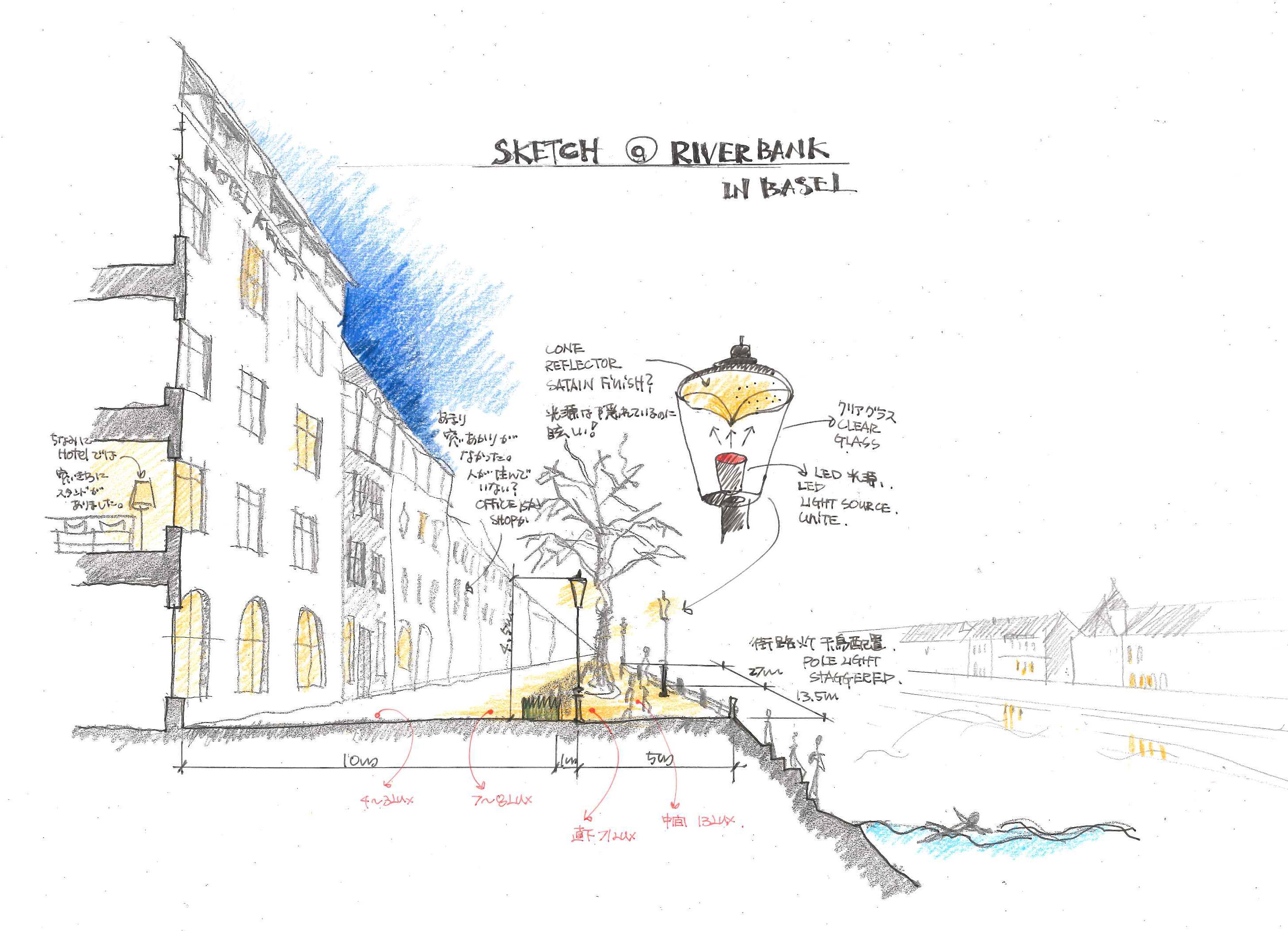
Sketch of the Basel Riverside: The pole lights are still glaring despite their light sources being concealed
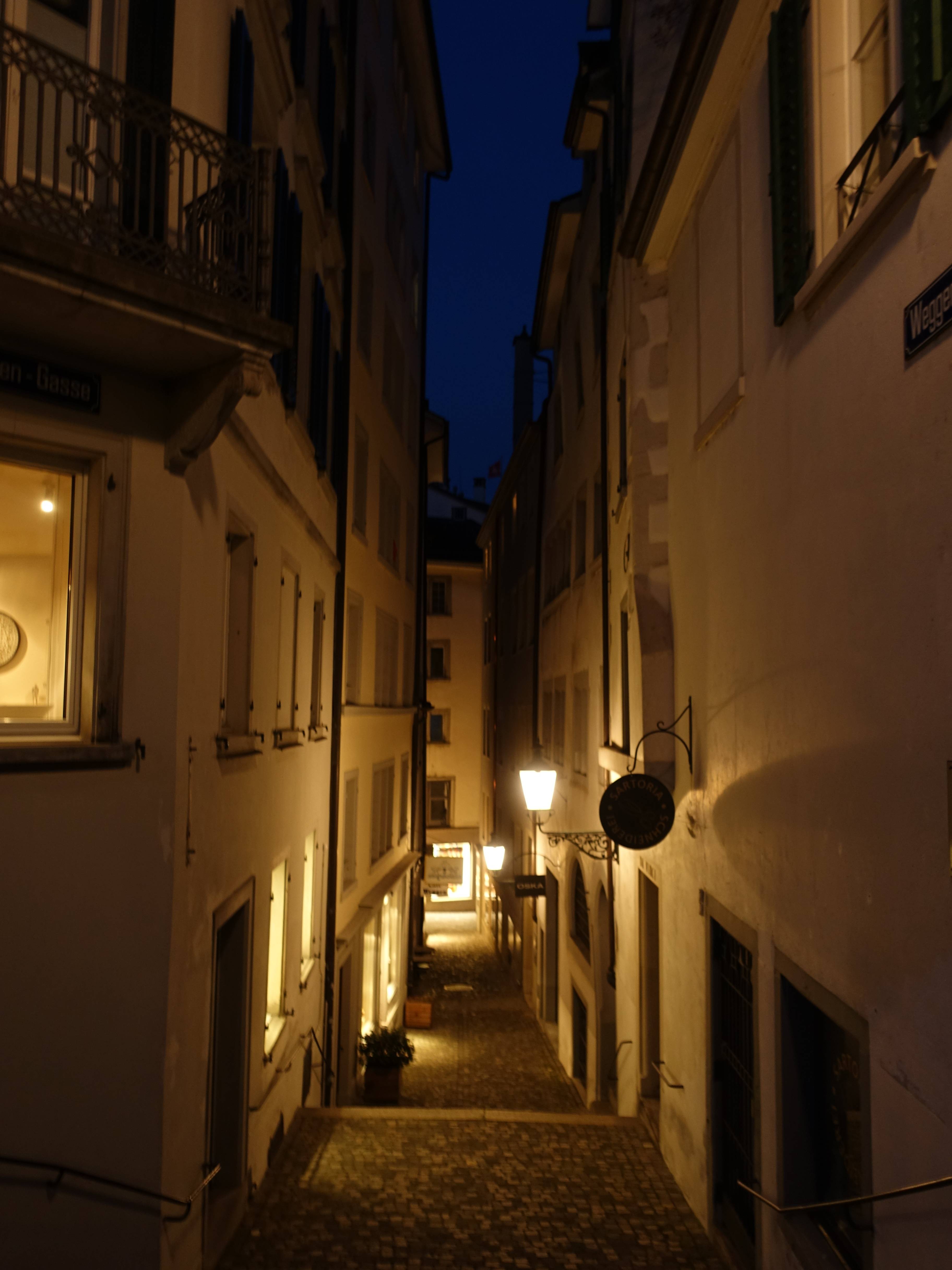
The Old Town of Zurich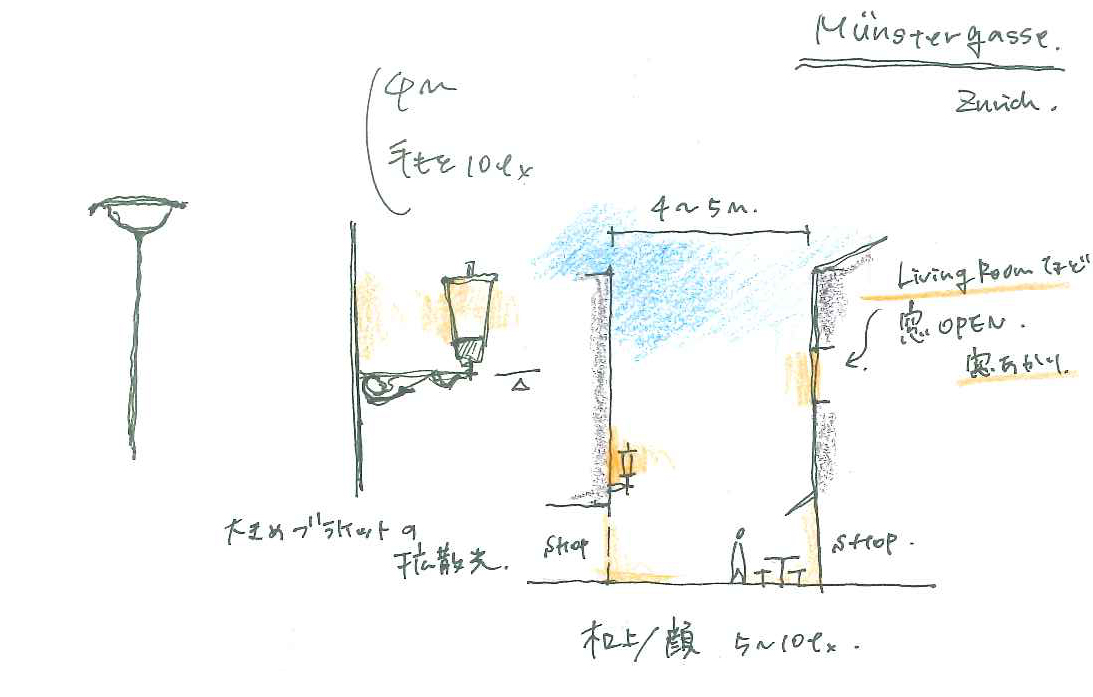
Sketch of allay in Zurich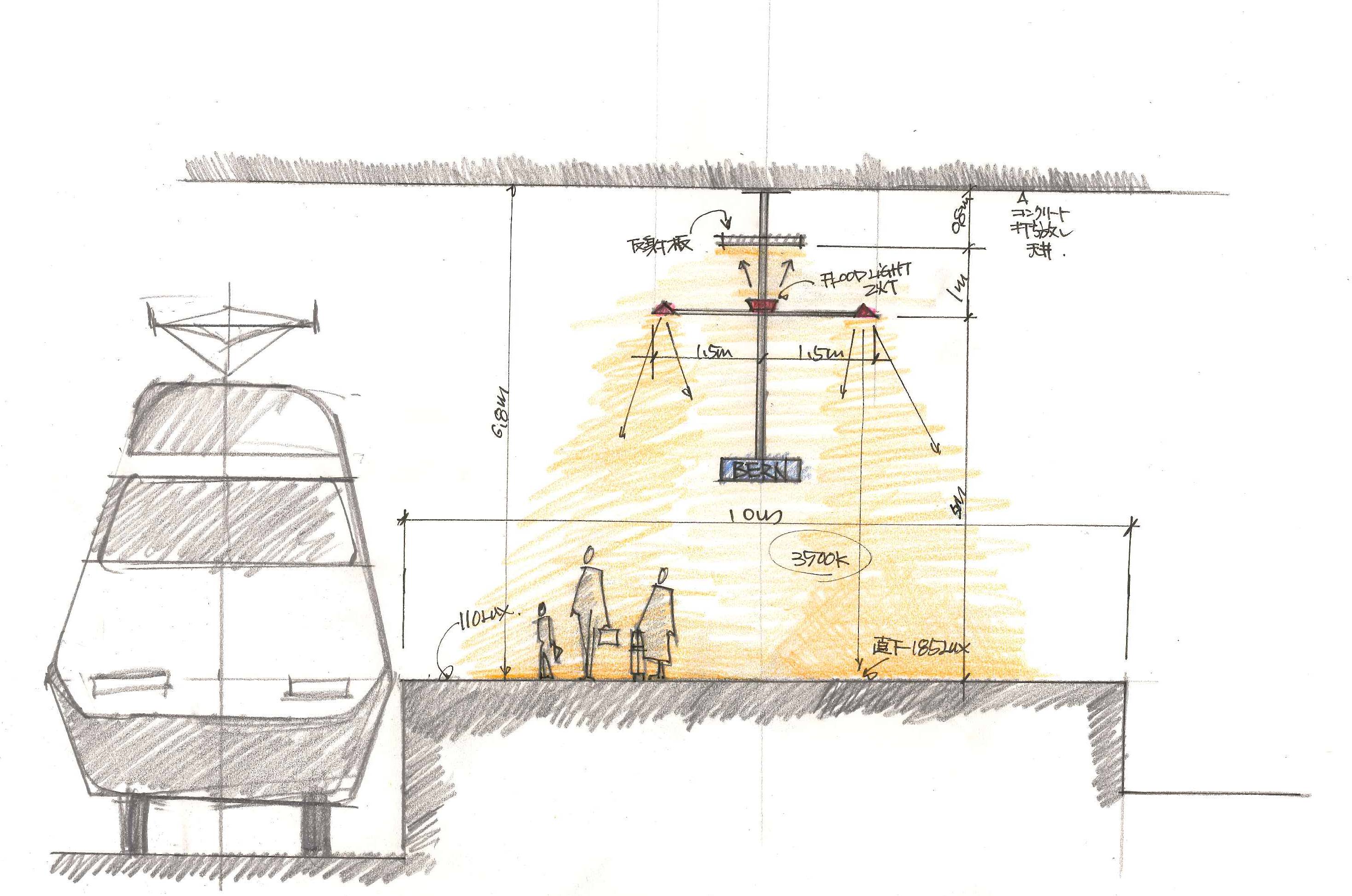
Sketch of Bern Station
■Unpretentious, Functional Cities and Light
The cities in Switzerland have a certain calm about them, with no signs of flashiness. This is probably because the government and municipalities are keeping a close eye on things. However, it’s clear that shop windows remain lit at night, trying to attract customers. The streetlights, while undeniably having some glare, illuminate the city in a modest way.
On the main streets of Zurich and Basel, 4-meter-high pole lights were installed at intervals of 12 to 15 meters. These pole lights hide their light source and use a reflector to cast light on the surroundings, providing an illuminance of 10 to 30 lux on the ground. The roads shared by trams and cars are brightly lit by glare-inducing LED catenary lights installed on 6-meter-high overhead lines. This light also softly illuminates the surrounding buildings, so we couldn’t find any facade lighting other than on important, must-see structures.
I was truly impressed by their simple integrity—even magnificent old buildings were left to fall into shadow with not even a single window light, and no one seemed to mind.
■Swiss Dignity Seen from the Station
Switzerland is known as a pilgrimage site for architecture, and you can see its high-quality design just by looking at the stations. The lighting fixtures installed on the exposed concrete ceilings and walls are equipped with louvers, reflectors, and light shields, which are designed to hide the light source directly from view. Even in the simple details, you can see that they were cleverly planned and constructed by a skilled craftsman. When you visit a station, you can understand the wealth and dignity of Switzerland.
I heard that almost all Swiss people enjoy mountain climbing as a hobby, and many people in the city wear mountain climbing or outdoor-style clothing. The gracefulness of the people living in Switzerland is also conveyed through their healthy and ecological lifestyles. I felt that there is a sense of admiration and hints for a future city in the functional and beautiful streets that prioritize people, nature, history, and culture while eliminating waste. (Kyoko Takubo)
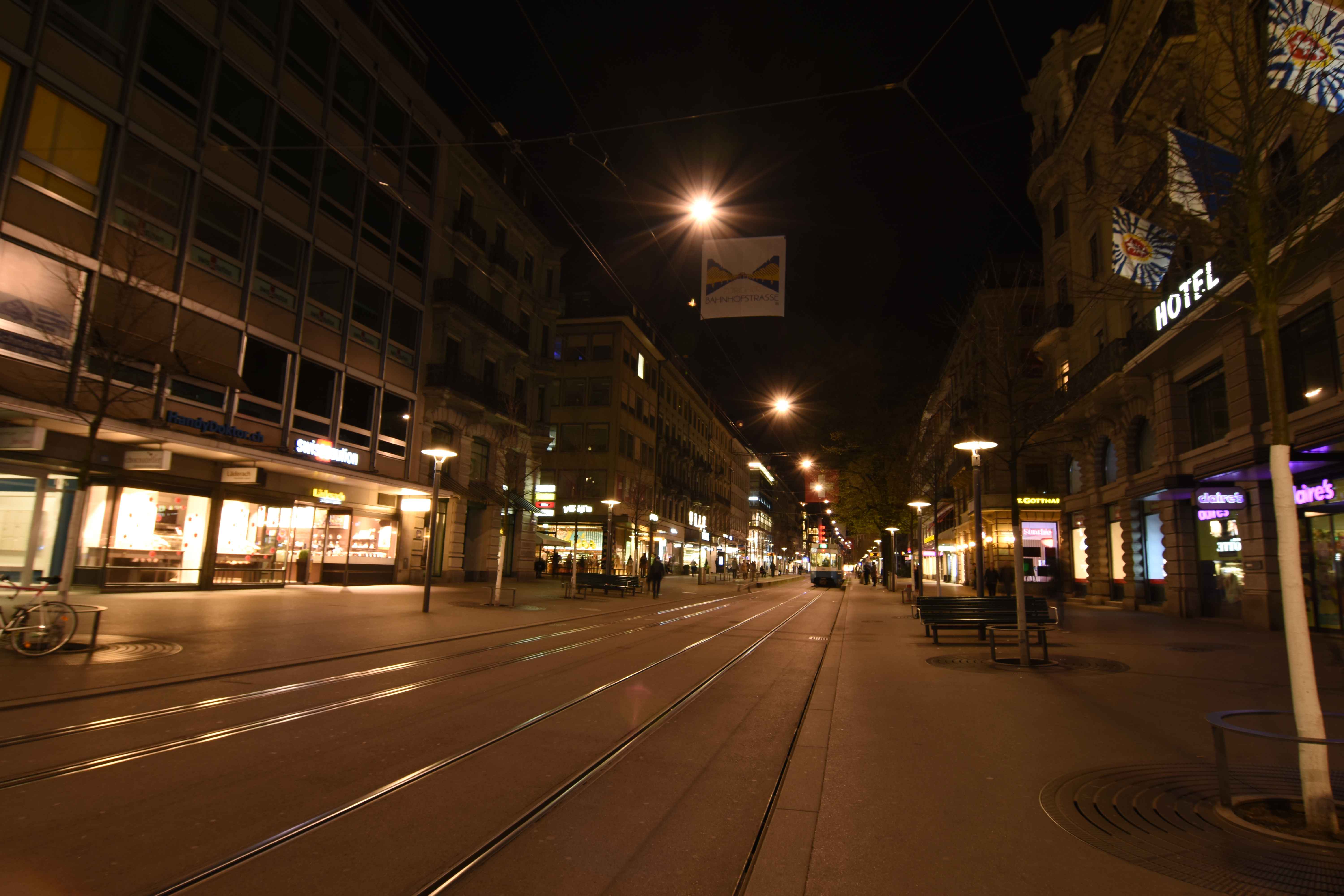
Around 10 p.m. on the main street in front of Zurich Main Station, there are roadway lights attached to the overhead lines in the center and pole lights on the sidewalks
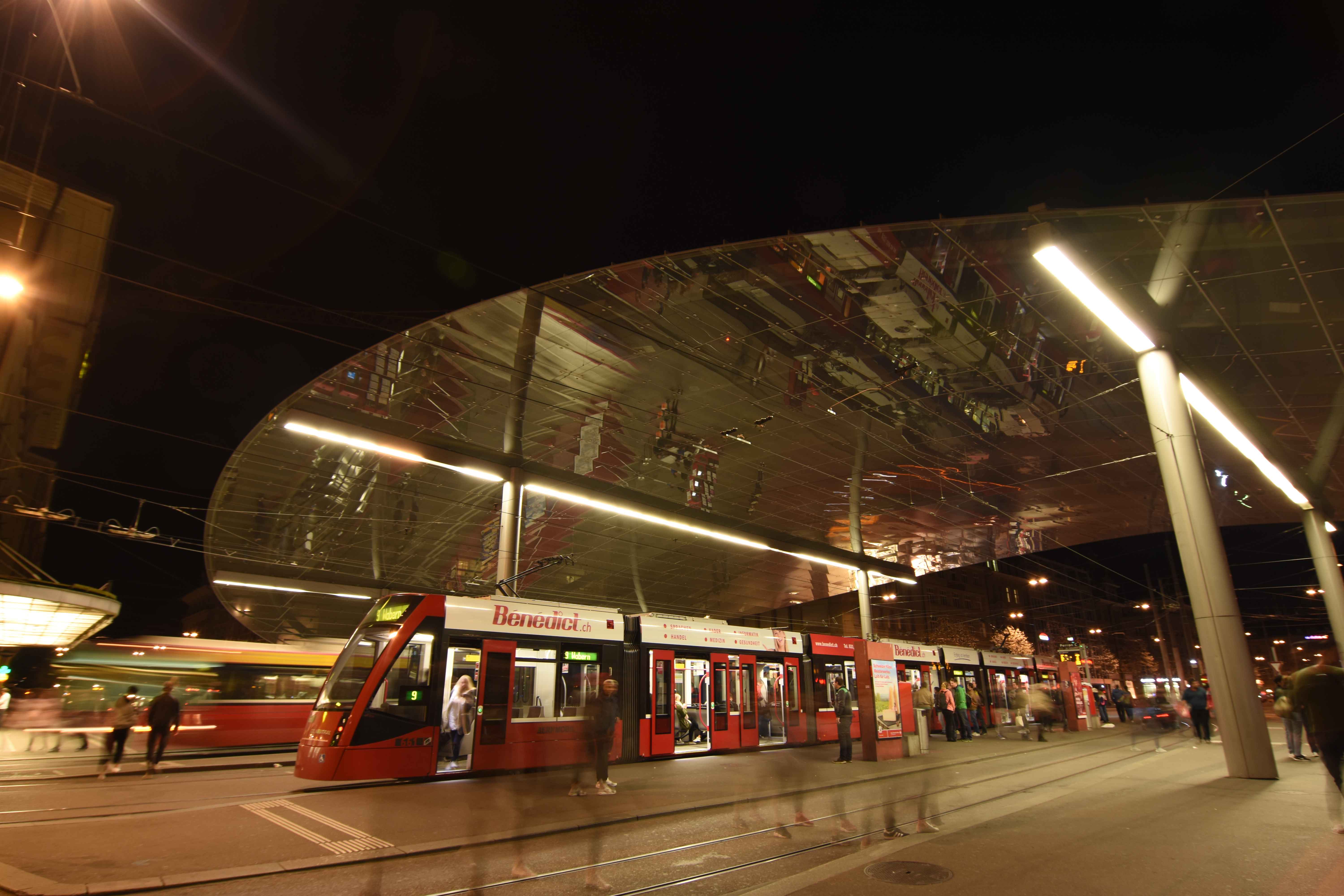
The tram station in central Bern: The movements of people and trams are reflected on the glass roof, amplifying the liveliness
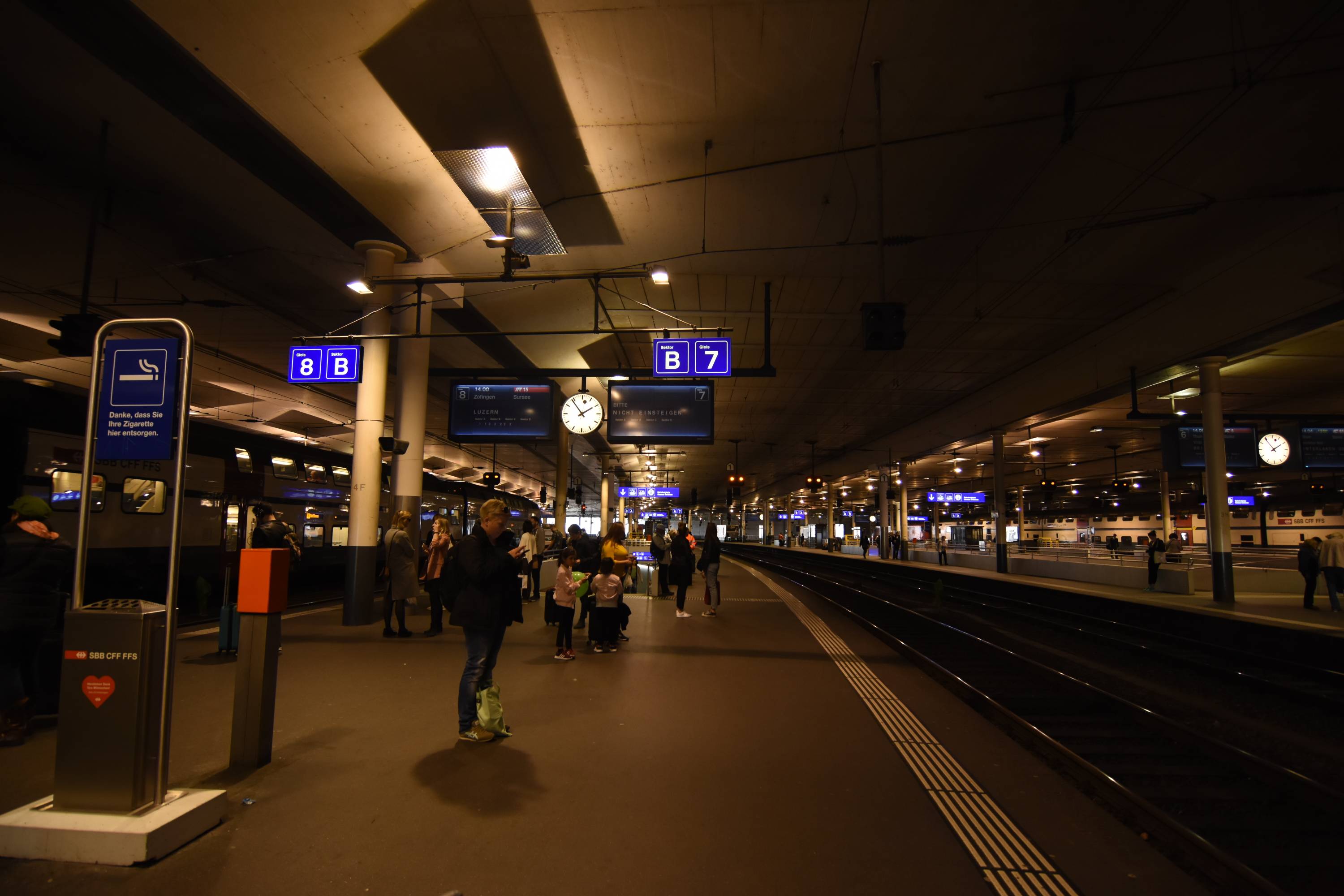
The platform at Bern Station: It illuminates both the ceiling and the floor using a reflector
■The Experience of Viewing a City Up Close
In Zurich, Basel, and Bern—the cities we surveyed—open squares were set up along the rivers and lakes. Many people were enjoying the sight of window lights and the moving lights of trams reflected on the water’s surface. When we looked down at the city from a hill, we were able to get a better grasp of the city’s structure by combining it with the experience of the paths we had walked.
From Zurich’s Lindenhof Hill, the elevation difference with the city is small. Beyond the lights along the river, a chain of dark rooftops stretches into the distance. While there was little flashiness, we could feel the city’s energy from the passing trams and the lights of the shops. Meanwhile, along the lake, the sparkle of window lights covered the sloping ground beyond the water’s surface, and a faintly white mountain range stood in the background. It was a scene that made us re-recognize the grandeur of nature embracing the expansive city.
The city of Bern is surrounded by the U-shaped Aare River. The elevation difference from the city center to the river is large. From the Rosengarten Hill on the opposite bank, the buildings look as if they are stacked in tiers. When we were walking in the city, the facade illumination from the catenary lights seemed like a modest brightness, but from the hill, the city’s vertical plane appeared more emphasized along the terrain than it did during the day. Amidst that, the clear contrast between the distinct shadows of the lit-up cathedral and the faint surrounding light was very effective.
In Basel, the elevated nightscape from the Cathedral Square along the Rhine River is impressive. Beyond the gentle impression of window lights and streetlights stretching across the river surface, you can see the blinking lights of several high-rise buildings and cranes under redevelopment. In contrast to the flat impression from above, the old town had a three-dimensional structure with many undulations and narrow roads where trams came and went.
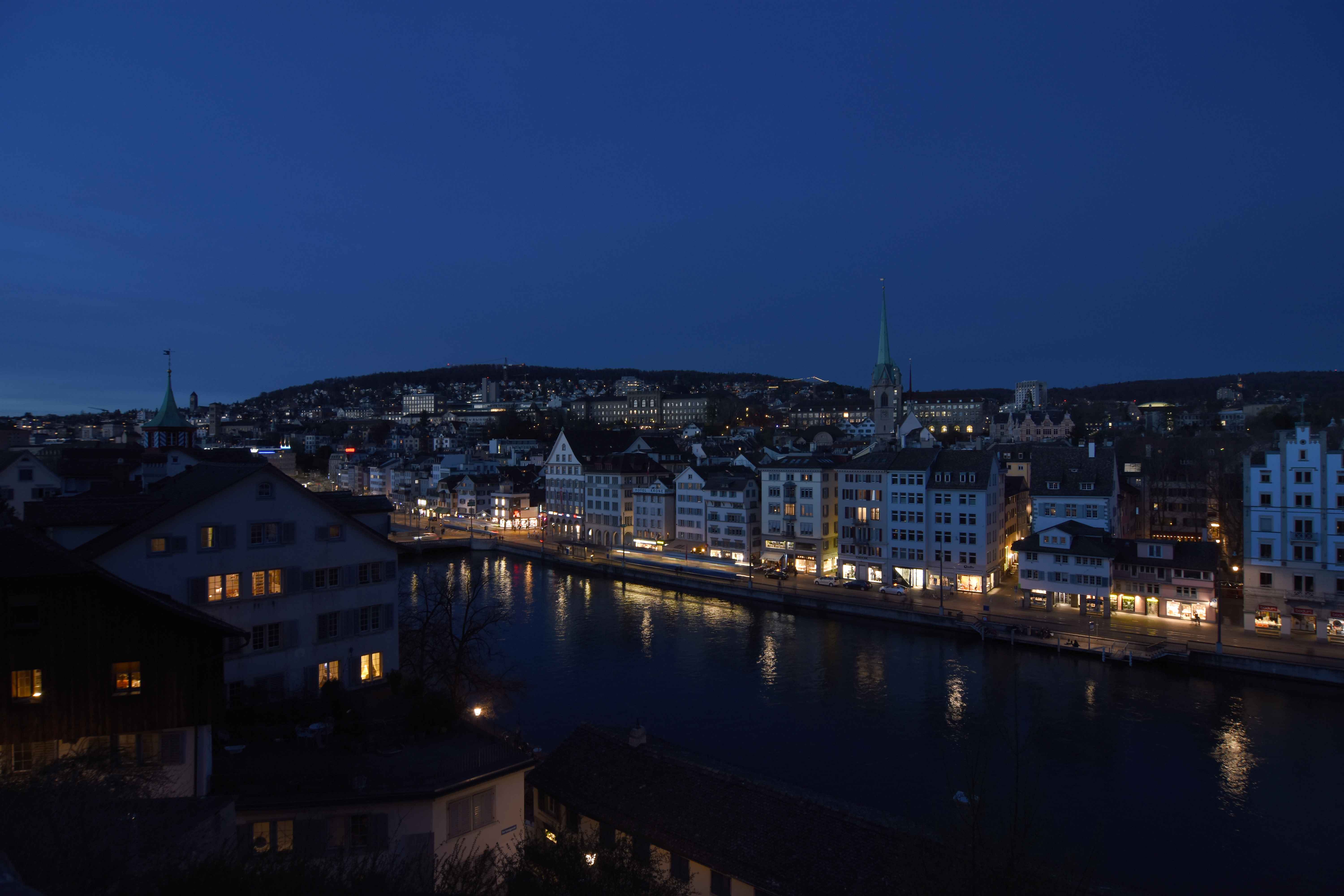
From Lindenhof Hill in Zurich, the lights from the shops and trams along the river are clearly visible, creating a nightscape with a lived-in feel
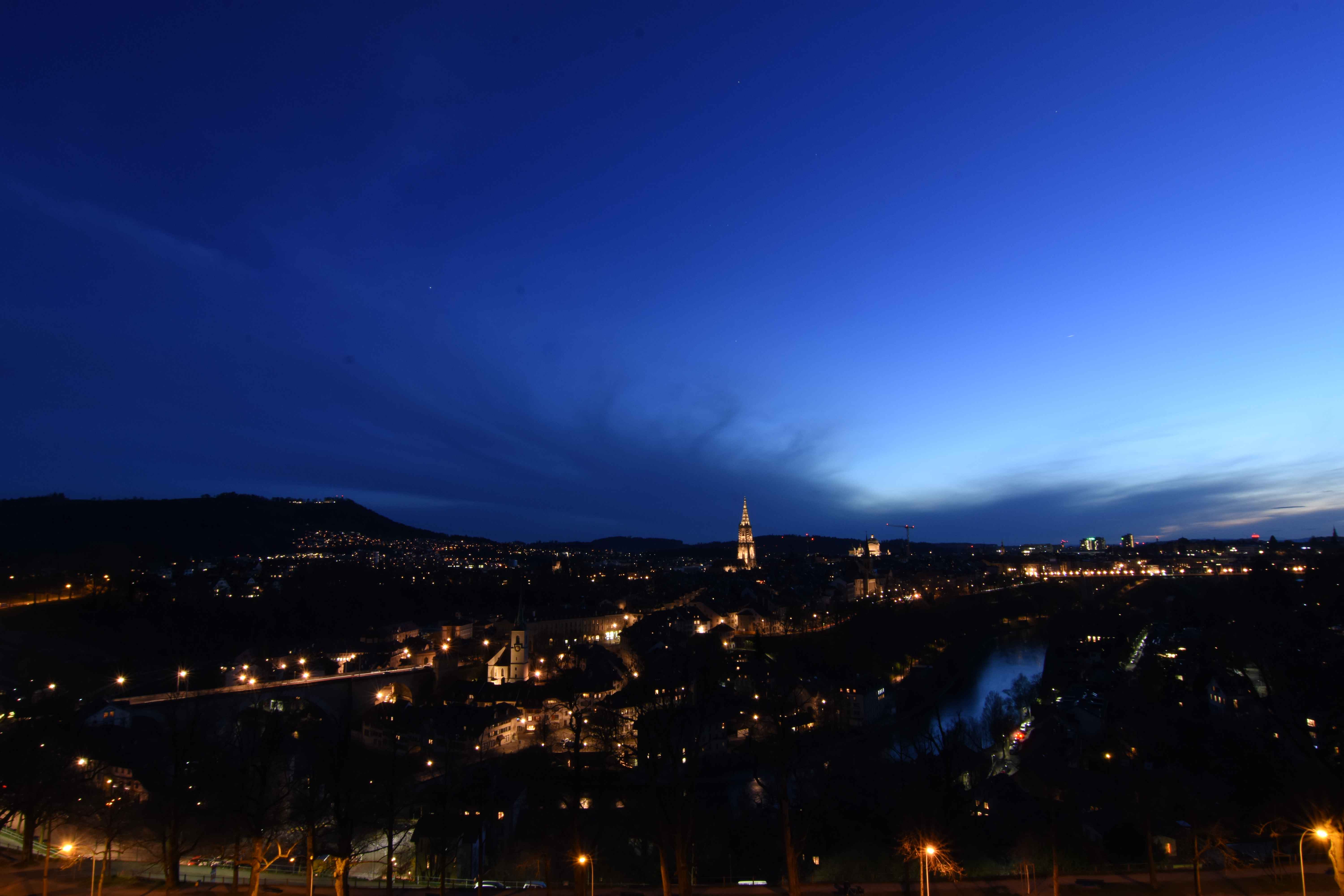
From Rosengarten Hill in Bern, you get an elevated view of the World Heritage city. The way the city rises from the river is emphasized by the undulations of the city lights
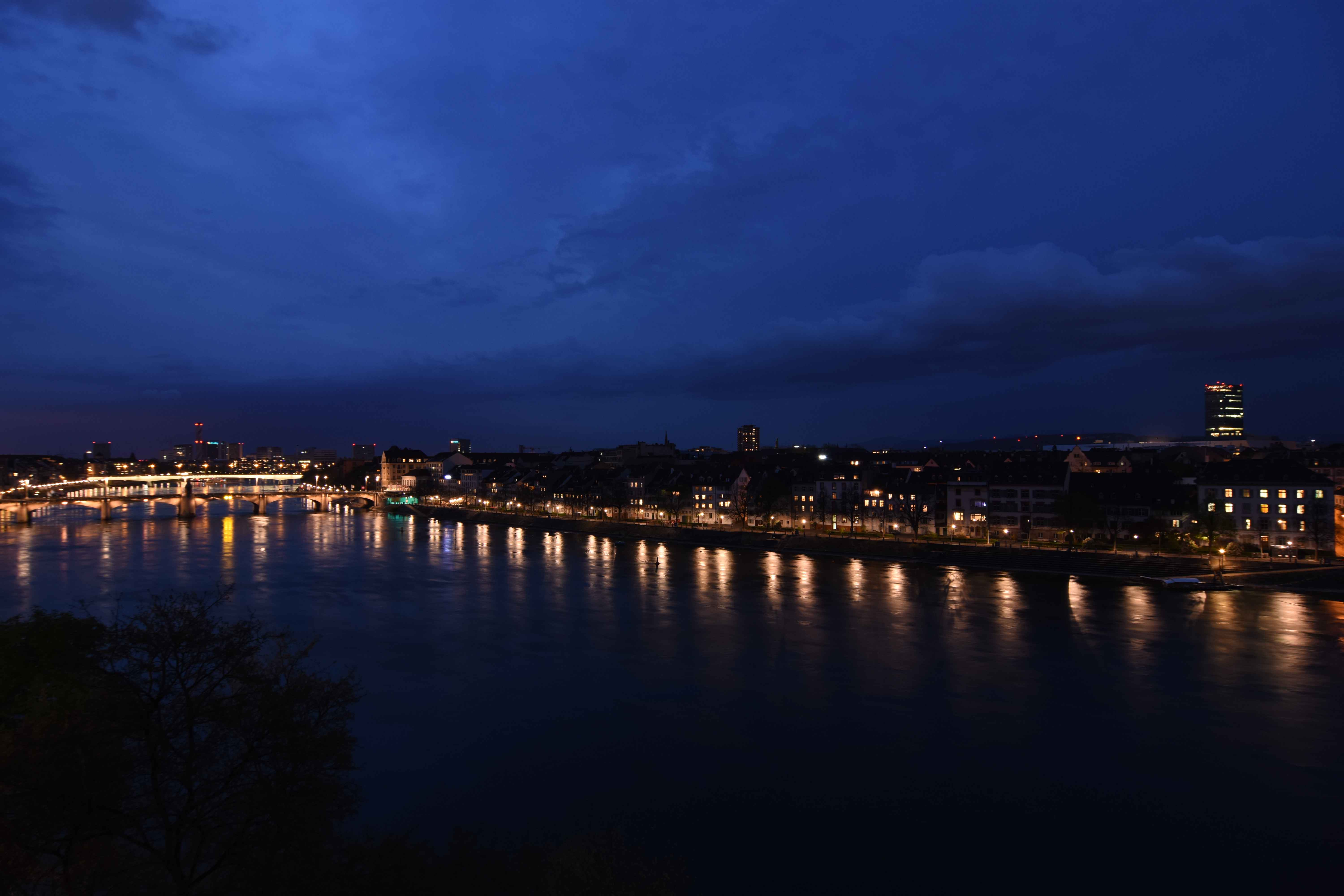
From behind the cathedral in Basel, you can see Kleinbasel across the Rhine River. High-rise buildings are visible in the distance, behind the peaceful cityscape along the river
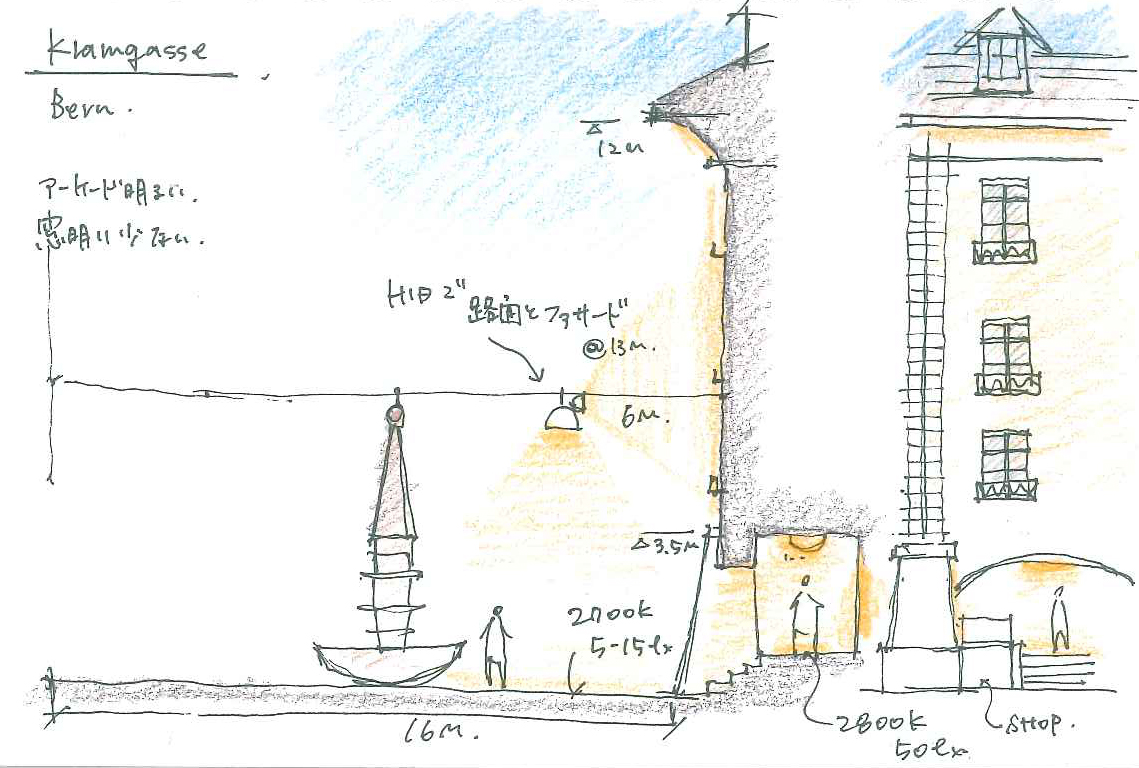
A cross-section sketch of Kramgasse in Bern. Contrary to our expectations, there are almost no window lights on the upper floors
Walking through the old town, our eyes were drawn to the decorations on the windows and eaves during the day, but at night, our gaze was guided downward. The only light came from the shop windows, aside from the head-sized bracket lights that extended from the second floor, softly illuminating the walls. With a low illuminance of around 10 lux on the desks and faces, you couldn’t clearly see people’s faces or the food on their plates. Despite this, many people gathered at the tables outside shops and on the benches in the squares. (The large number of terrace seats is probably a major result of the well-developed public transportation and the low number of cars.)
Streetlights were almost all warm-white, but of course, the shop windows and stores also had white, colored, and neon lighting. However, there were few floodlights on signs or glowing projecting signs. Also, because there was no extreme difference in brightness between the streets and places people could enter at night, such as open stores and stations, we felt completely safe with just a faint brightness. In the commercial areas, there were few window lights on the upper floors, possibly because there were few residents. However, many of the windows that were open with lights on inside looked like living rooms. Since many people looked relaxed and comfortable in the city from morning until night, they might have the sense that the city is an extension of their living room.
Indeed, even at the hotel we stayed at, there was a standing lamp placed by the window.
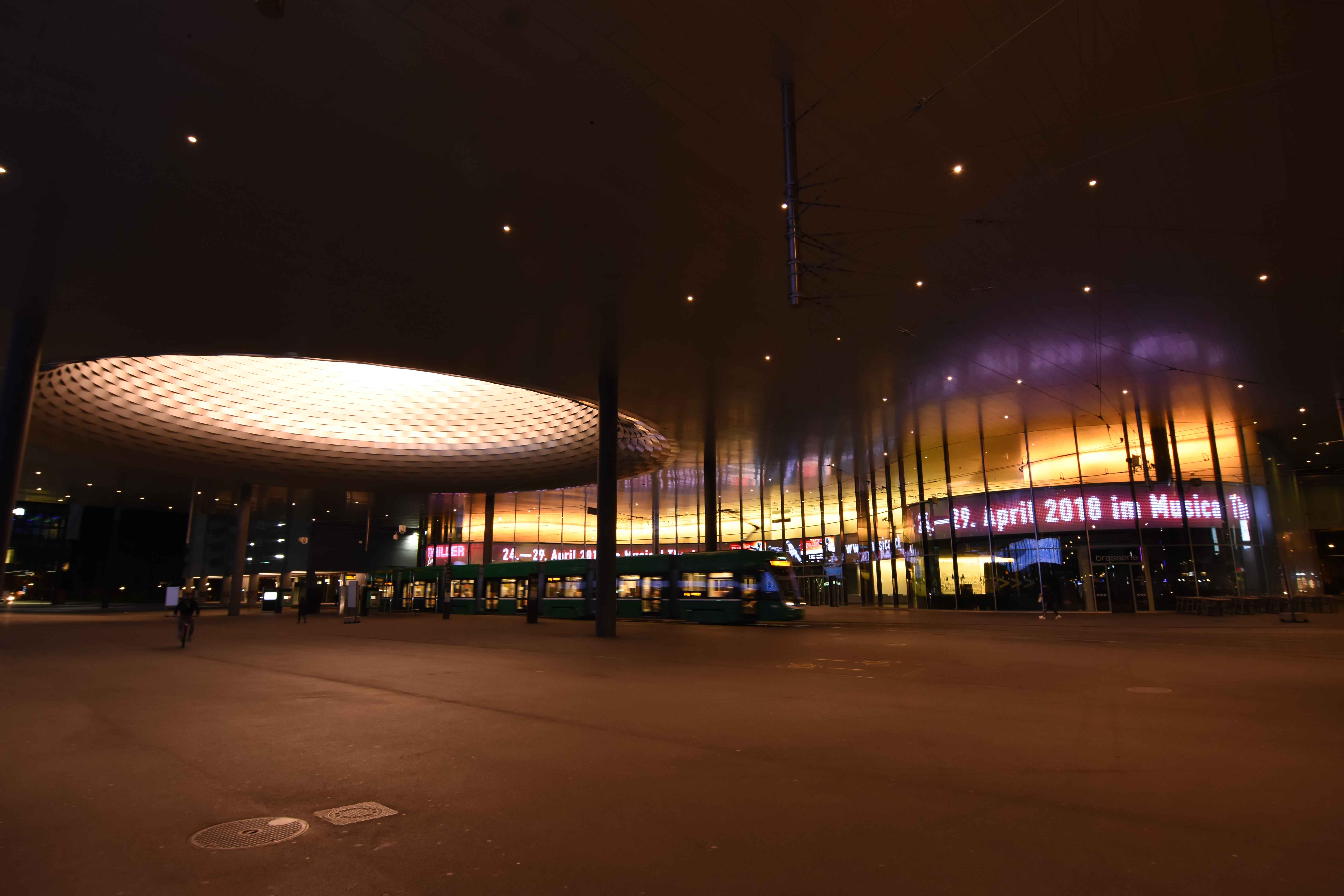
Basel Messe
The building built over the road also serves as both a square and a tram station underneath

At Kramgasse in Bern,
the light that spills from the arcade gives the pillars a rhythmic appearance
■In Praise of Sunlight, In Praise of Shadow
Switzerland is famous for its modern architecture as well as its old towns. The museums and university campuses we visited during the day had many spaces that made generous use of natural light. As mentioned earlier, many Swiss people like sunlight, and a lot of them spend time relaxing outdoors. However, at night, they don’t seek the brightness of the day, but instead chat and laugh in the dark. Their use of time is different from that of Tokyo, where the lights of shops and buildings shine brightly both day and night.
On the final day, the city of Zurich was bustling with a festival celebrating the start of spring. Although the festival itself ended in the evening, people enjoyed a BBQ around the remnants of a large bonfire in the square. In the city, a parade of people in medieval costumes carrying candlelit lanterns marched late into the night. The neatly laid stones in the square were worn smooth by people’s footsteps, and they shimmered when they caught the faint light. The Swiss nighttime allowed us to focus on the delicate aspects of light and the elements of the city that create a calm night, not just on the lighting itself. (Yumi Honda)実)
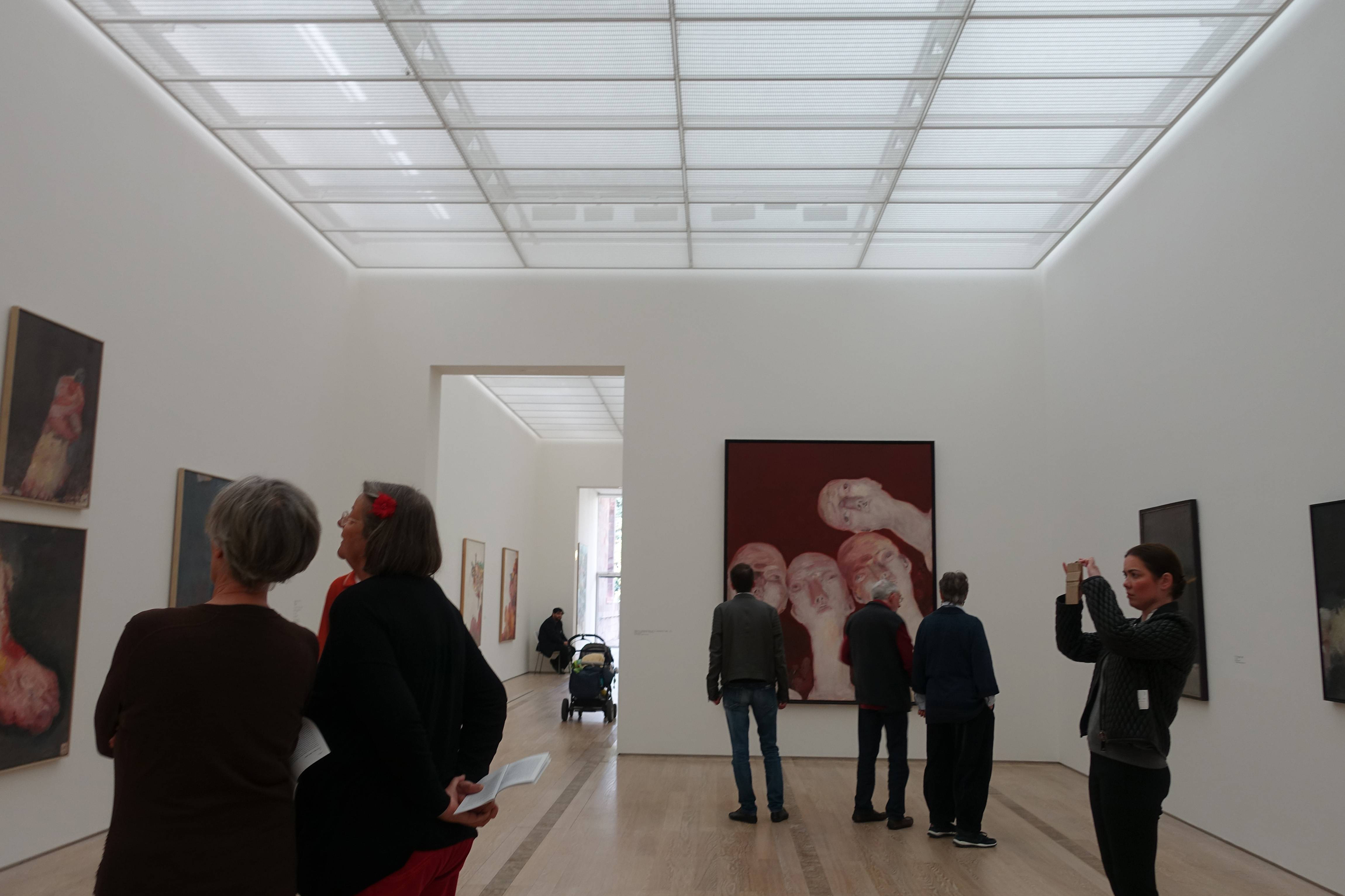
Beyeler Foundation
The exhibition room where natural light gently pours in
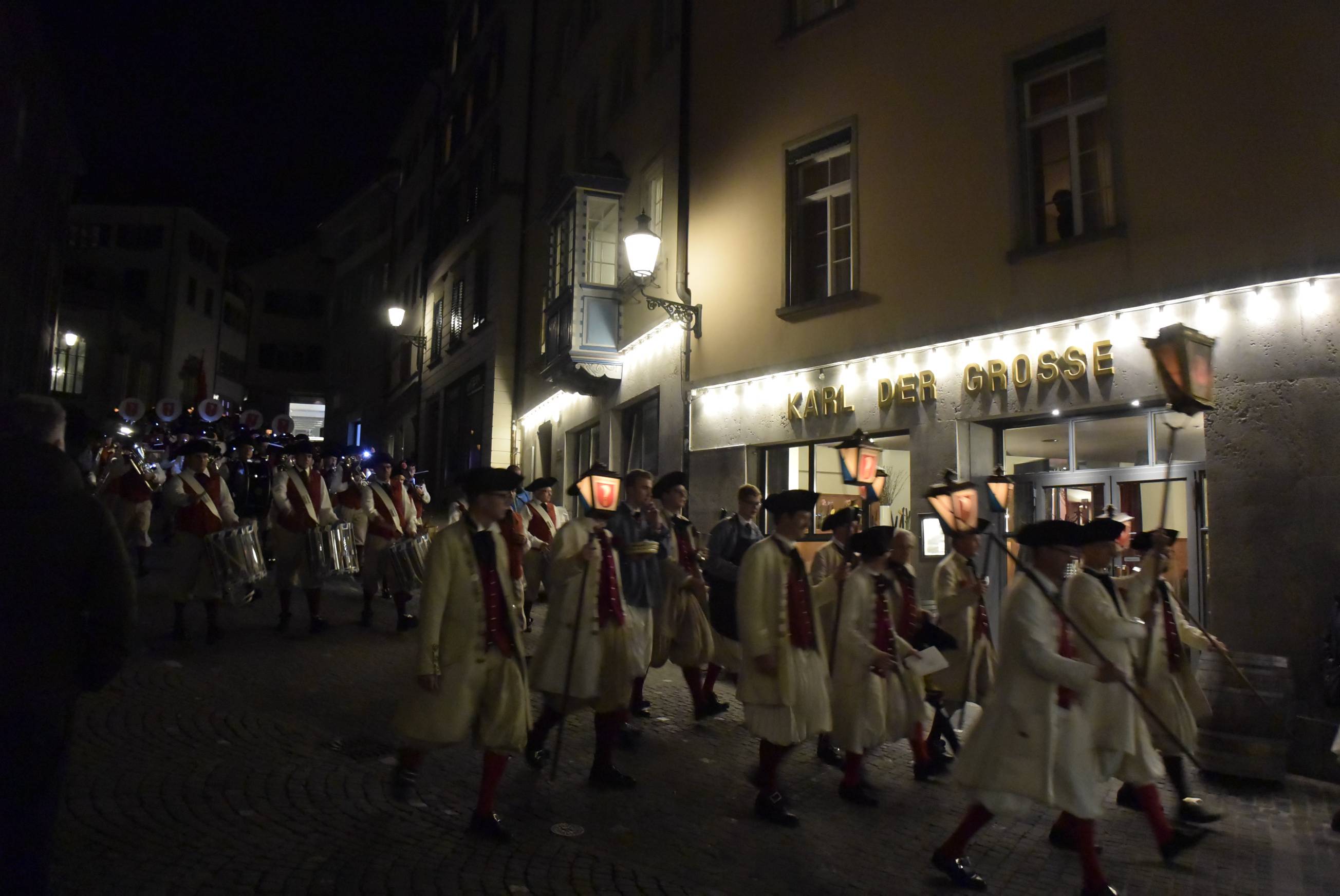
Zurich Spring Festival Night Parade: Dressed in traditional costumes and carrying lanterns, they march through the city late into the night